When people hear the word preservation, they often imagine an old object placed in a dark, climate-controlled case and touched as little as possible. For historic textiles, that kind of protection is essential. Silk weakens. Light fades dyes. Metallic foil abrades. Embroidery threads lose strength.
But the exhibition “Noh Costumes Revived Today — Precision of Embroidery, Brilliance of Foil”, which opened September 18 at the Gunma Prefectural Museum of History, asks a second question: what if the object survives but the knowledge required to make it disappears?
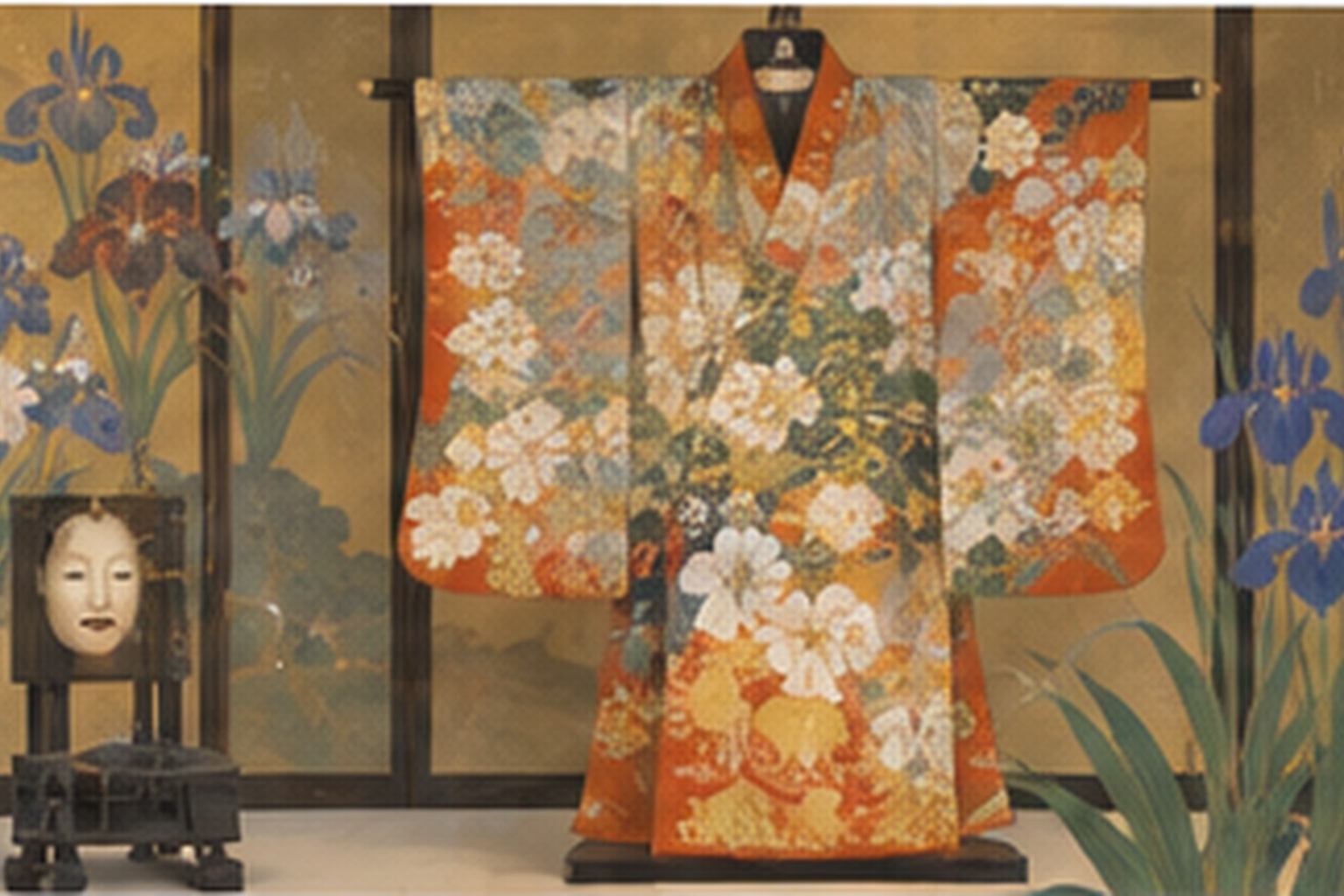
The center of the exhibition is an extraordinary group of 50 nuihaku reconstructed by the Yamaguchi Noh Costume Research Institute. The museum says the institute has spent years analyzing Edo-period Noh costumes and reproducing them faithfully from materials through technique. It describes the display of 50 nuihaku together as unprecedented.[1][2]
Reconstruction is not restoration
The distinction is fundamental. The exhibition is not showing 50 historic garments repaired until they look new. In the museum’s Japanese terminology, they are fukugen: new reconstructions made after studying old garments, materials, weave structures, embroidery, foil work and tailoring.
That makes a reconstruction more than a visual copy. It is an argument made in silk.
Which thread creates the right luster? How tightly should it be twisted? How was gold or silver foil attached to cloth? How did the weight of the textile affect the way the garment hung? If a reconstruction only resembles the original in a photograph, it has not necessarily reproduced the historical technique.
Gunma describes the Yamaguchi institute as one of Japan’s leading specialist organizations for the study and faithful reconstruction of Edo-period Noh costumes, from materials through production methods.[2]
What is nuihaku?
The word itself almost explains the technique. Nui refers to embroidery; haku to metallic foil. A nuihaku is a kosode-form silk garment whose pattern is built from embroidery together with applied gold and silver foil.
Cultural Heritage Online describes nuihaku as a costume particularly associated with female roles in Noh. In earlier periods it could be used as an outer garment; by the Edo period it was often worn around the waist, with the sleeves unused, as a koshi-maki beneath other layers.[4][5]
That creates a paradox. Some of the most elaborate embroidery and foil work in Japanese performance costume can be partially hidden during performance.
The craft was never only about maximizing what the audience could see.
Fifty garments reveal a visual language
The exhibition includes reconstructed works with designs translated as evening glory behind brushwood fences, shippo and floral lozenges, pampas grass and butterflies, autumn plants with Genji wheels, and waves with a flower-decorated Chinese ship. The museum identifies the last as derived from a piece transmitted by the Maeda family.[1]
Viewed alone, each can be appreciated simply as an ornate textile. Viewed in a group of 50, color and motif begin to function as a language of role, age, season and narrative atmosphere.
Historic Noh costume conventions, for example, use prominent red in garments known as iro-iri for younger female roles, while restrained palettes without conspicuous red—iro-nashi—can signal older women. Costume is therefore not just clothing; it is character information.[4]
Embroidery is physics, not only drawing
Faithful reconstruction is difficult because reproducing the outline of a flower is not enough.
Thread thickness, twist, stitch direction and density change how light travels across a motif. Flat silk and tightly twisted thread create different surfaces. Some historic embroidered kosode deliberately used strongly twisted thread to create dimensional detail in cords or architectural elements.
The design is therefore not only color and shape. It is also how the thread behaves under light.[6]
Foil is not gold-colored paint
The same is true of metallic decoration. Suri-haku applies extremely thin gold or silver foil to selected areas of textile. The reflection is fundamentally different from metallic pigment.
Historic garments often survive after much of their foil has vanished. e-Museum descriptions of Momoyama-period nuihaku note examples whose original gold and silver surfaces are now largely lost.[6]
A reconstruction can therefore help viewers imagine something the aged original may no longer show clearly: how intensely a costume once reflected light.
There are two kinds of preservation: preserving the object and preserving the skill
The original object must be protected. But an intact garment without living knowledge of how it was made represents only part of the culture.
Conversely, a craft tradition passed down only by memory can drift away from the evidence preserved in historical textiles.
Reconstruction forces the two forms of knowledge together. Researchers examine old garments, infer materials and techniques, and then test those interpretations by making something. Failure becomes evidence: if a particular stitch or material cannot create the historical effect, the hypothesis may be wrong.
It is also about preserving enough knowledge that future makers can explain why it looks the way it does—and, when appropriate, reproduce the technique.
Noh costumes are art made to move
A Noh costume is not a painting. It was designed to be worn on stage. Sleeves swing, hems overlap, silk catches stage light and metallic surfaces flash as an actor turns.
That creates a conservation dilemma. Use causes wear. But if a textile is never worn, some knowledge of its weight, motion and relationship to the performer can become abstract.
Reconstruction cannot eliminate that problem, but it creates a way to study construction and movement without subjecting a historic original to the same stress.
It is equally important not to confuse the reconstructed garment with the original. A historic costume retains information that cannot be copied: aged materials, wear patterns, repairs, ownership history and physical evidence of actual use. Reconstruction supplements that record; it does not replace it.
Why is this exhibition in Gunma? The answer is silk
At first glance, a major Noh costume exhibition may seem unexpected at the Gunma Prefectural Museum of History. The connection is the material beneath the embroidery: silk.
Gunma was one of Japan’s great sericulture and silk-reeling regions. Tomioka Silk Mill and Related Sites were inscribed on the World Heritage List in 2014, representing innovations in the mass production of high-quality raw silk and the exchange of silk technology.[9]
The brilliance of a Noh costume does not begin with the embroiderer. It begins with mulberry trees, silkworms, cocoons and the labor required to reel continuous raw silk.
638 tools show what comes before the stage
The exhibition also presents material from “Gunma Sericulture and Silk-Reeling Tools,” designated an Important Tangible Folk Cultural Property by Gunma Prefecture in 2025.
The collection contains 508 sericulture tools and 130 silk-reeling tools—638 objects in total. They document the process from raising silkworms and feeding mulberry leaves through cocooning, harvesting and hand-reeling raw silk using tools such as the Joshu zaguri reel.[7][8]
Placed beside the reconstructed nuihaku, agricultural tools create a powerful material connection.
Behind one glittering theatrical costume is a long chain of labor: growing mulberry, raising silkworms, sorting cocoons, reeling thread, dyeing, weaving, embroidering, applying foil and tailoring.
Reconstruction also updates tradition
“Preserving a technique” can sound like freezing a historical process forever. Real craft traditions are more complicated.
Some historic materials become unavailable. The people who once made particular tools disappear. Division of labor changes. Environmental and safety standards change.
Reconstruction therefore forces a difficult question: what is essential?
Is it the silk species? The thread twist? The stitch? The weight? The way foil catches light? When every historical condition cannot be recreated, researchers and makers have to identify which characteristics must survive for the result still to be meaningfully nuihaku.
That is not merely preservation. It is the design of transmission.
The museum lets visitors see what the stage hides
By the Edo period, nuihaku could function as an inner layer or waist-worn garment, leaving much of its surface concealed during performance. Gunma highlights precisely this point in explaining why a display of 50 full garments is so unusual.[2]
A museum freezes the costume so the viewer can examine what performance hides.
But the museum also removes movement. A textile hanging still in a gallery does not reveal exactly how foil flashes as an actor turns or how the weight of silk changes a pose.
Performance and exhibition therefore preserve different kinds of knowledge. Reconstruction can help connect them.
The 50 garments are not only about historical beauty
It would be enough to visit simply to see beautiful textiles. The deeper subject, however, is the chain of knowledge behind the beauty.
Historic garments preserve evidence. Researchers interpret it. Contemporary artisans turn interpretation back into material form. Gunma’s sericulture tools show the agricultural and industrial processes that supplied the silk in the first place.
Culture does not remain alive merely because an old object still exists.
It remains alive when someone can read the object, someone can teach what it means, and someone can still make the technique intelligible through practice.
The significance of 50 reconstructed nuihaku is therefore not that the Edo period has been recreated. It is that the craft can still answer a question from the future: How was this made?
Sources
- Gunma Prefectural Museum of History: “Noh Costumes Revived Today — Precision of Embroidery, Brilliance of Foil”
- Gunma Prefecture: exhibition announcement
- Gunma Prefectural Museum of History: exhibition programs and gallery talks
- Cultural Heritage Online: Edo-period nuihaku example
- Cultural Heritage Online: history and use of nuihaku
- e-Museum: Momoyama-period nuihaku
- Gunma Prefecture: designation of sericulture and silk-reeling tools
- Gunma Prefecture: 638 sericulture and silk-reeling tools
- Gunma World Heritage Center: Tomioka Silk Mill and Related Sites
