One series, two one-run games, and an unfinished ending
The Pacific League’s opening postseason round has become a duel of margins. Saitama Seibu won Game 1 in ten innings, 3–2. Hokkaido Nippon-Ham answered with a 1–0 victory in Game 2. Two games, six total runs, and neither club able to claim the series.
The decisive third game is scheduled for October 12 at Belluna Dome. As this report was prepared before its 2 p.m. Japan-time start, no result or advancing team can yet be responsibly stated. This is a thoroughly sourced pregame draft, not an account of an event that has not happened. Its lead and next-round passage must be refreshed from official records before October 14 publication.
How Seibu stole the first game
Seibu opened the series with a walk-off victory in the tenth inning on October 10. The Lions scored once in the first, the Fighters countered with two in the fourth, and Seibu drew level in the fifth. Neither team broke the deadlock until the extra inning.
That result gave Seibu home-field momentum but no guarantee of advancement. In a two-win series, every stranded runner matters disproportionately. Baseball’s familiar long-season measures—depth, durability and the ability to survive a few bad nights—yield to the consequences of a single late at-bat.
A shutout with a rescue mission attached
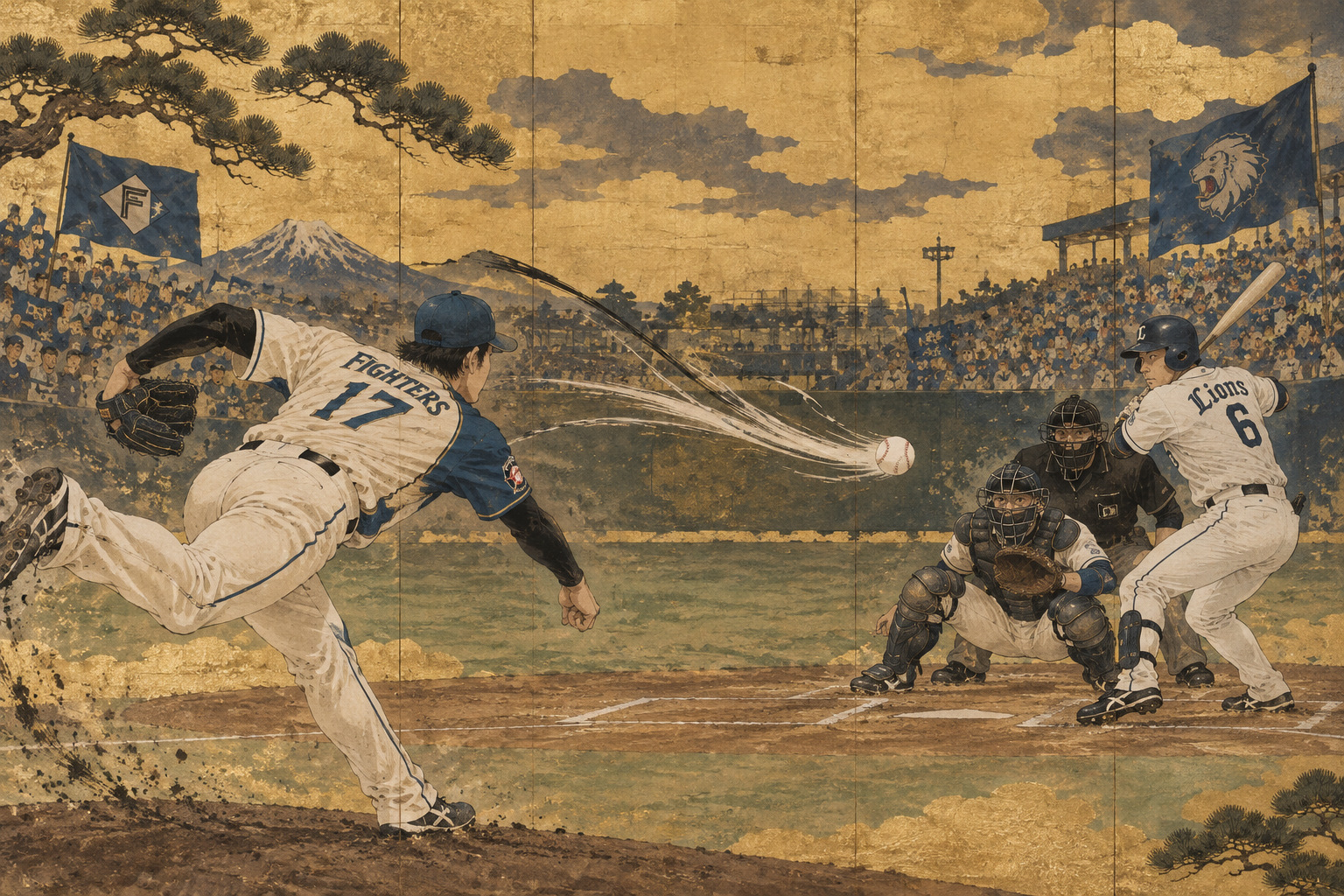
On October 11, the Fighters scored the day’s only run in the fifth inning. Starting pitcher Kota Tatsu worked six scoreless innings, allowing three hits and striking out seven. Ren Fukushima, Mizuki Hori and Taisho Yanagawa completed the shutout. Yanagawa recorded the save.
Seibu starter Kona Takahashi was almost as effective: seven innings, five hits allowed and only one run. His team managed five hits of its own but could not score. The official attendance was 27,610. For the home crowd, the difference between an excellent start and a winning one was painfully narrow.
The small offensive moment that mattered
Yuki Nomura drove in the Fighters’ only run of Game 2. His single RBI did more than settle one game: it ensured that a season would continue into Monday. The Fighters committed two errors yet escaped without giving up a run.
The outcome underlines why postseason analysis should not confuse a final score with a full explanation. Strikeouts, relief usage, timing of contact, base-running and sequencing can be decisive even when the box score shows similarly modest offensive totals.
These clubs were almost neighbors in the standings
Seibu went 79–60–4 in the regular season, finishing second. Nippon-Ham went 78–62–3 and finished third, only 1.5 games back. That small difference earned the Lions the right to host all First Stage games and the procedural advantage when a series ends with tied win totals.
Pre-game scheduling lists Natsuki Takeuchi for Seibu and Hiromi Itoh for Nippon-Ham as expected starters in Game 3. Anticipated lineups and assignments should not be confused with verified actual appearances, which require the completed game’s official box score.
Why a tied series does not erase the regular season
The Climax Series First Stage pits the league’s second- and third-place finishers against each other, with the first club to two victories advancing. Under the official rules, a tied win count at the relevant endpoint favors the higher regular-season finisher. That is part of the bargain between sporting merit accumulated over months and the theatrical uncertainty of October.
Japan’s playoff system emerged from the Pacific League’s 2004 postseason arrangements and became a two-league Climax Series in 2007. Its recurring philosophical question is whether a championship should reward the best long-season team or the one that can win a few highly pressurized games. The system tries to preserve both values.
A much steeper mountain waits in Fukuoka
The next opponent is certain even though the challenger is not: the Fukuoka SoftBank Hawks, who won the Pacific League with a 91–49–3 record. They finished 11.5 games ahead of Seibu and 13 games ahead of Nippon-Ham. Either potential opponent therefore falls under the newly strengthened advantage rule for 2026.
If either advances, SoftBank begins the Final Stage with two credited wins in a possible seven-game stage and needs three on-field victories to reach the Japan Series. The challenger needs five on-field wins. Play is scheduled to begin October 14 at Mizuho PayPay Dome. The identity of that challenger awaits the third game.
The 2026 rule change is not cosmetic
Ordinarily, a league champion starts the Final Stage with a one-win advantage in a stage decided by four credited wins. This season introduces a stricter format if the champion finished at least ten games ahead of the challenger or the challenger finished the season under .500. In those circumstances, the champion is credited with two wins and the stage extends to a possible seven games.
The purpose is to accord extra weight to regular-season dominance. But critics may question whether the greater deficit makes the underdog’s road disproportionately difficult. That is an editorial debate, not a reason to misstate what the NPB rulebook requires.
Managers face an unusually compressed chessboard
Relief arms used on Sunday may be needed again on Monday. A manager must balance the value of one additional inning from a starter against the danger of allowing a tired pitcher to face the lineup again. The same calculation applies to pinch-hitters, defensive replacements and the value of one run.
There is no verified basis yet to announce precisely which bullpen plan either manager will pursue in the deciding game. It is reasonable to describe the decisions the managers face; it would be irresponsible to present a tactical prediction as a reported instruction.
History does not play the ninth inning
Nippon-Ham’s championships in 2006 and 2016 remain milestones in the franchise’s Hokkaido era. Seibu’s title tradition reaches back to a dominant earlier era, and SoftBank’s sustained postseason successes have made its home stadium a formidable destination. None of those achievements settles a game before it is played.
The verified story is of two tightly matched challengers, two extraordinary contrasting finishes, and a league champion waiting with a structural advantage. For an October 14 edition, the final chapter must be written from the October 12 box score—not from a forecast pretending to be hindsight.