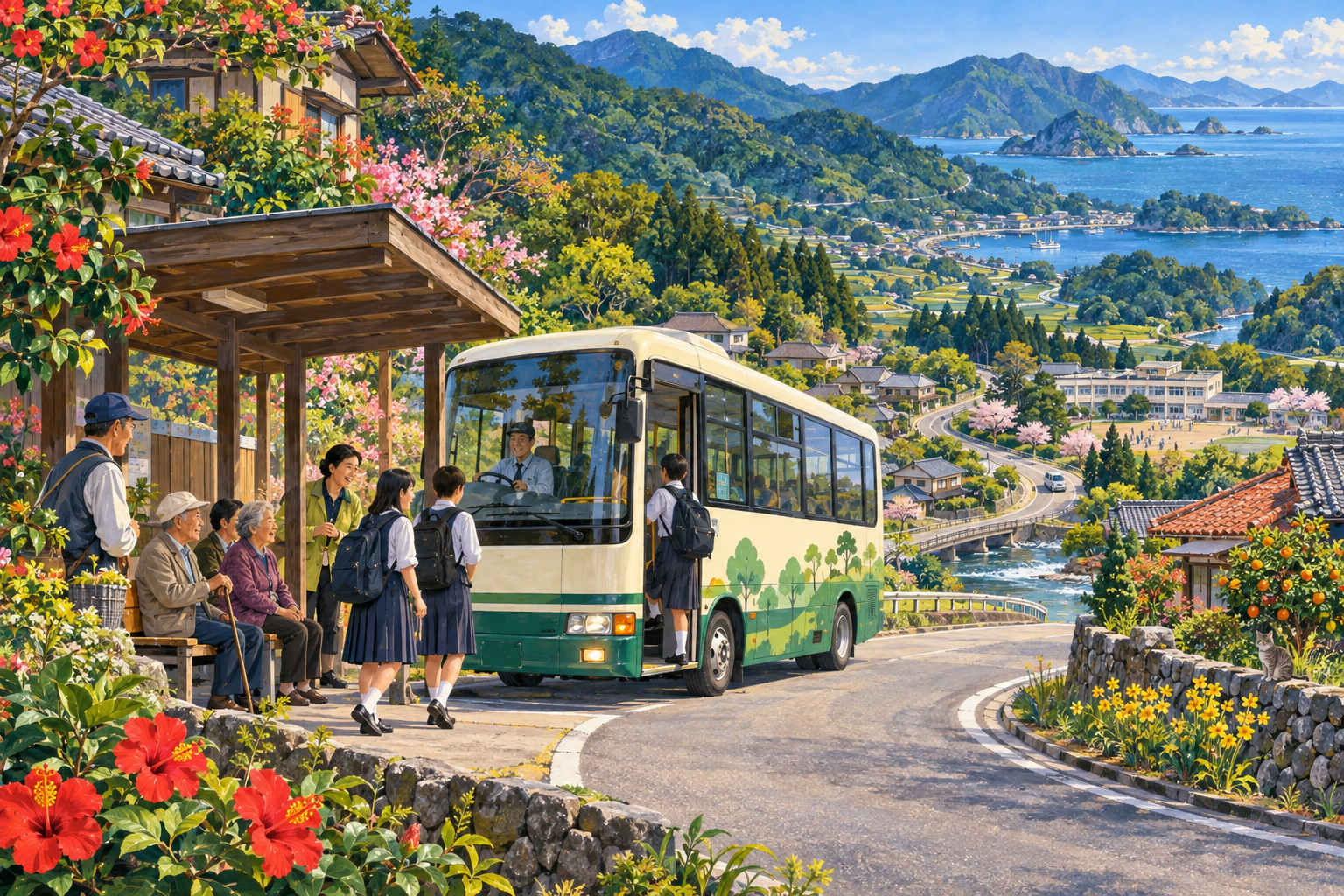
Nikken Sekkei and its partners are expanding Community Drive to three more Japanese cities, testing whether local organizers can turn discussions about mobility into lasting action. The company’s September 10 announcement adds Ichihara, Toyooka and Matsue to earlier work in Kurobe and Fukuyama.[1]
Launched in July 2024 by three organizations, including Nikken Sekkei, the project develops people and organizations that can address local transport problems.[1] The expansion does not mean that new bus services have opened across all five cities.
Organizing is part of the transport problem
The project’s official explanation sets out a process of dialogue, investigation, mapping problems, small experiments and organization-building. It aims to help residents, transport operators, government and businesses work from shared evidence and test possible responses.[2]
“Community driver” is a project role broader than driving a vehicle. Toyooka’s local partner explains that it includes people who help others shop, support outings or connect residents with those able to respond to their difficulties.[3]
What has happened in Toyooka
The Toyooka Smart Community organization reports that more than 35 people attended an August 24 meeting. Participants identified more than 120 examples of activities and mutual assistance supporting mobility, to be organized alongside previously collected problems.[3]
Those entries are a record of information gathered in a workshop. They are not 120 new services, nor a count of residents whose transport needs have been resolved. The next question is how that information changes practical arrangements.
Different places, different stages
Nikken Sekkei describes Kurobe as moving toward a continuing operating organization, while Fukuyama is developing resident-led experiments.[1] The project’s Matsue page lists a local taxi operator as host and records an August 20 kickoff.[4]
In a May 21 notice, the project office said work in five municipalities had been selected under the transport ministry’s program addressing transport gaps through regional redesign.[5] That supports implementation; it is not an independent finding that mobility has improved.
The test comes after the workshops
Japan.co.jp’s assessment is that the important questions are who takes responsibility, how costs are shared and whether an activity survives beyond its initial trial. For local businesses and welfare providers, participation is most useful when it leads to a clear operating role and measurable benefits for residents.
Follow-up reporting should examine actual use, access for people previously unable to make necessary trips and the resources needed to keep a solution running. The project offers a way to organize that work; its wider reach makes sustained results the next test.
