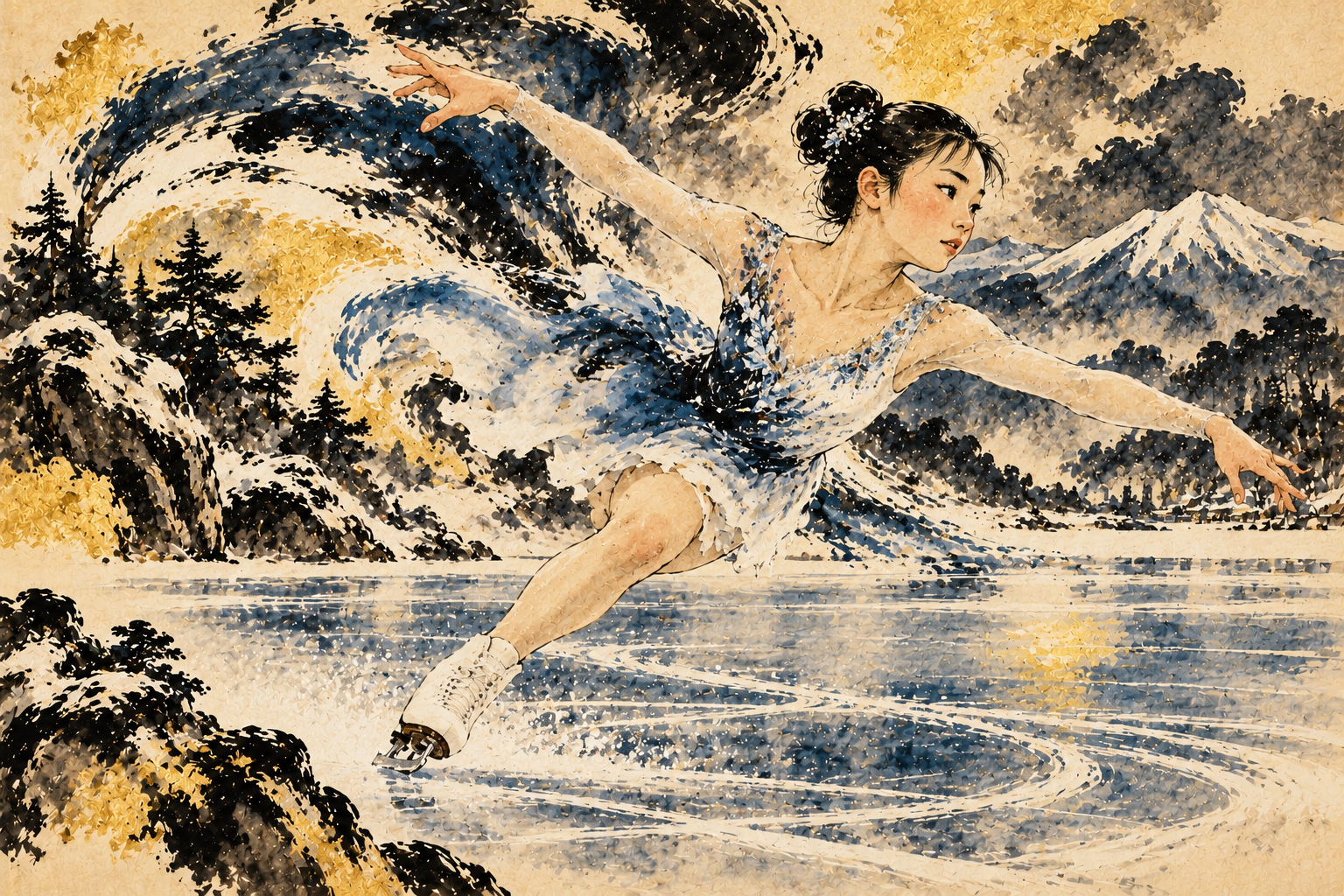
A skating nation's future isn't decided only at the Olympics. It takes shape in regional rinks, student competitions and the first national outings of children who may never become famous.
Two competitions, two views of the pipeline
Japan's figure-skating season is easy to follow if one watches only international stars. But its foundations are visible in a much less publicized October calendar. The 20th East Japan Student Figure Skating Championships are scheduled for October 16–18 at Tanaka Kikinzoku Ice Arena, also known as Tokyo Tatsumi Ice Arena, in Tokyo's Koto Ward. Five days later, October 23–25, Sapporo's Tsukisamu Gymnasium is due to host the 30th All-Japan Novice Figure Skating Championships.
Those events should not be mistaken for successive rounds in one competition. Student skating takes place alongside higher education and the competing demands of academic and professional plans. The novice championships bring much younger skaters onto a national stage. Together they offer two perspectives on a central question: what allows a small child who loves skating to remain involved with the sport, and perhaps excel, for years?
Japan Skating Federation notices confirm the dates and venues. They do not, at the time of this research, provide a verified final-results list that would justify naming October 18 winners. This feature consequently examines the structure and history of Japan's skating pipeline, not an imaginary race for podium places.
Why the pathways matter
Figure skating is not a straight escalator from novice to junior to senior fame. Club environments, regional competitions, national qualifying rules, university opportunities and international selection all shape the options. Each season's federation regulations specify eligibility by competition, including categories and qualifications. Taking part in a university championship is not, by itself, a step in the same qualifying bracket as the novice nationals.
Japan's published season calendar also lists the East Japan and East Japan Junior Championships from October 29 to November 1; the national junior championships from November 21 to 23; and the national championships from December 24 to 27. Dates are not proof that the same athlete can or will enter every competition. What they illustrate is the remarkable range of organized skating happening far from the Olympic spotlight.
At Sapporo's novice championships, spectators are offered free admission, while official practice is closed to the general public and photography is tightly restricted. These are important rules for a competition involving minors, not mere logistical footnotes. Enthusiasm for emerging talent ought to coexist with appropriate boundaries around young athletes' lives.
The long shadow of Japanese skating greatness
Anyone tracing Japan's international standing eventually reaches Midori Ito. Her pioneering triple Axel and silver medal at the 1992 Albertville Olympics made the extraordinary demands of women's singles newly visible to the wider public. The story continued with Mao Asada, a three-time world champion and silver medalist at Vancouver in 2010, and Yuzuru Hanyu, Olympic men's champion in 2014 and 2018. Their accomplishments can be checked against the International Skating Union's athlete records.
These careers helped make Japan one of figure skating's great audience markets. They also created a challenge. A child with an elegant first national performance should not instantly be branded the next Hanyu or Asada. There is no single route to excellence, and the attention given to precocious talent can obscure the many skaters who improve slowly, balance other obligations or find fulfillment without winning world medals.
History becomes more instructive when it is treated as evidence of the sport's institutions rather than a conveyor belt of stars. Athletes rely on coaches, choreographers, rinks, clubs, families, and places to train. Sustaining the system demands resources and time that do not appear on a competition scoreboard.
What a rising Japanese star can—and cannot—tell us
International records offer a useful example in Mao Shimada, whose junior-level achievements, including multiple junior world titles and strong junior Grand Prix performances, have placed her among the best-known young Japanese skaters. Results and biographies also document her attempts at technically demanding elements, including the quadruple toe loop and triple Axel. Her development demonstrates how talent can advance across several competitive seasons rather than through a single breakthrough.
Shimada is not being described here as an entrant in the East Japan university event or the forthcoming national novice championships. That distinction matters. A journalist cannot treat a well-known promising athlete as a participant in every youth-skating story simply because she represents the next generation.
What judges—and viewers—ought to see
Multi-rotation jumps attract the headlines. Yet skating also depends on edge quality, control, spins, footwork, choreography, musical phrasing and the transitions that join one element to another. The balance between technical and performance criteria varies by discipline and is governed by annually updated rules. Success is not accurately explained as the skater who attempts the most difficult jump automatically winning.
For young athletes, the story is as much about patient skill development as spectacular tricks. The relationship between technical ambition, injury risk, growth and sustainable training is complicated. Neither coaches nor families should be expected to maximize a child's short-term scores at the expense of an entire skating life. A responsible account of novice competition recognizes development without pretending to diagnose training choices or individual health from a score sheet.
The hidden cost of making a skater
Figure skating requires specialized ice time, coaches, boots, sharpenings, travel and often costumes. The cost is not uniform: a student living near a rink has very different opportunities from one traveling long distances for practice. Institutions with reliable ice access and stable coaching can make a striking difference to the number of children who stay involved.
University competition adds another dimension. Some skaters are chasing elite careers while studying; others may find that competition offers a meaningful final chapter before moving into professional life outside the sport. That is not failure. A system worth supporting should value both paths and help athletes transition with dignity.
How to discover the next generation without creating a myth
October's competitions provide real opportunities for regional discovery. The most revealing profile may be not the winner with the biggest score but an athlete who has overcome a lack of local ice, learned an unusual skill, returned from an interruption or contributed to a university skating community. Those are reporting possibilities, not claims about any unnamed competitor.
The responsible next step is to consult the official results when published, verify names and affiliations, study the performances and invite young skaters and coaches to describe their experiences in their own words. When Sapporo's novice championships open on October 23, those facts can create genuinely new stories. Until then, the value of the scene is already clear: beyond the spectacular achievements celebrated around the world, Japan's skating culture survives because ordinary rink days add up.
Reporting cutoff: October 17, 2026. The final standings of the October 16–18 student competition and outcomes of the October 23–25 novice event have not been independently verified and are not asserted here.