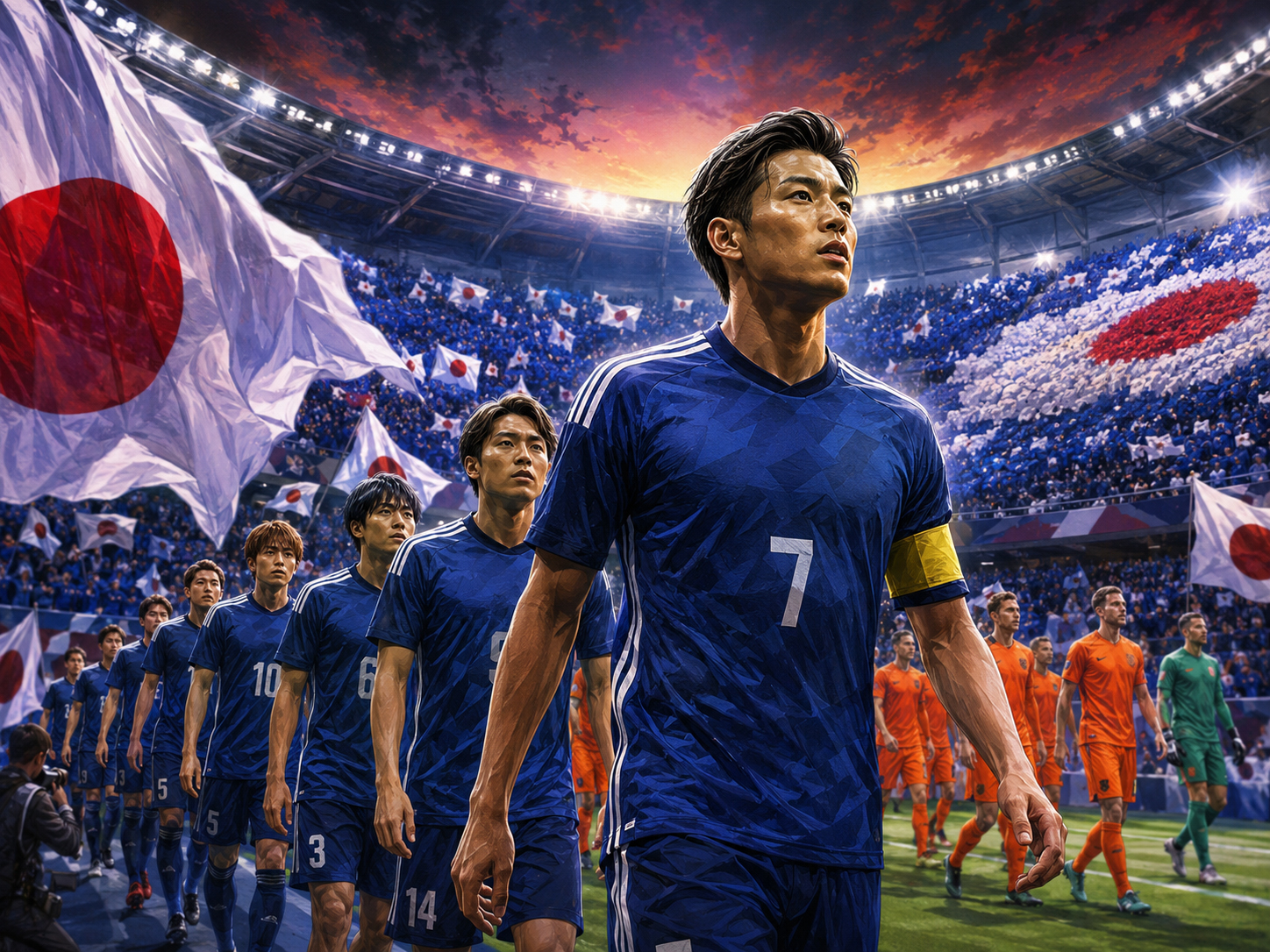
Sunday sport has its own kind of time. It is slower than breaking news and warmer than a fixture list. It gives people a few hours to imagine the match before the match actually arrives. Japan’s opener against the Netherlands should have belonged to that Sunday mood. In the United States, it does: an afternoon kickoff in Dallas. In Japan, the clock bends the story into Monday morning, when the alarm goes off early and the national team walks into the day before most offices have opened.
FIFA’s match centre lists Netherlands vs Japan as a Group F match on June 14, 2026, in Dallas. AT&T Stadium’s event listing identifies the fixture as a June 14 match, with local kickoff listed at 3 p.m. ESPN’s tournament schedule also places Netherlands vs Japan on Sunday, June 14, in Arlington, Texas. The geography matters. This is a World Cup hosted across North America, but for Japan the game will be watched through the familiar ritual of time-zone sacrifice.
The more important dislocation is not geographic. It is emotional and tactical. Japan arrived at this opening match without Wataru Endo, its captain and midfield reference point. Reuters reported that Endo withdrew from the World Cup squad because of injury and announced his retirement from international football. Reuters also described the consequence plainly: Japan must rethink the midfield before facing the Dutch.
Endo’s absence is not just a missing name. It removes one of Japan’s instruments for reading the temperature of a match.
What Endo leaves behind
Endo was not a highlight player in the usual sense. He did not need the ball at his feet for long to shape the game. His work often happened before the camera decided what mattered. He stood in passing lanes before the pass was made. He anticipated the second ball before the first duel was finished. He provided the small acts of control that keep a team from becoming emotional when a match begins to tilt.
That is why replacing him is not a one-player problem. It is a memory problem. Who tells the midfield line when to step up? Who calms the first loose clearance? Who reminds the forwards that the press begins with body shape, not with sprinting? Who protects Ao Tanaka if Japan’s midfield becomes stretched? Reuters has pointed to options including Kaishu Sano and Daichi Kamada, while Shuto Machino has entered the squad as Endo’s replacement. But a replacement on the registration sheet is not the same as a replacement inside the match.
The armband can move. Authority has to be earned in the first five minutes, then again in the next five, and again after the first Dutch spell of possession. Ko Itakura’s role therefore becomes bigger than the back line. If he is the new captain, he must organize the defensive block, manage the emotional tempo, and become the player who turns Endo’s knowledge into the team’s next language.
The Dutch problem is structure, not reputation
Against the Netherlands, reputation is easy to see and hard to ignore. Virgil van Dijk. Frenkie de Jong. Memphis Depay. The orange shirt carries its own history. But Japan cannot afford to play against the names. It must play against the structure. The Netherlands can stretch a team across the width of the pitch, invite pressure, then cut through the exposed space. If Japan presses badly, the danger will not simply be one pass; it will be the chain of passes that follows.
The Dutch are not without their own uncertainty. Reuters reported that Jurrien Timber will miss the tournament through injury. Reuters also reported that Jan Paul van Hecke could step into the Dutch line-up next to Van Dijk and that Dutch fitness questions remain around key figures. Those are details Japan will study, but they are not shortcuts. A weakened Dutch side is still a Dutch side: organized, physical, and comfortable making the opponent chase.
Japan’s path is continuity
Japan’s best chance is not chaos. It is continuity. The team has to stack small successes: surviving the opening press, winning second balls, turning recovery into the first forward pass, keeping the front line close enough to the midfield, and making the Dutch centre-backs defend toward their own goal. That is how an underdog stops being an underdog for long enough to make the game uncomfortable.
Takefusa Kubo’s creativity matters. So does the pace of Japan’s wide players and the ability of the midfield to receive under pressure. But creativity needs a platform. If Tanaka is isolated, if the full-backs are pinned, if the first pass after a turnover is rushed, Japan’s attack can shrink into moments rather than become a method. Against the Netherlands, isolated moments may not be enough.
The long distance from 2010
Japan and the Netherlands have World Cup history. In 2010, the Dutch won 1-0. For Japan, that match belonged to an older era of self-image: disciplined, brave, close, but still chasing the elite. Sixteen years later, the expectation has shifted. Japan no longer wants to be praised merely for resistance. It wants to take points, manage matches, and force the football world to discuss it as a serious tournament team.
That shift makes this opener unusually revealing. If Japan loses badly, the Endo absence will become the easy explanation. If Japan competes, the conversation changes: perhaps the team has matured beyond one captain, one shape, one emotional centre. If Japan takes points, Group F becomes less a survival exercise and more a legitimate route to the knockout stage.
Five things to watch
- How quickly Japan’s midfield settles without Endo.
- Whether Itakura can organize more than the defensive line.
- How Japan handles Dutch switches of play and aerial strength.
- Whether Kubo and the front line can receive the first forward pass after turnovers.
- What happens after 65 minutes, when substitutions, heat, nerves, and World Cup pressure begin to change the match.
The Monday morning back home
World Cups do not happen only in stadiums. They happen in kitchens, trains, convenience-store parking lots, office elevators, and phone screens held sideways before sunrise. In Japan, this match will become part of a Monday morning. A win would change the national mood before breakfast. A draw would make the rest of the group feel alive. A defeat with structure would still leave something to build from. A defeat without structure would make Endo’s absence feel larger.
That is why this Sunday edition belongs to the Netherlands match. It is not simply a fixture. It is a transition story. Japan has moved beyond being satisfied with brave performances. It enters Dallas with a stronger football identity, but also with a fresh wound in the centre of the team. The question is whether the blue shirt can carry memory forward without becoming trapped by it.
Japan.co.jp reads this match as the beginning of a new national-team chapter. The result will be decided in 90 minutes. The deeper story is whether Japan can turn the absence of its captain into a new form of responsibility.
Against the Netherlands, the first whistle will test more than tactics. It will test inheritance: who speaks, who steadies, who remembers, and who leads.
Sources and reference
This Japan.co.jp Sunday Long Read is based on FIFA match information, AT&T Stadium event information, Reuters reporting on Japan and the Netherlands, and ESPN’s tournament schedule. It is a pre-match report; lineups, injuries, kickoff details, and broadcast information can change.
- FIFA Match Centre: Netherlands vs Japan
- AT&T Stadium: FIFA World Cup 26 Group Stage Match: Netherlands v Japan
- Reuters: Endo retirement forces midfield rethink for Japan ahead of Dutch meeting
- Reuters: Japan captain Endo withdraws from World Cup due to injury, retires from internationals
- Reuters: Van Hecke seeks to emulate uncle's success
- Reuters: Netherlands defender Timber to miss World Cup with groin injury
- ESPN: 2026 FIFA World Cup fixtures and results