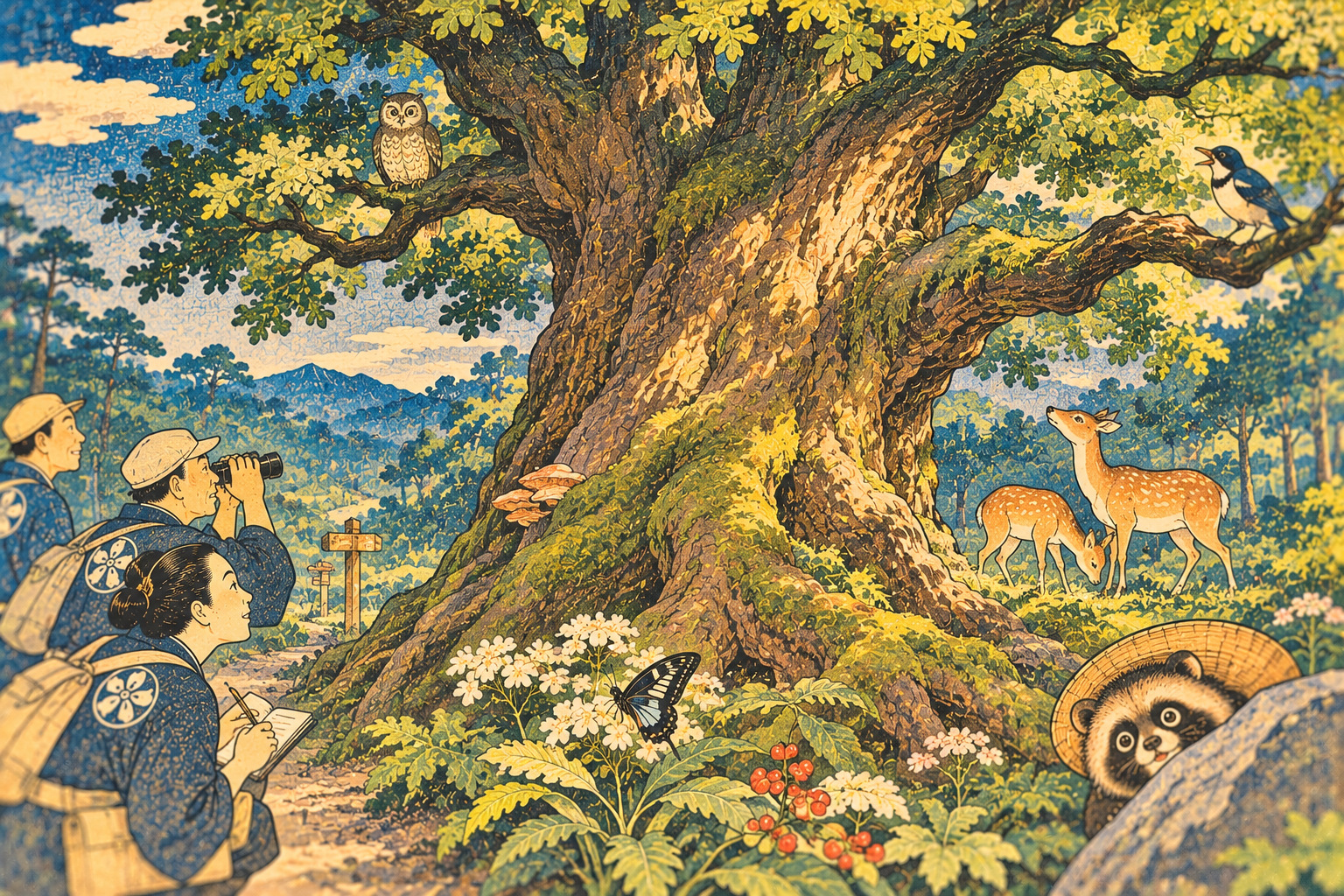
A forest beside a test track, and a change in what counts as conservation
A motor company's proving ground is not the first place most people would look for a nature reserve. Yet on October 30, the Japanese government recognized 571 hectares within Honda's Takasu Proving Ground in Hokkaido under its Nature Symbiosis Site system. It was one of 122 sites recognized in the second round of fiscal 2026, bringing the national total to 700 and the combined certified area to approximately 127,000 hectares. The figures, published jointly by Japan's environment, agriculture and transport ministries, mark the expansion of an approach that counts conservation on land managed for purposes other than wildlife protection. But the announcement also introduces a harder test: what happens after the certificate is awarded? Japan must demonstrate that maintaining forests, restoring degraded sites and supporting local stewards can produce measurable ecological benefits for decades, not only another increase in site numbers.
What was actually approved on October 30
The ministry's decision covered 116 independently prepared biodiversity-enhancement activity plans and six collaborative plans coordinated through municipalities. Among the 116 were 106 classified as maintenance, seven as recovery and three as creation; all six collaborative plans were for maintenance. These labels are important. A site recognized for maintaining existing biodiversity is not necessarily land on which a new forest was planted, while a recovery or creation designation does not mean that the ecological target has already been reached. The system legally recognizes both the plan and the area where designated activities take place. Nor do the 122 certificates necessarily represent 122 entirely new landscapes: some applicants transition from an earlier, nonstatutory recognition system. Reporting the headline total without this history could exaggerate how much new acreage has been secured.
Hokkaido: Honda’s unusually large protected working landscape
Honda's research subsidiary opened the Takasu Proving Ground in 1996 on a 789-hectare site in Takasu, Hokkaido. The company says 571 hectares—roughly 70% of the property, excluding driving tracks and other facilities—have now been certified as HondaWoods Takasu Taisei no Mori. Its account describes restricted entry, a roughly three-meter perimeter fence intended for vehicle-testing safety, protected elm and ash stands, monitoring, patrols and non-native species management. The company identifies mountain hawk-eagles, black woodpeckers and other wildlife among the organisms of interest. That does not mean a test track is intrinsically beneficial to nature, and the restrictions around an industrial property are not equivalent to an ecological impact assessment. What the certification shows is that unused and managed parts of an industrial estate can have explicit conservation goals. Long-term evidence about species trends, habitat connectivity and development pressure remains vital.
Kyoto: a wetland that has needed protection for decades
Kyoto City's October 30 release identifies six certifications within the city: four new recognitions and two transitions into the legal system. The new examples include Hacchōdaira Wetland in northern Sakyo Ward, an approximately 221.76-hectare area within Kyoto Tamba Kogen Quasi-National Park. Kyoto says the rare raised bog supports threatened wetland species, including Yachisugiran, and that surveys date back to fiscal 1979. Maintenance has included boardwalks, patrols and deer-exclusion fencing. The site's inclusion inside an existing protected area is particularly revealing: the scheme can recognize local management effort without automatically adding the whole site to international tallies of conservation outside protected areas. A national label should not obscure forty-seven years of local knowledge, expense and continuing work.
A city park and a ceremonial mountain are also ecosystems
Another new Kyoto certification covers Takaragaike Park and the mountain associated with the “Ho” character of Kyoto's Gozan Okuribi fires. Kyoto lists the combined area at approximately 72.98 hectares. Its woods contain different forest communities across ridges and valleys, while the pond supports waterbirds, including wintering mandarin ducks. The area has been shaped by generations of use for firewood and ceremonial purposes, not enclosed in a human-free wilderness. The city also lists a pharmaceutical company's arboretum and a textile company's site among its newly certified areas. This is a powerful corrective to the idea that urban green space is an ornamental afterthought. City habitats require management choices about foot traffic, invasive organisms, water, deer damage and cultural use; no certificate can make those trade-offs disappear.
Yokosuka: the volunteers who keep a hillside alive
In Kanagawa Prefecture, Yokosuka announced on November 2 that Takatoriyama Park and its urban forest received the same October 30 recognition. The city credits the Takatoriyama Nature Observation Group, which has conducted environmental conservation since fiscal 2017. The park is the fourth recognized site on city-owned land, following Nobi Kagamida Green Space, Ashina Weir and Nagasaka Green Space. The notable actor here is neither a ministry nor a famous company but a local group doing work that can become invisible in a national announcement. The award acknowledges past activity and a recognized plan; the municipality has not published a new independently audited biodiversity trend analysis in that release. Continued public participation, stable funding and a succession of volunteers are the next tests.
From national parks to satoyama and commercial property
Japan's familiar conservation history includes national parks, natural monuments and wildlife protection laws. But its ecological landscape has never been limited to formally designated parks. Satoyama mosaics of managed woodland, paddies, irrigation ponds and villages historically depended on recurring human use. Where cultivation, grazing or coppicing disappear, open habitats can change, sometimes at the expense of species adapted to those environments. Conversely, preserving some forest interiors requires reducing disturbance rather than adding more interventions. The new legal scheme accommodates this diversity by recognizing maintenance, recovery and creation as different conservation tasks. It is less a declaration that every managed site is pristine nature than a framework for setting out responsibilities where society and wildlife overlap.
How an international promise became a Japanese law
The Kunming–Montreal Global Biodiversity Framework was adopted at the Convention on Biological Diversity's COP15 in December 2022. Among its goals was effective conservation of at least 30% of land and sea by 2030, widely called 30by30. Japan revised its National Biodiversity Strategy in March 2023 and started a Nature Symbiosis Site recognition initiative in fiscal 2023. The Act on Promoting Activities to Enhance Regional Biodiversity came into force in April 2025, turning the mechanism into a statutory process involving the environment, agriculture and transport ministers, with implementation support through the Environmental Restoration and Conservation Agency. A Kyoto garden or corporate woodland is therefore connected to a global agreement—but its actual ecological contribution remains dependent on evidence from that particular place.
Why 700 certified sites are not 700 new international protected areas
Japan uses “other effective area-based conservation measures,” or OECMs, for places making a sustained biodiversity contribution outside conventional protected areas. The categories are not interchangeable. The ministry says certified maintenance areas outside existing protected lands are slated for registration in an international OECM database. Recovery and creation sites must first reach the specified biodiversity-value standard before becoming eligible; overlap with pre-existing protected areas is excluded from the OECM portion. In August 2026, the ministry reported that 10,000 hectares from fiscal 2025 had been added to the international database, bringing the registered OECM area to 64,600 hectares. That was an earlier reporting date and should not be confused with the October nationwide 127,000-hectare certified-site figure. Nor is a certified hectare automatically a newly conserved hectare.
The financial question: who pays to keep nature healthy?
Site recognition brings visibility, but the recurring work can be costly. A wetland may need invasive-species control, deer fencing and water monitoring; a volunteer urban forest needs tools and trained participants; a company's testing ground needs long-term management even when commercial priorities change. Companies may value a credible framework for discussing nature-related risks with investors or employees, but a badge is not a biodiversity offset and should not be used to cancel damage elsewhere. The underlying plans, spending commitments, monitoring protocols and governance arrangements matter more than promotional imagery. A robust account would ask whether the landholder publishes baseline conditions, the number of years funded, records of habitat condition and a transparent process for responding if the site deteriorates. Those details cannot be inferred merely from an approved list.
The next task is to count outcomes, not just places
A national inventory can answer where action is proposed and who is responsible. It is less capable, on its own, of showing whether a rare bird population is stable, water quality improved or invasive plants were reduced. Baseline surveys, repeated measures and an explicit comparison against plausible deterioration are needed to evaluate outcomes. Even then, a changing wildlife count may reflect climate, weather or land use beyond a site's boundaries. The government and participating organizations can strengthen credibility by making monitoring accessible, recording failed as well as successful interventions, and distinguishing newly created ecological value from the continued stewardship of existing habitats. The most useful future statistic may not be another round number of certified sites, but how many sites can show healthy ecosystems five or ten years later.
A different map of conservation, with a condition
From Takasu's vehicle-test landscape to a Kyoto wetland, from an urban ceremonial forest to Yokosuka's volunteer-managed hillside, October's recognitions point toward a broader geography of responsibility. Japan's biodiversity future will be shaped on land owned by businesses, cities, religious institutions, farmers and neighborhoods as well as in national parks. That is a promising institutional shift, not a guarantee. The question that should follow every recognition is straightforward: what natural value is being maintained or restored, who will do the work, and how will the public know whether it endured? If the country can answer those questions with evidence rather than awards alone, its 700-site milestone will become more than a headline.
Sources and reporting method
The following primary-source announcements establish the certification decisions and attributed site descriptions; they do not independently prove long-term ecological outcomes.
- Environment Ministry: second FY2026 certifications (Oct. 30)
- MAFF: co-issued certification announcement
- MLIT: nationwide area and certification count
- Honda: Takasu Proving Ground, Japanese release
- Kyoto City: six local certifications and site details
- Yokosuka City: Takatoriyama Park and volunteer conservation
- Environment Ministry: August 2026 OECM registration
- Environment Ministry: scheme, OECMs and 30by30
- ERCA: legal certification and transition process