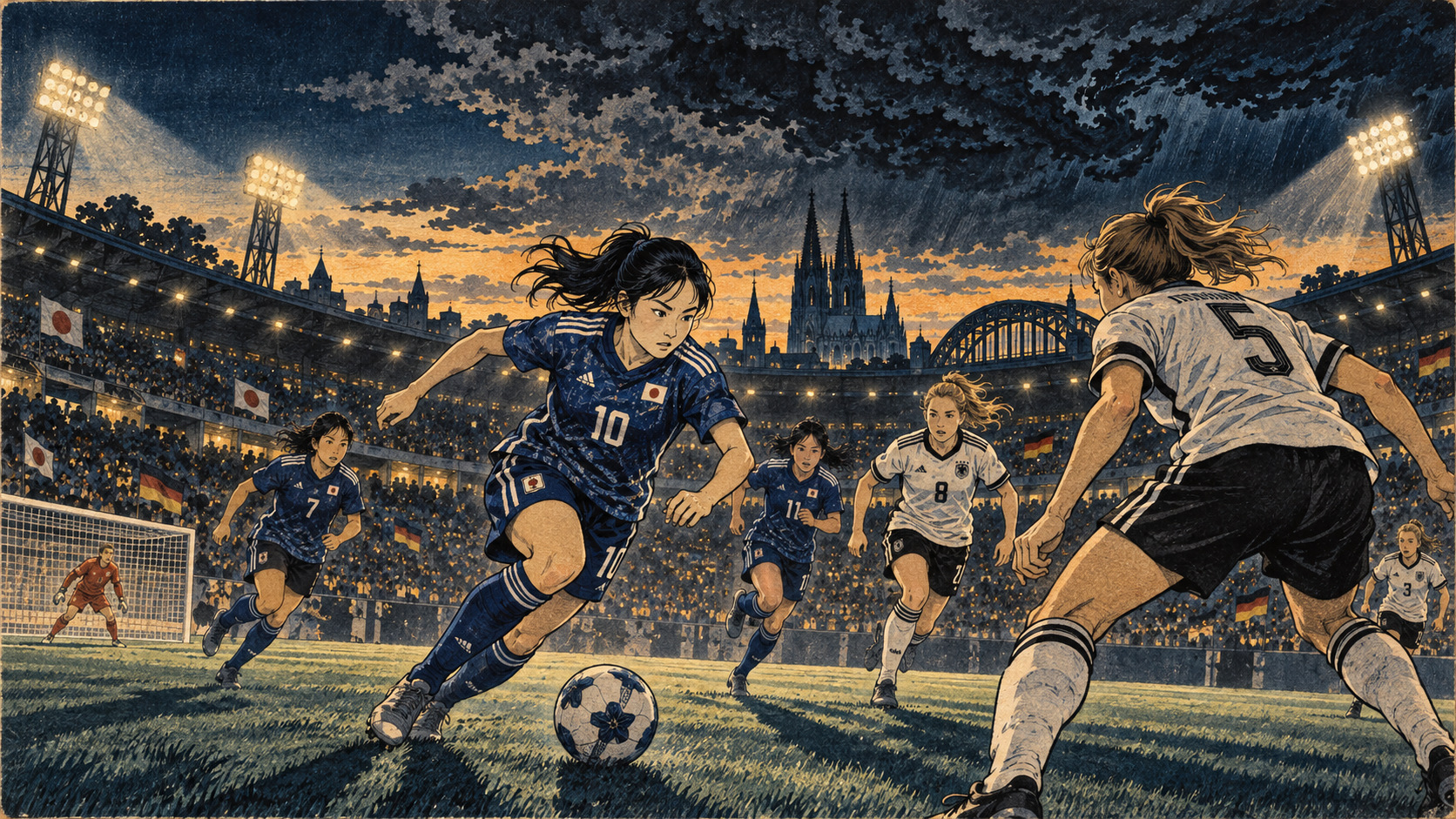
Europe is a test of Nadeshiko’s present tense
Nadeshiko Japan’s October trip to Europe is not merely another set of friendlies. It is a referendum on where the team stands now. The Japan Football Association announced on September 22 that Japan would face Haiti in Saint-Ouen on October 9 and Germany in Bremen on October 13. The squad blends established leaders such as Hasegawa Yui with players developing in England, Scotland, the United States and the domestic WE League. The larger question is simple: how close is this team, under coach Kano Michihisa, to becoming a side that can again impose itself on the world’s strongest women’s national teams?
The squad shows how international the team has become
The call-up list itself tells a story. Goalkeeper Yamashita Ayaka is at Manchester City. Kitagawa Hikaru and Ishikawa Rion are at Everton. Ohba Shu plays for Rangers FC, and Okuma Akane for Aston Villa. Moriya Miyabi and Yamamoto Yuzuki add U.S.-based experience. At the same time, domestic football remains central, with Takahashi Hana of Mitsubishi Heavy Industries Urawa Reds Ladies among the squad’s anchors. Nadeshiko Japan is no longer best understood as a team built either at home or abroad. It is a team assembled across multiple football cultures, and the challenge is turning that variety into a shared tempo and identity.
Why the midfield matters most
Japan’s attack will draw attention, but the heart of this side still lies in how it structures midfield control. Hasegawa Yui remains the player most associated with rhythm, progression and calm under pressure. Nagano Fuka offers circulation and balance, while Seike Kiko, Miyazawa Hinata, Fujino Aoba, Hamano Maika and Tanikawa Momoko expand the team’s range between the lines and in transition. Against a physically assertive opponent such as Germany, Japan cannot rely on speed alone. It must use spacing, passing angles and rotation to move the game onto terms it can manage. That is why the composition of the midfield and attacking band is more than a list of names; it is the team’s tactical blueprint.
What Kano’s tenure is being asked to prove
The JFA pages for 2026 show that Kano Michihisa’s tenure began in a period of transition and immediate expectation. Japan defeated South Africa 5–0 in the first match under Kano in June, then lost the second meeting 1–0. In late September and early October, the team captured a third consecutive Asian Games gold medal. Those results matter, but they do not answer every question. International friendlies against Haiti and Germany are the kind of matches that reveal how a side responds when the level of physical pressure, tactical variation and opponent quality all rise together. Kano’s task is not simply to win isolated games. It is to define a credible route back toward sustained elite status.
History helps—but it does not play the next match
Nadeshiko Japan carries one of the richest histories in women’s football. The 2011 Women’s World Cup triumph in Germany remains one of the landmark achievements in Japanese sporting history, and the silver medal at the London 2012 Olympics confirmed that the title was no accident. Yet history can become sentimental if it is used only as a memory. The current team is competing in a different football environment from the one that produced that generation. Women’s football has become faster, deeper and more professionalized, especially in Europe. The meaning of this October tour lies in measuring how much of Japan’s traditional technical clarity can still create an edge in that new environment.
Why Germany is the real examination
A friendly against Germany is never just a routine fixture. Germany’s women have long represented one of the structural powers of the game: organized, forceful, experienced and difficult to control for long periods. For Japan, the Germany match is a test of several interlocking capacities. Can the defenders maintain compactness under pressure? Can the first pass out of the back survive a strong press? Can the wide players help both in escape routes and defensive recovery? Can Japan create chances without losing its positional discipline? These are not abstract coaching questions. They are the ingredients of whether Japan can rejoin the small group of teams that consistently threaten deep tournament runs.
The younger generation is not waiting politely
Squad evolution is also part of the story. Players such as Shiragaki Uno, Narumiya Yui, Shimada Mei and Hijikata Maya represent a younger competitive layer pushing into the national-team picture. In friendlies, their value is not measured only in goals or assists. Coaches watch how quickly they process pressure, how they react immediately after losing the ball, and whether they can handle duels without the tempo of the match overwhelming them. The next core of Nadeshiko Japan will be built from these details. Europe provides a harsher classroom than many domestic matches, which is precisely why the tour matters.
From Haiti to Germany: the structure of the tour
According to JFA’s official match pages, Japan opened the trip against Haiti in Saint-Ouen before preparing for Germany in Bremen. At the time of source verification for this article, the publicly retrievable JFA page for the Haiti match still displayed a pre-match state rather than a completed official result. That unresolved point is worth noting carefully. It does not diminish the importance of the tour, but it does mean this feature focuses on the structure and meaning of the European test rather than asserting an unverified match outcome. The more important storyline is how the staff and players use two contrasting opponents to sharpen both tactical flexibility and squad depth.
The global environment is changing around Japan
To understand Japan’s challenge, it is necessary to see how quickly the women’s game is changing around it. European clubs have invested more heavily, training environments have intensified, and national teams now draw from deeper professional systems. Japan’s own players are increasingly part of that ecosystem, scattered across elite leagues. That internationalization is a strength, but it also raises the standard for what the national team must look like. Technical quality remains essential; so do pressing resistance, transition speed, duel strength and the capacity to sustain intensity over ninety minutes. This European trip is partly an audit of how well Japan has adapted to that wider transformation.
The point of a friendly is to build the next victory
Friendlies can be dismissed because they do not carry the finality of knockout tournaments. But for a national team in development, they are where future victories are engineered. Nadeshiko Japan’s October tour is ultimately about creating more than one way to win. Hasegawa Yui may still be the side’s clearest reference point, but elite international football demands more: finishing quality up front, a defense that survives sustained pressure, and bench options capable of altering the match. Haiti offers one kind of calibration. Germany offers another, harder one. Together, they form a meaningful chapter in the effort to define what the next Nadeshiko Japan will be.