Nadeshiko Japan Win Third Straight Asian Games Gold After Penalty Shootout
Japan reached the final without conceding, fell behind for the first time all tournament, equalized in the 86th minute and won on penalties. The third straight title underlined the depth of the domestic player pool.
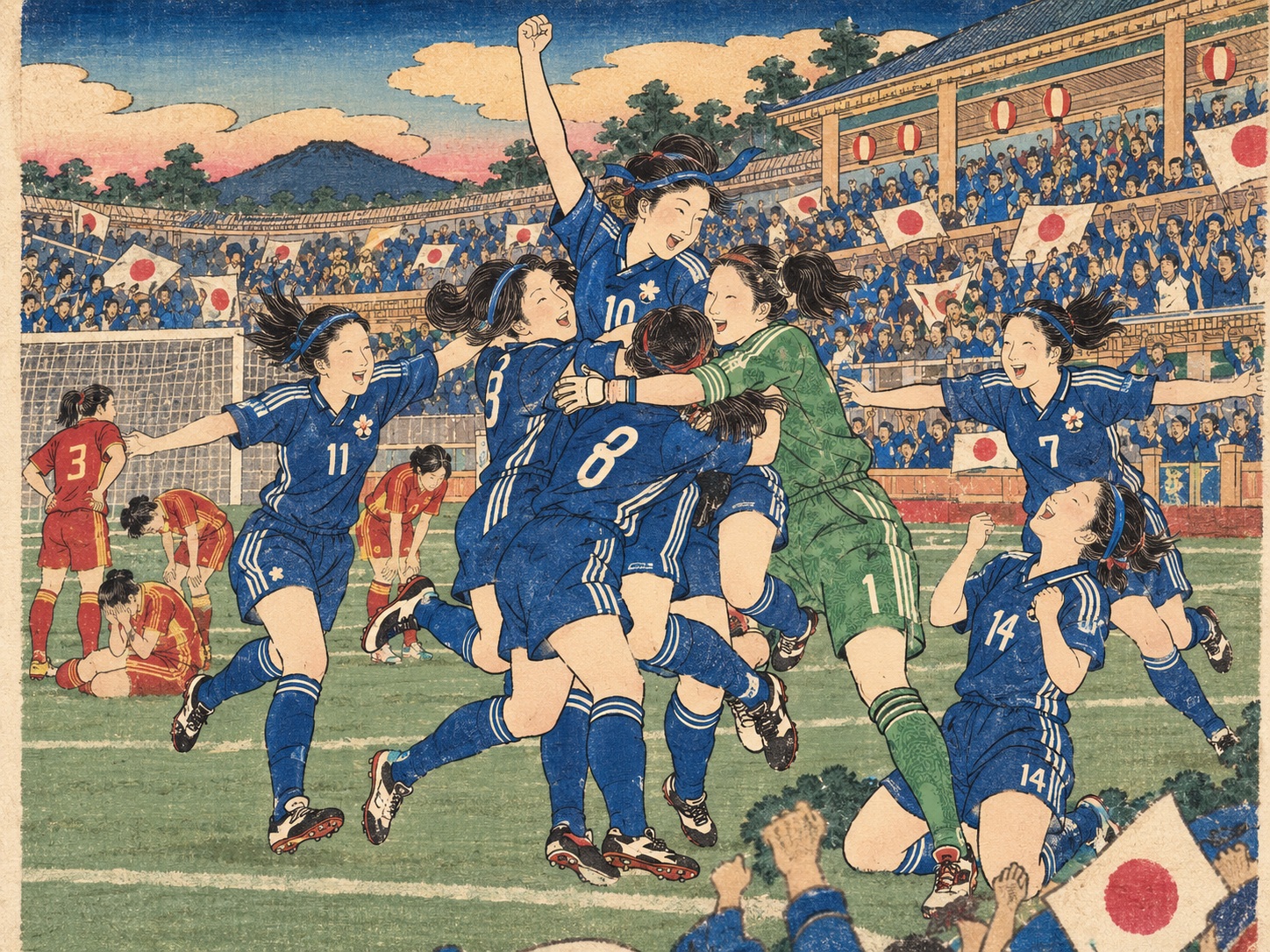
SHIZUOKA. With four minutes left in regulation, Japan was behind for the first time in the tournament.
Funa Mizuno played the ball into the right side of the penalty area. Substitute Hanon Nishio turned inside, kept her eyes on the goalkeeper and drove a right-footed shot into the far corner. The score was 2-2. The 6,243 spectators inside Shizuoka Stadium Ecopa erupted.
Extra time produced no winner. In the shootout, goalkeeper Shu Ohba saved North Korea’s third penalty. Japan converted all five of its attempts, and Yuzuho Shiokoshi buried the fifth to complete a 5-3 shootout victory and Japan’s third consecutive Asian Games women’s football gold medal.
Japan struck first after a difficult opening
Coach Michihisa Kano changed two starters from the semifinal victory over South Korea and kept Japan in a 4-3-3 shape. Ohba started in goal, with Mirai Hamada, Juri Ito, Sakurako Ohashi and Ai Kuwahara across the back. Ueno anchored midfield behind Funa Yanase and Shiokoshi, while Yui Narumiya, China Kamiya and Yoshino Nakashima led the front line.
North Korea initially imposed greater physical pressure and Japan struggled to progress the ball. Yanase gradually helped Japan recover control in midfield, and the breakthrough came in the 32nd minute. Kuwahara and Nakashima combined on the left, Yanase crossed, Shiokoshi’s shot was blocked and Ueno drove the loose ball into the lower-left corner.
Kano said after the match that his staff had prepared for a game that could extend through extra time and penalties. He praised the squad’s ability to endure difficult phases and keep competing. citeturn135090view0
The first goals conceded all tournament changed the match
Japan had reached the final without conceding. It beat Thailand 8-0, Vietnam 8-0, Chinese Taipei 4-0, the Philippines 4-0 and South Korea 2-0. The sequence produced 26 goals and five clean sheets before the final. citeturn415320search0turn415320search6turn676339search0
North Korea broke that pattern immediately after halftime, scoring in the 47th minute and again in the 69th. For the first time in the tournament Japan was trailing.
Kano responded aggressively, bringing on Nishio and Saori Takarada and pushing players higher. Rather than wait for the game to settle, Japan increased its attacking presence.
Nishio’s equalizer arrived in the 86th minute. She later told JFA that she entered the match believing she could decide it and was comfortable in big games. citeturn135090view0
Extra time became a test of survival
North Korea continued to press with energy in extra time. Japan’s response was collective. Juri Ito repeatedly covered behind teammates, while Shiokoshi dropped deep to defend near the back line.
Short tournaments often turn on more than tactical superiority. Fatigue, substitution depth, penalty preparation and emotional control become decisive. Kano’s comment that Japan had planned for 120 minutes and penalties showed how seriously that scenario was treated.
Japan went first in the shootout and converted through its sequence. Ohba’s save against North Korea’s third taker created the margin. Shiokoshi then finished the job with Japan’s fifth kick.
Three straight titles, three different kinds of final
Japan’s run began in Jakarta-Palembang in 2018. Under Asako Takakura, Japan beat North Korea 2-1 in the quarterfinal, South Korea 2-1 in the semifinal and China 1-0 in the final to claim its second Asian Games title. citeturn676339search1turn676339search6
The next Asian Games, officially Hangzhou 2022 but held in 2023 after the pandemic delay, produced a more dominant run. Japan won all six matches and defeated North Korea 4-1 in the final before 37,166 spectators. Yoshino Nakashima, Haruka Osawa, Momoko Tanikawa and Remina Chiba scored in the title match. citeturn131054search0turn131054search1
In 2026, the opponent was again North Korea, but the route was entirely different. Japan conceded a lead, fell behind, equalized late, survived extra time and won on penalties.
| Tournament | Final | Result | Character of title |
|---|---|---|---|
| 2018 Jakarta-Palembang | Japan vs China | 1-0 | Three tight knockout wins |
| Hangzhou 2022, played 2023 | Japan vs North Korea | 4-1 | Six wins from six and a decisive final |
| 2026 Aichi-Nagoya | Japan vs North Korea | 2-2, Japan 5-3 pens | Comeback, extra time and shootout resilience |
A largely domestic-based squad made the title significant
The 2026 title was not produced by simply assembling every Europe-based senior international available to Japan.
The Asian Games squad relied heavily on players from Japan’s WE League. Narumiya said after the final that with increasing numbers of Japanese players moving overseas, she saw the tournament as one of the best opportunities to demonstrate the value of the domestic league. citeturn135090view0
That matters commercially and competitively. Many of the players who scored or decided matches at the Asian Games can be watched regularly in Japanese club football.
The tournament therefore became a test of depth as much as a test of the first-choice national team. Japan could field a different mix of players from its strongest World Cup lineup and still win a major Asian title.
The deeper history: from 1981 to world champions
JFA traces the modern women’s national team to the 1981 Asian Women’s Championship. Japan created its first nationwide women’s league in 1989 and qualified for the inaugural FIFA Women’s World Cup in 1991. At that tournament, Japan lost all three matches and failed to score. citeturn909563search0
Twenty years later, Nadeshiko Japan reached the top of the world. In the 2011 World Cup final, Japan came from behind twice against the United States and won the shootout 3-1 after a 2-2 draw. Homare Sawa won both the Golden Ball and Golden Boot. It was Japan’s first FIFA world title in men’s or women’s football. citeturn909563search4turn909563search2
Japan followed with Olympic silver in 2012 and another World Cup final in 2015. The country also won youth world titles, helping establish a development pipeline from junior levels to the senior national team.
The 2026 Asian Games gold belongs to that longer project. The significance is not that this squad was identical to Japan’s strongest senior lineup. It is that Japan had enough trained players to build another title-winning team.
North Korea remains a serious Asian rival
Japan and North Korea have met repeatedly at senior and youth levels and remain two of the strongest women’s football programs in Asia. The 2026 final was their second consecutive Asian Games title match.
Japan won 4-1 in Hangzhou. In Shizuoka, North Korea led 2-1 and controlled long stretches of the second half and extra time. The difference in results should not be read as evidence that Japan has established permanent superiority.
For Japan, the final offered a more useful test than another large group-stage win: how to respond when technical control disappears and the opponent’s pace and strength begin to dictate the match.
The next benchmark is global
The Asian Games title closes one competition but not Japan’s autumn schedule. JFA’s 2026 calendar has Nadeshiko Japan traveling to Europe for friendlies against Haiti and Germany in October, followed later in the year by home matches against Brazil. citeturn808165search4
Not every Asian Games player will immediately become a first-choice senior international. But Ueno’s opener, Nishio’s equalizer, Ohba’s penalty save and Shiokoshi’s winning kick all become evidence when future squads are selected.
A medal can preserve a record. The more important legacy is what the players take back into the WE League and into competition for future national-team places.
Nadeshiko Japan’s third straight Asian Games title therefore ends with two truths: Japan remains a dominant force in Asian women’s football, and the next challenge begins immediately.
Sources
- Japan Football Association, match report: third consecutive Asian Games gold, Oct. 3, 2026
- JFA, 2026 Asian Games women’s final match page
- JFA, 2026 Asian Games Nadeshiko Japan tournament page
- JFA, 2018 Asian Games women’s tournament archive
- JFA, Hangzhou Asian Games women’s final report, Oct. 7, 2023
- JFA, Japan women’s national team World Cup and Olympic history
- JFA, history of the FIFA Women’s World Cup