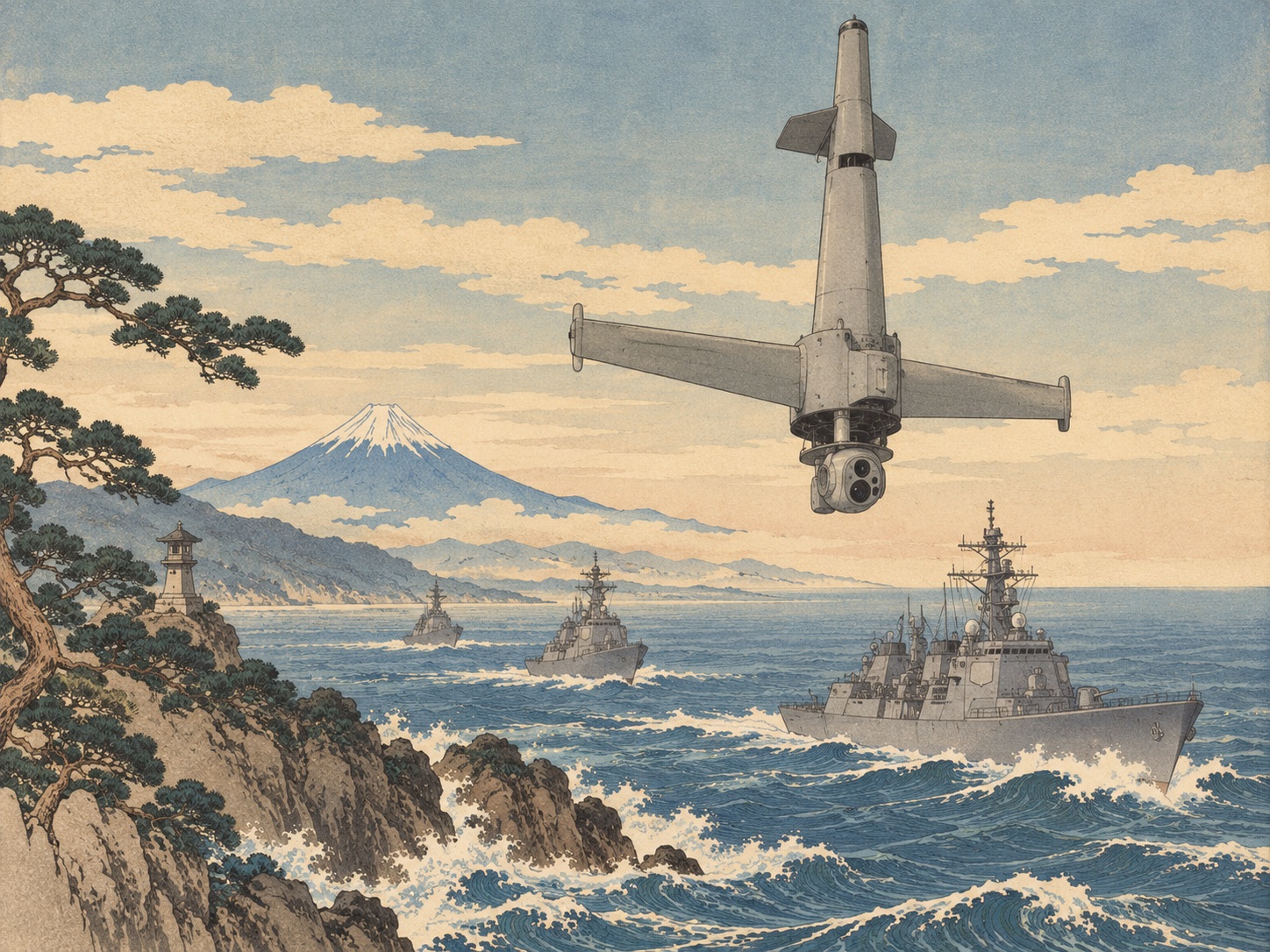
Japan’s Maritime Self-Defense Force is beginning to push its eyes beyond the horizon without putting another crew in the air.
Jiji/The Japan Times reported on October 5 that the JMSDF is operating six V-BAT uncrewed reconnaissance aircraft made by U.S. defense-technology company Shield AI. The aircraft can follow preplanned patrol routes autonomously and transmit surveillance imagery back to a command vessel in real time. The aim is to expand maritime surveillance while easing personnel demands.
A fixed-wing drone that does not need a runway
V-BAT combines fixed-wing flight with vertical takeoff and landing. The aircraft stands upright for launch and recovery, allowing it to operate without a conventional runway or large flight deck.
When Japan selected the system, the Defense Ministry said it would be carried primarily aboard patrol vessels and used for surveillance and intelligence gathering around surface ships. The selection process evaluated communications and sensor requirements.
The ministry estimated a unit cost of roughly ¥600 million and a lifecycle cost of about ¥38.8 billion, while cautioning that both figures were planning estimates and could change.
Why the JMSDF wants small shipborne UAVs now
The strategic problem is straightforward: the area Japan wants to watch is large, while ships, aircraft and trained personnel are finite.
A ship’s own radar and optical sensors are constrained by height and the curvature of the Earth. An unmanned aircraft can climb above the vessel and extend the horizon dramatically. If it can stream imagery back in real time, it becomes a remote sensor controlled by the ship.
“Uncrewed” does not mean “no people”
In June, the JMSDF chief said all six aircraft had been acquired and that operators were being trained. The service planned training cycles centered on Ominato Air Base beginning in August 2026, with courses of roughly three months held about twice a year.
Shipboard operations still require mission planning, weather decisions, launch-and-recovery safety, maintenance, fuel handling, data interpretation and integration with shipboard networks. The advantage is not that V-BAT removes humans from the mission; it is that the same crew can potentially watch more ocean for longer periods.
Training from JS Kumano
In late June 2026, the JMSDF publicly demonstrated V-BAT flight training from the Mogami-class frigate JS Kumano in Sagami Bay. Japanese defense reporting said two aircraft were taken aboard and operated from a control station inside the ship.
The Mogami class was itself designed around reduced crew requirements and high levels of automation. Pairing such a ship with an unmanned airborne sensor fits the same philosophy.
What the aircraft can see
According to Jiji/The Japan Times, V-BAT carries an infrared camera in its nose and can remain airborne for up to around 12 hours. It can fly a preprogrammed route autonomously and relay live surveillance imagery back to the vessel.
That makes it useful for identifying surface contacts, monitoring coastal areas, following suspicious activity and collecting information during emergencies or disasters.

Shield AI sells autonomy as much as airframes
Shield AI, founded in 2015, markets V-BAT alongside its Hivemind autonomy software. When the company announced Japan’s selection in January 2025, it described the contract as the beginning of a planned multiyear stream of increasing V-BAT orders for JMSDF operations.
That statement is the manufacturer’s expectation, not a confirmed Japanese procurement schedule. Japan’s Defense Ministry had not publicly fixed a future total.
The safety record will matter in Japanese service
Reuters reported in June 2026 on a series of V-BAT crashes and injuries, as well as allegations from a former Shield AI employee about safety and reporting practices. Shield AI denied wrongdoing and said some incidents involved failures to follow safety procedures.
Those reports do not establish defects in Japan’s individual aircraft, but they make accident reporting, maintenance data and shipboard safety procedures important areas to watch.
V-BAT is an early piece of a much larger unmanned shift
Japan’s fiscal 2026 defense program expands far beyond small reconnaissance drones. The Defense Ministry is acquiring or developing ship-launched UAVs, attack-capable shipborne UAVs, unmanned surface vessels and unmanned underwater vehicles.
The government aims to establish the SHIELD concept—Synchronized, Hybrid, Integrated and Enhanced Littoral Defense—during fiscal 2027. V-BAT is significant because it is one of the unmanned systems already in the fleet and being trained from actual ships.
It fills a different role from SeaGuardian
The JMSDF is separately moving toward the MQ-9B SeaGuardian, a much larger long-endurance UAV. Japan plans to begin JMSDF operation of MQ-9B in fiscal 2028, with an early-introduction program at Kanoya Air Base from fiscal 2027.
MQ-9B is designed to watch very large areas for long periods from shore-based operations. V-BAT is a smaller organic sensor that a ship can carry and launch where needed. They are complementary rather than direct substitutes.
Autonomy changes mission design more than stick-and-rudder flying
If a drone can fly a preplanned route by itself, the operator can focus more on what area matters, what the sensors are seeing and what should happen next.
Japan’s fiscal 2026 budget includes ¥2.2 billion for demonstrations related to simultaneous control of multiple unmanned assets, a sign that the ministry is already thinking beyond one-drone-at-a-time operations.
The real test will happen at sea
Buying six aircraft is the easy part. Integrating them into a warship’s daily routine is harder.
The questions now are operational: Can crews launch and recover V-BAT reliably in poor weather? Can the aircraft keep functioning in a contested electromagnetic environment? How much maintenance does it require? How useful is the live imagery to commanders? Can it be integrated with larger UAVs, helicopters, surface ships and future unmanned surface and underwater systems?
V-BAT will not remove people from maritime surveillance. But it can let ships send a sensor farther away without sending another crew with it. If that works reliably, the most important change will not be the aircraft itself. It will be how far a Japanese warship can see, and how much ocean a smaller crew can understand at once.
Sources and references
- 防衛省 — 「艦載型UAV(小型)」機種選定結果、2024年12月27日。
- 防衛省 — 令和7年度予算「艦載型UAV(小型)の取得(6機:40億円)」。
- Jディフェンスニュース — 海上幕僚長定例会見、V-BAT6機取得・大湊での操作員教育、2026年6月23日。
- Jiji / The Japan Times — “MSDF deploys V-BAT uncrewed surveillance aircraft,” October 5, 2026.
- Shield AI — V-BAT selected as JMSDF maritime ISR platform, January 22, 2025.
- 防衛省 — 令和7年版防衛白書「無人アセット防衛能力の強化」。
- 防衛省 — 令和8年版防衛白書「無人アセット防衛能力の強化」。
- 防衛省 — 令和8年度予算案、SHIELD・無人機同時管制・各種UAV/USV/UUV。
- Jディフェンスニュース — 「海自の新装備 V-BAT艦載型無人機の飛行訓練を初公開」2026年7月24日。
- Reuters — Shield AI safety incidents and allegations, June 5, 2026.
Reporting cutoff: October 6, 2026, 1:23 a.m. JST. Selection of V-BAT, the six-aircraft ¥4.0 billion acquisition, operator training centered on Ominato and Japan’s unmanned-systems policy are verified in Ministry of Defense/JMSDF primary materials. Current operational use, autonomous patrol details and roughly 12-hour endurance are attributed to Jiji/The Japan Times. Safety concerns are attributed to Reuters and do not establish defects in Japan’s individual aircraft.
Why it matters
The JMSDF is using six shipborne V-BATs to extend surveillance beyond a ship’s own sensors without adding another crewed aircraft.
Policy context
The six-aircraft ¥4.0 billion purchase is part of Japan’s wider push toward unmanned air, surface and undersea systems.
What to watch
Operator training, shipboard reliability, safety performance and integration with MQ-9B, crewed aircraft, USVs and UUVs.