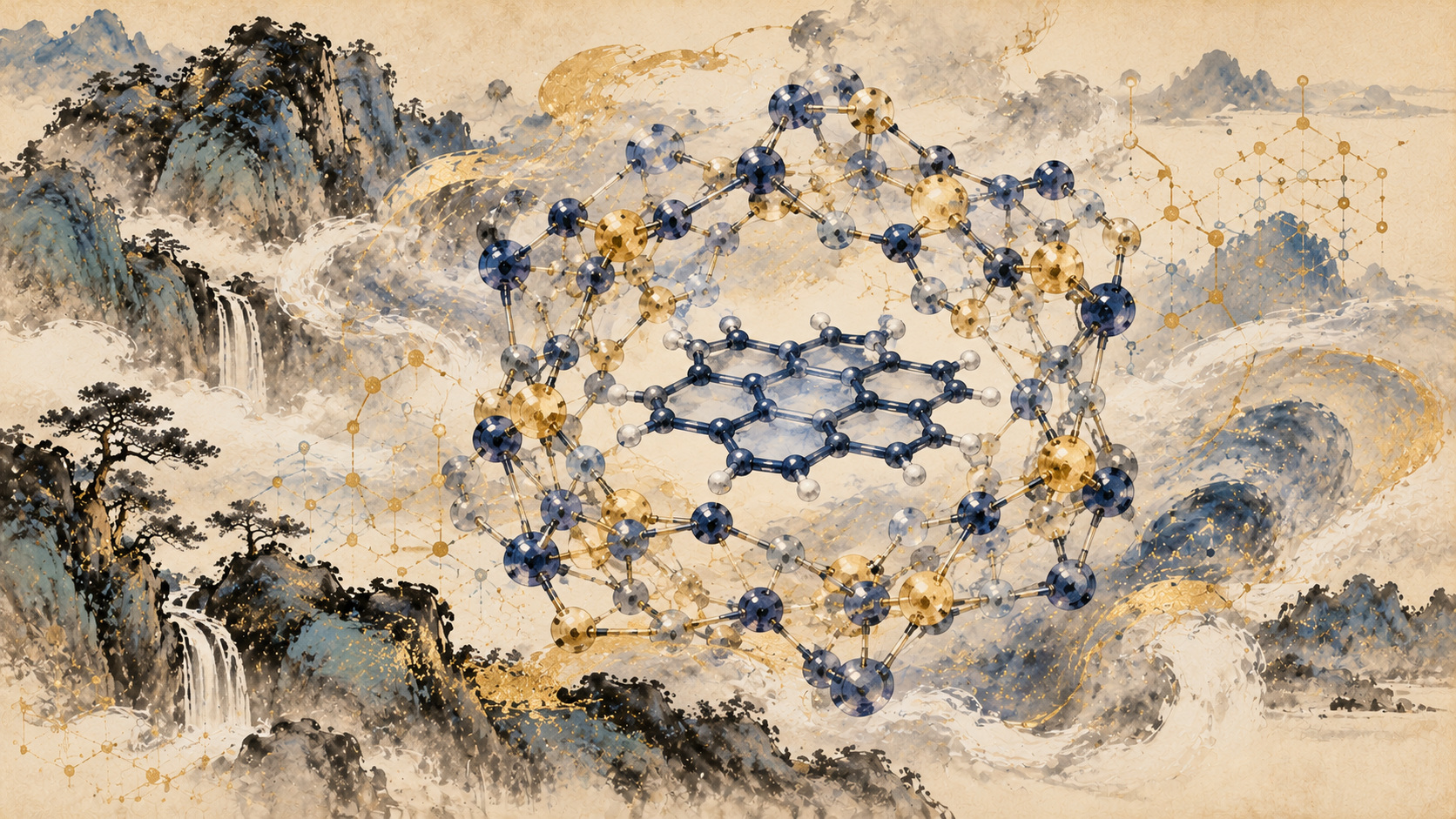
A molecular container that can recognize which guests to let pass—and imprison others while it is assembled—marks a clever new turn in the chemistry of shape.
How do you build a prison for a molecule?
The hardest part of containing something at the molecular scale is not necessarily making the walls. It is deciding what may enter, what may leave, and how to keep the contents secure when the surrounding structure is itself smaller than any visible machine. Molecules jostle, collide and exchange partners constantly. Chemical hosts often capture guests only temporarily. Building a cage around a guest can prevent escape, but the constraints become formidable when the guest is a broad, flat aromatic molecule.
A Japanese research group has now demonstrated a particularly elegant answer. A cage made from two curved, electronically conjugated panels and three connecting bridges captures aromatic molecules according to their geometry. Some guests slip in and out through lateral openings. Others, too bulky to enter a completed host, can be permanently enclosed if the cage assembles around them. The researchers call the design π-Armor.
The work was published online October 13, 2026, in the Journal of the American Chemical Society and announced October 15 by Japan's Institute for Molecular Science, the Graduate University for Advanced Studies (SOKENDAI) and the Japan Science and Technology Agency. The paper lists Haruka Kano, Takashi Harimoto and Yasutomo Segawa; Segawa is an associate professor, and Harimoto was an assistant professor at the time of the research.
A problem that dates back decades
The broader discipline is supramolecular chemistry: understanding and designing systems in which molecules recognize, assemble around and interact with one another without necessarily forming new covalent bonds between host and guest. Its host–guest branch gave chemists a language for selectivity, binding strength and reversible exchange.
In 1985, Donald Cram reported the first carcerand, a host capable of imprisoning a molecular guest. Two years later, Cram shared the Nobel Prize in Chemistry with Jean-Marie Lehn and Charles Pedersen for foundational research into molecular recognition. The complex of a trapped guest inside such a host is called a carceplex, a name derived from the Latin word for prison.
But the ability to trap a guest permanently is not the same as merely attracting it strongly. A removable guest can escape when molecular motion and changing conditions allow it to pass through an opening. A carceplex restricts the escape path so thoroughly that release would require breaking part of the host's covalent framework. Making such protection selective for flat, π-conjugated molecules has been unusually challenging.
Two curved plates and three carefully sized doors
The new cage uses a pair of hexa-cata-hexabenzocoronene (c-HBC) panels, large aromatic structures with a distinctive wavy curvature. Three dibenzodiazocine (DBDA) linkages hold the panels face-to-face. According to the team's quantum-chemical calculations, the resulting cavity has about 6.3 ångströms between its facing panels and three side openings approximately 10 ångströms wide. An ångström is one ten-billionth of a meter.
The researchers synthesized the empty host in a reported 55% yield. That does not mean 55% of all possible guest molecules were trapped. It is the yield for a defined chemical synthesis of the cage itself, an important distinction when interpreting experimental figures.
The molecular architecture is deliberately unlike a sealed sphere. Its openings make it possible for small enough guests to enter and exit, while the curved interior surfaces provide extensive contact with flat aromatic visitors. The whole concept relies on shape complementarity: how well the physical contours of host and guest fit together.
A 90-fold lesson in molecular recognition
One particularly striking experiment compared positional isomers of dichlorinated aromatic guests. When the chlorine substituents occupied the meta positions, the guest bound around 90 times more strongly than a counterpart with substituents in the para configuration. The molecules shared closely related ingredients, yet the arrangement of those ingredients drastically changed the relationship with the cage.
The investigators also varied the sizes of substituent atoms. Chlorine and bromine gave comparatively strong association; smaller fluorine and larger iodine produced weaker binding. Guests bearing electron-donating methyl groups could also associate, suggesting that the system was not dependent on a single favorable electronic polarity. Modeling attributed much of the attraction to dispersion forces operating across closely fitting surfaces.
The result matters beyond this particular chemistry: a molecular host can read three-dimensional fit rather than requiring a specially engineered donor–acceptor pair. Strong binding is not the same as irreversible capture, however. These smaller guests remained able to exchange in and out of the completed cage.
The unusual trick: imprison the guest as the cage is born
Some larger guests cannot travel through the openings of an already assembled cage. That might seem to disqualify them. Instead, the team used the guest as a participant in the host's assembly process. With the appropriately shaped guest present, the cage formed around it, producing a carceplex that physically trapped the guest.
For the reported set of experiments, such carceplexes formed in yields reaching 57%, with no empty host detected in the specified reaction. In one stability demonstration, the trapped guest did not escape even when heated to 200°C under reduced pressure. Those observations establish robust trapping under the tested conditions; they are not a universal promise that every guest would withstand arbitrary temperature or chemical environments.
There was a further twist. The chemists enclosed a larger, three-armed aromatic guest so that its arms projected through the three cage openings. After entrapment, the exposed groups could undergo further chemical transformation that extended the conjugated molecular system. In other words, the molecule was not merely stored: aspects of it could be modified while the core remained protected.
Why flat aromatic molecules matter
π-Conjugated molecules have networks of electrons distributed across connected rings or alternating bonding patterns. Their optical and electronic properties make this family scientifically significant for fields that include organic light-emitting devices, dyes, and organic solar technologies. That does not mean the new cage is already a component of such devices. Rather, the chemistry may eventually offer a way to stabilize or organize molecules with useful properties and explore how confinement alters their behavior.
Traditional guest recognition sometimes depends strongly on differences in electron-rich and electron-poor character. π-Armor's designers deliberately investigated a broader shape-driven strategy. Its success with both electron-withdrawing and electron-donating substituents makes that point more compelling, even as the guest family studied remains limited.
What is proven—and what remains conjecture
The most defensible claim is precise: the team synthesized a neutral π-conjugated host demonstrating reversible shape-sensitive binding, and prepared permanently trapped carceplexes by assembling the host in the presence of larger guests. The paper also demonstrated post-encapsulation chemistry on a protruding guest structure. These are laboratory-scale molecular design results.
The release discusses possible future protection of unstable molecules and optical or electronic functionality in capsules. Applications in industrial separations, catalysis, sensors and medicine belong to the wider host–guest research landscape; they have not been established as commercial uses of π-Armor. Scale-up, cost, stability under practical conditions, broader guest compatibility, measurable device benefits and independent reproduction remain questions for future studies.
No technology has to be commercially ready to be intellectually consequential. The advance is a more flexible grammar for molecular architecture: selectivity from geometry, access through openings, permanent incarceration during construction, and the ability to modify a guest while held in place.
The great smallness of the discovery
One of chemistry's most revealing ideas is that identity alone does not determine function. Two arrangements of nearly identical atoms may behave differently because one fits, twists or touches its surroundings better. This study turns that old insight into a deliberate device at a breathtakingly small scale.
π-Armor is not a universal molecular vault. It is a demonstration that carefully designed shape can decide whether an aromatic guest comes and goes—or becomes part of an interlocked chemical assembly.
The next milestones will be scientific rather than promotional: more guest families, independent validation, a better understanding of the functional properties of captured molecules, and perhaps materials that could not be examined so easily without confinement. For now, Japanese researchers have given chemistry a new kind of molecular armor—and a sharper way to think about shape itself.