- A festival shaped by a fire
- Why the island is sacred
- What it means to keep a flame alive
- Two kinds of remembrance in Hiroshima
- Chim↑Pom: three candles, different histories
- The archive, the absent figure and the forest
- A working temple rather than a neutral gallery
- Visiting the exhibition and looking beyond it
A festival shaped by a fire
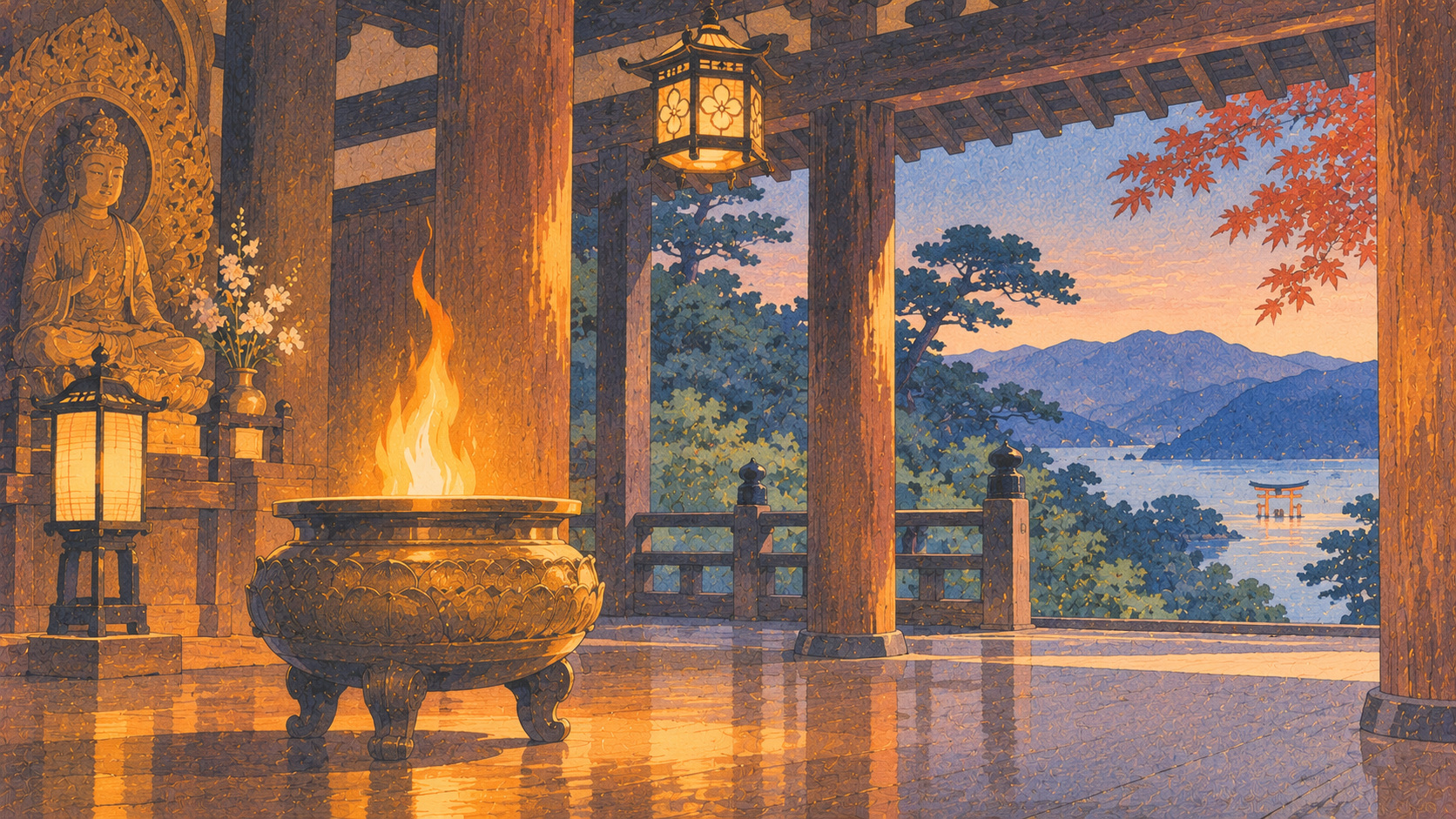
A flame can survive the building that shelters it. That distinction has acquired particular force on Miyajima, where a contemporary art exhibition opened at Daishoin Temple on November 20. The second Miyajima Art Festival in the Narrative (MAFIN) runs until December 13 under the theme 時の目, literally an eye of time, with Manami Totsuka as curator. It follows the inaugural 2025 event, established in the year marking eight decades since Hiroshima's atomic bombing.[1][2][11]
Six months before the opening, the Reikado Hall on Mount Misen and an adjoining reception building burned down. Daishoin reported no injuries or spread into the mountain forest. Local reporting quoted the temple's chief priest explaining that portions of the sacred flame were kept in other locations and that a source flame was removed safely.[4][5]
The incident has become part of the exhibition itself. Charred timber from the hall is incorporated into a new work by Chim↑Pom from Smappa!Group. The material makes an abstract subject immediate: cultural continuity is not simply a matter of keeping objects unchanged. It also depends on what people do when objects are lost.[12]
Why the island is sacred
To understand the setting, begin with the geography rather than the gallery. Miyajima, also called Itsukushima, rises from the Seto Inland Sea. Its wooded mountains and shore have long been associated with worship. According to shrine tradition, Itsukushima Shrine was founded in 593. In the twelfth century, patronage by the warrior aristocrat Taira no Kiyomori helped shape the distinctive complex built over tidal waters.[8][9]
The familiar vermilion gate is only one part of the island's religious landscape. Buddhist practices developed alongside shrine worship. Daishoin describes how its Eleven-faced Kannon image was formerly housed in the shrine's inner sanctuary. This historical relationship is a reminder that the modern distinction between Shinto shrines and Buddhist temples does not fully describe religious life in earlier Japan.[3]
Itsukushima Shrine was inscribed on the World Heritage List in 1996, making 2026 its thirtieth anniversary. The listing recognizes the shrine and its associated setting; it should not be confused with a designation of the art festival itself.[9]
What it means to keep a flame alive
The temple traces the sacred fire to Kukai, also known by his posthumous title Kobo Daishi, who lived from 774 to 835. According to local tradition he practiced on Mount Misen in 806 after returning from Tang China. The fire is associated with goma, an esoteric Buddhist ritual in which offerings are burned as part of prayer and religious practice.[3][8]
The story of a flame transmitted for some 1,200 years is a religious tradition, not a continuously instrumented record of combustion. Its significance lies in the succession of people who have cared for it. A flame is not an artifact that can simply be locked away in a cabinet. It needs fuel, supervision and provision for emergencies.
The local tourism association records an earlier destruction of Reikado in 2005 and reconstruction in 2006. Following the latest fire, Daishoin announced on May 28 that debris removal had been completed and that consultations toward rebuilding would continue. The survival of the distributed flame illustrates how preservation can depend on redundancy as much as on a single sacred location.[4][5][16]
Two kinds of remembrance in Hiroshima
The Flame of Peace in Hiroshima Peace Memorial Park was lit on August 1, 1964. Designed by architect Kenzo Tange, its pedestal evokes two open hands. Hiroshima's municipal records describe a ceremony drawing on flames contributed by 35 religious institutions as well as industrial fires from around Japan. Daishoin identifies its sacred fire as one of the sources.[3][6][7]
The memorial honors the victims of the atomic bombing and expresses the aspiration for nuclear abolition. The fire was deliberately assembled almost nineteen years after the bombing of August 6, 1945. It is not itself simply a surviving ember of the bombing.
That matters because another peace flame, transmitted from fire associated with the bombing, figures in the exhibition. The histories of these flames are not interchangeable. A memorial created through collective contributions and a preserved remnant connected with destruction can carry different meanings even when their physical appearance is similar. The exhibition asks visitors to attend to those histories rather than treating fire as a universal symbol with only one interpretation.
Chim↑Pom: three candles, different histories
The exhibition's opening coverage describes the collective's 2026 work 《よい火、わるい火、ふつうの火》 (literally Good Fire, Bad Fire, Ordinary Fire) as a grouping of three lit candles. One draws on Miyajima's sacred flame, another on a flame inherited from the aftermath of the Hiroshima bombing, and a third has no special historical origin. Salvaged wood from Reikado also forms part of the installation.[12]
Combustion does not reveal a moral label. The observer must learn the provenance of each flame to understand why people attach such different significance to them. Fire warms homes and sustains religious ritual, but it can also destroy a building or become inseparable from memories of violence. The installation's spare arrangement offers a way to confront those contradictions without resolving them into a slogan.
The collective has worked in Hiroshima before. In 2014 it undertook a ritual burning project involving donated paper cranes at Daishoin. That history raises a difficult question for memorial practices: whether the purpose of an offering is fulfilled by keeping its physical material forever, by recording it, or by transforming it through a ritual.[12]
The archive, the absent figure and the forest
Sumi Kanazawa approaches time through the everyday newspaper. Kyoto Seika University, her alma mater, describes an installation using about 100 newspaper drawings covered in graphite, together with drawings concerning the atomic bombing. The daily news cycle normally pushes yesterday's headlines out of view. A newspaper transformed into an artwork can instead invite sustained attention to what a dated sheet of paper carries.[10]
Ilya Yerashevich's 2026 work 《漂う光》, literally Drifting Light, explores figures rendered in gold and spaces left when those figures are removed. The opening report connects the work with representations of absence in early Buddhist art and with the destruction of the Bamiyan Buddhas. The empty space becomes a sign of a presence that can no longer be seen.[13]
Hiroko Kubo, a sculptor from Hiroshima, presents 《森の目》 (Eyes of the Forest), a work dated 2024, placing eye-like forms among trees. Her practice draws on folklore and industrial materials. On an island where nature has long been invested with sacred meaning, the installation offers a reversal: rather than merely looking at a forest, a visitor might imagine being observed by it.[14][15]
A working temple rather than a neutral gallery
The choice of Daishoin changes the conditions in which art is encountered. Visitors may arrive to worship, admire the grounds or attend the festival. The same spaces serve purposes that precede and will outlast the exhibition. An artwork about absence or prayer can therefore have a different resonance here than it would in a room designed exclusively for displaying art.
There is also a practical lesson in this setting. Preservation depends on people who maintain buildings, arrange ceremonies, handle visitors and make exhibitions safe. The organizer's public funding statement identifies artist costs, installation, insurance and documentation among its expenses. Free admission removes one barrier for visitors, but does not remove the costs of providing the experience.[15]
The curator's framework asks audiences to spend time with questions that resist immediate solutions. In an era in which information can be retrieved almost instantly, that is a distinctive proposition for an art festival. It is an invitation to reflect, not a claim that art by itself can settle the political or historical problems associated with peace.
Visiting the exhibition and looking beyond it
MAFIN is scheduled daily from 10 a.m. to 5 p.m. through December 13, with free admission. The venue is Daishoin Temple, 210 Miyajima-cho, Hatsukaichi, Hiroshima Prefecture. The guest hall containing the Chim↑Pom installation is unavailable on December 1. Check the organizer's website before visiting. The exhibition venue is distinct from the destroyed Reikado Hall on Mount Misen; visitors should not assume that the latter has reopened.[1][2][4]
For readers exploring the wider region, our Hiroshima prefecture feature provides further historical and cultural context.
Miyajima's flame is a useful reminder that continuity is an activity, not a static condition. Every generation inherits something it did not create and decides how to care for it. The festival's works bring that responsibility into focus through burned wood, altered newspapers, absent figures and a forest that seems to return our gaze. They offer no guarantee of peace, but they offer space in which to consider what sustaining it might require.
Sources and further reading
Based on official records and published opening coverage; not an eyewitness report.
- MAFIN 2026
- カルチャーひろしま / Culture Hiroshima
- 大聖院:寺の歴史 / Daishoin history
- 大聖院:火災・再建のお知らせ / Temple notices
- 広島ホームテレビ:霊火堂火災 / Fire report
- 広島市:慰霊碑等の概要 / Hiroshima memorial records
- 広島市:平和の灯 / Flame of Peace
- 宮島観光協会:宮島の歴史 / Miyajima history
- 文化庁:厳島神社 / Cultural Heritage Online
- 京都精華大学:金沢寿美 / Sumi Kanazawa
- 美術手帖:開幕報道 / Opening report
- 美術手帖:Chim↑Pom
- 美術手帖:金沢・イリヤ
- 美術手帖:久保寛子
- 宮島芸術祭実行委員会:事業説明 / Organizer project statement
- 宮島観光協会:年表 / Chronology