Discover Hiroshima: From Aki and Bingo to Peace, Industry, People and the Inland Sea
A prefecture beyond one defining moment: ancient sea routes, castle towns, the atomic bombing and reconstruction, an aging population, industries, artists, and a journey from Miyajima to Onomichi and Kure.
Share on FacebookThe sea before the city
To approach Hiroshima only through the catastrophe of August 6, 1945 is to miss much of what made this region—and the city—possible. Hiroshima Prefecture is a meeting place of mountain valleys, river deltas, harbors, industrial towns and islands. The Inland Sea once carried pilgrims, merchants and armies; today it connects shipyards, factories, fishing villages and cycling routes. Its history is not a single story of destruction and recovery, but a long negotiation between the sea, human ambition and the limits of land.
The prefecture occupies western Honshu and encompasses the old provinces of Aki (安芸) and Bingo (備後). That inherited division still helps explain regional identities: Hiroshima and Miyajima in the west, and Fukuyama, Onomichi and the approaches to Shikoku in the east. The northeastern interior has forests, upland fields and winter conditions quite different from the temperate coast.
Before Hiroshima: Aki, Bingo and the sacred island
Official prefectural history traces human activity through Paleolithic sites in Higashihiroshima, Jōmon remains in Shōbara and later tombs, settlements and temples. Ancient Aki and Bingo developed as distinct administrative regions. Shipbuilding and maritime connections are recorded long before the emergence of the modern city. Aki’s shoreline mattered because the Seto Inland Sea was a corridor linking western Honshu with the Kinai heartland and western Japan.
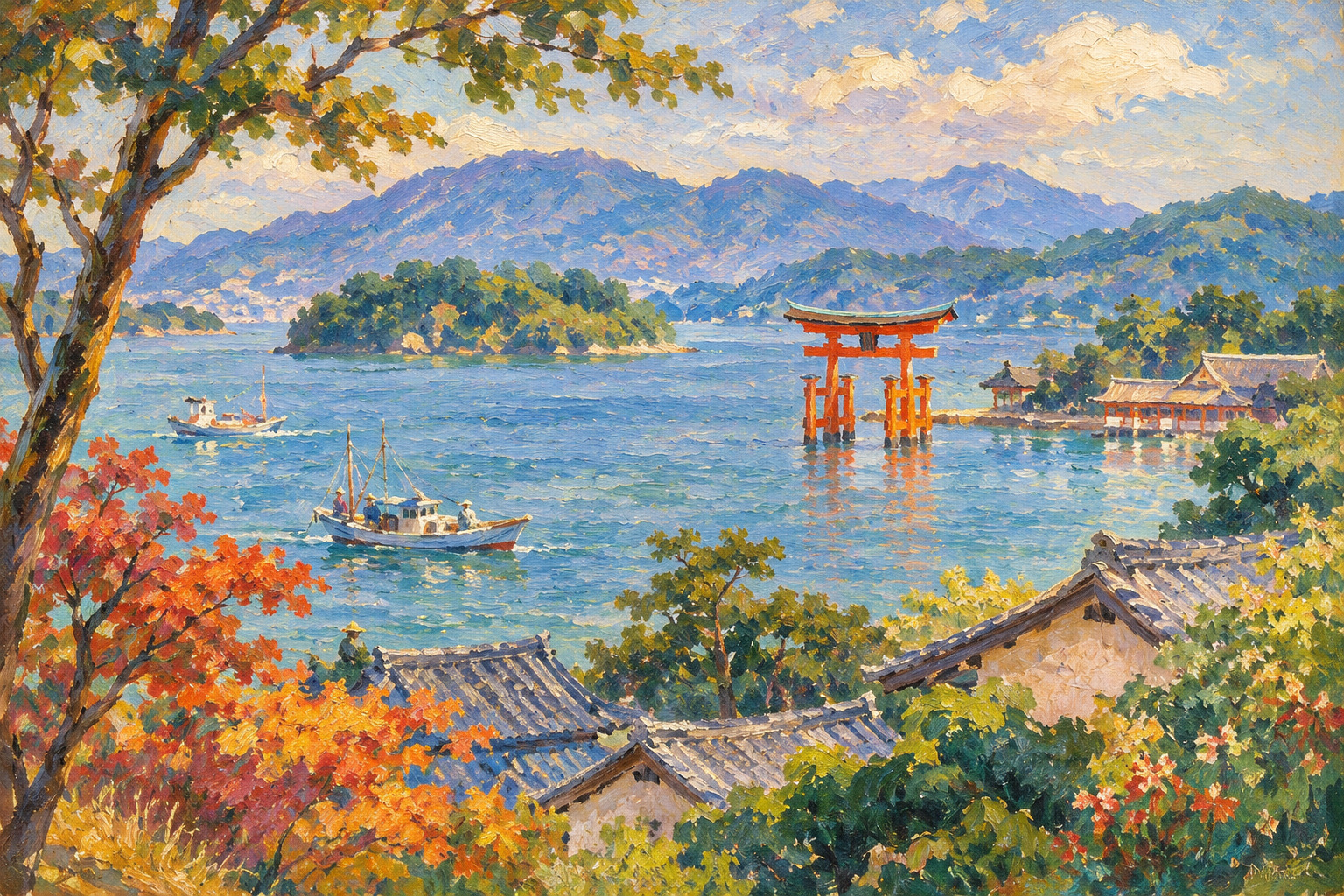
Itsukushima Shrine on Miyajima is the most visible surviving symbol of that older maritime world. Shrine tradition places its founding in 593. The court noble and warrior Taira no Kiyomori, appointed governor of Aki in 1146, patronized extensive rebuilding in the 12th century; the shrine dates his celebrated reconstruction to 1168. Its buildings appear to float over the tidal shore, although the complex is a working sacred site rather than simply a scenic object. The shrine and island were inscribed as UNESCO World Heritage in 1996.
Miyajima’s sacred mountain, Mount Misen, and its forests give context to the shore architecture. The tide matters: a high-tide visit and a low-tide visit reveal different relationships between the great torii, the buildings and the sea. Visitors should consult tide tables and current shrine access notices rather than assume the same scene all day.
Warring states and the making of a castle town
In 1555 Mōri Motonari defeated Sue Harukata at the Battle of Itsukushima. This was not only a dramatic island battle: it accelerated Mōri power across western Japan. His grandson Mōri Terumoto began building Hiroshima Castle in 1589 on the delta where rivers made an important military and trading position. The castle town gradually became the hub that lent its name to the modern prefecture.
After the Battle of Sekigahara in 1600, Terumoto was displaced to the western domains of Suō and Nagato. Fukushima Masanori received the Hiroshima domain, followed in 1619 by Asano Nagaakira. The Asano family ruled Hiroshima through much of the Edo period, while Fukuyama developed as an important castle town under Mizuno Katsunari and successors. Saltmaking, coastal shipping, agricultural production and trading networks connected towns across the region. The merchant streets of Takehara and the port lanes of Onomichi preserve traces of those economies.
Modernization, naval power and industrial infrastructure
The Meiji state remade the region’s strategic geography. The sheltered harbor at Kure became a major naval base and shipbuilding center, while railways and factory investment connected inland settlements to ports. That infrastructure helped create Hiroshima’s modern technical workforce, but it also tied local industry to Japan’s imperial expansion and wartime mobilization.
The modern industrial map still follows the water. Automotive manufacturing and suppliers cluster around Hiroshima, machinery and electronics around the central corridor, and steel, shipbuilding and other heavy industry along the eastern coast. The prefecture’s economic accounts show manufacturing is a substantial share of its economy. None of this should be mistaken for a single-company economy: small subcontractors, logistics, agriculture and services matter across cities and towns.
August 6, 1945: the history that cannot be abbreviated
At 8:15 a.m. on August 6, 1945, a U.S. atomic bomb exploded approximately 600 meters above central Hiroshima. The heat, blast and radiation devastated the city and inflicted injuries and illnesses that endured long after the fires. Hiroshima’s official histories estimate approximately 140,000 deaths by the end of 1945, with uncertainty of about 10,000. The figure is an estimate, not a complete count of every victim.
Those harmed included Japanese civilians and conscripted students, people working in military and civilian institutions, Koreans living under Japanese colonial rule, and others who happened to be in the city. To tell the history responsibly is to acknowledge the city’s wartime military role without making the civilians it contained responsible for the attack, and to recognize survivors—the hibakusha—as people whose testimony and advocacy shaped how the world understands nuclear weapons.
The Peace Memorial Museum presents personal objects, witness accounts and documentation of the consequences of nuclear war. Peace Memorial Park and the Atomic Bomb Dome are places for reflection, not amusement. Travelers should allow time, avoid disruptive photography and remember that mourning and ordinary urban life coexist in this city.
Reconstruction was a political choice as well as a human achievement
The first recovery was practical: water, trams, food, shelter and the return of families and shops. A longer effort followed to decide what a rebuilt city should mean. The Hiroshima Peace Memorial City Construction Law of 1949 provided an important legal and financial basis for reconstruction. A design by architect Tange Kenzō’s team was selected for the Peace Memorial Park, aligning the museum, cenotaph and Atomic Bomb Dome on a deliberate visual axis.
Peace Boulevard, the wide green east–west thoroughfare, was another highly contested urban decision. Rebuilding also depended on people whose names are less familiar than the architects’: construction workers, shopkeepers, teachers, returnees, municipal staff and survivors. Hiroshima’s rebirth therefore cannot be reduced to the claim that a single building or law “saved” the city.
A shrinking, aging prefecture—and the meaning of the numbers
Hiroshima Prefecture’s September 1, 2026 estimated population was 2,675,196, according to its monthly population survey. The prefecture reported that the year-on-year total had declined for 258 consecutive months. This is a time-specific estimate, not a count of everyone registered as a resident on the same day.
A separate, resident-register-based calculation for January 1, 2026 counted 2,706,285 residents, including 818,329 aged 65 or older (30.2%) and 493,105 aged 75 or older (18.2%). These numbers use a different population base and date. They should not be mixed into a single percentage calculation. They nonetheless point to an unmistakable challenge: schools, buses, hospitals, housing and work must be sustained as age structures change.
Hiroshima City remains the largest metropolitan center, but the prefecture is far more than its capital. In many inland and island communities, transport and medical access can shape whether residents remain. The question for Hiroshima is not simply how to attract tourists or factories, but how the economic benefits reach aging towns and younger households.
Manufacturing meets food, fishing and new technology
Mazda and its supplier network are prominent around Hiroshima, while shipbuilding, steel, machinery and electronics contribute across the coastal belt. Semiconductor manufacturing in Higashihiroshima and newer high-technology investment show how older industrial skills are being repurposed. Even the name of Hiroshima’s best-known food, okonomiyaki, tells a story of postwar local entrepreneurship: a filling meal made through improvisation, then developed into a distinctive layered style.
Oysters are both cuisine and livelihood. The prefecture publishes annual production and shipping guidance because aquaculture depends on water quality, hygiene, seed supply and changing environmental conditions. Visitors should understand that oyster rafts are working infrastructure, not decoration. Other tastes worth seeking include anago (conger eel), lemons from the islands, sake from Saijō, and the maple-leaf-shaped momiji manjū. Seasonal freshness, allergies and fishery conditions vary.
People who made Hiroshima visible beyond its borders
Mōri Motonari and Mōri Terumoto stand at the turning point between medieval competition and the castle city. Taira no Kiyomori’s patronage gave Miyajima one of its defining forms, although he was not a native of modern Hiroshima Prefecture. Those are historical connections, not a list of Hiroshima-born celebrities.
The novelist Ibuse Masuji (1898–1993), born in the area now known as Fukuyama, wrote Black Rain (Kuroi Ame), an influential literary treatment of atomic-bomb memory. The filmmaker Shindō Kaneto (1912–2012), born in Hiroshima City, made Children of Hiroshima and The Naked Island; his work links the metropolis to the islands around Mihara. Hiroshima-born painter Minami Kunzō (1883–1950), from present-day Kure, helped bring modern Western-style painting into Japanese visual culture. These figures demonstrate that literature, film and painting have given Hiroshima voices far beyond tourism imagery.
Contemporary names in music, sport and entertainment continue that outward reach, but celebrity should not crowd out the people who operate ferries, tend oyster beds, preserve temples or run small factories. A serious portrait of Hiroshima has room for both.
Where to go: eight different Hiroshimas
Hiroshima City — Peace Memorial Park and Museum. Begin with historical context and give the museum sufficient time. Walk along the Motoyasu River and look at how the city’s rebuilt street grid, bridges and greenery relate to its memorial spaces.
Miyajima / Hatsukaichi — Itsukushima Shrine and Mount Misen. See the tidal setting, old lanes and forested mountain. It is a sacred place, and some paths are steep; check ferry services, tides and trail advisories.
Onomichi — Senkōji, hillside alleys and the waterway. The city’s official tourism page recommends views from Senkōji Park across the harbor, islands and, in clear weather, the Shikoku mountains. Stairs and narrow lanes reward unhurried exploration.
Shimanami Kaidō — islands by bicycle. The designated full route from Onomichi to Imabari is roughly 70 kilometers; the regional cycling operator also recommends shorter circuits. This is a network of bridges and island roads shared with local residents, not a traffic-free theme park.
Kure — shipbuilding, naval history and everyday port life. The Yamato Museum reopened on April 23, 2026 after renovation, according to Kure’s official communications. Pair its exhibits on technology and war with the waterfront, historic buildings and the wider ethical questions raised by military industrialization.
Takehara — preserved merchant town. Narrow streets, traditional houses and links to saltmaking evoke the commercial Seto Inland Sea of the Edo period. Respect residential lanes.
Fukuyama and Tomonoura — castle and harbor. Fukuyama has a castle-town inheritance while Tomonoura retains a historic port landscape tied to coastal trade. Allow time for the sea views rather than rushing between stops.
Mihara and the interior — Buttsūji and mountain landscapes. The Zen temple at Buttsūji, seasonal walking and the upland scenery of northeastern Hiroshima show the prefecture’s quieter side, where a car or carefully planned transit connection may be necessary.
Three sensible journeys, and what to do along the way
One day in Hiroshima City: devote the morning to the Peace Memorial Museum and memorial park; explore the riverfront and streetcars in the afternoon; finish with Hiroshima-style okonomiyaki. Do not schedule the museum as a hurried photo stop.
Two days, city and island: spend one day in the city and the next on Miyajima. Check the ferry and the weather, and leave enough time to experience the shrine at the actual tide rather than an imagined one.
Four to six days, a prefecture rather than a postcard: add Kure and Onomichi, choose a manageable Shimanami cycling segment, then consider Takehara, Fukuyama or a temple or forest excursion. Rail and ferries connect key urban and island stops, but smaller villages may have infrequent service. Verify venue calendars, holidays, accessibility and last departures before traveling.
This is a route framework, not a claim that all services or museums are operating at particular hours on November 22. Hiroshima’s strongest experiences depend on slower attention: a ferry’s approach, the angle of afternoon light, a neighborhood meal, and an explanation from someone who lives there.
The work of remembering and remaining
For Hiroshima, remembrance and prosperity are not opposing projects. The same prefecture that asks visitors to confront the devastation of nuclear war also wants young people to build lives in coastal towns and inland communities, and workers to keep producing ships, cars, electronics, food and art.
Its most revealing landscape may be the view from an ordinary harbor: a fishing boat crossing in front of a factory and a distant shrine roof, with mountains behind. Hiroshima is both the memory the world carries and the daily labor of people who stay. The serious traveler—and reader—owes it the patience to see both.
Primary sources and reporting notes
Based on publicly available Hiroshima Prefecture, Hiroshima City, shrine, municipal museum and local destination sources. Population figures retain their distinct reference dates and methodologies. Suggested journeys are not verified opening-hours or transport schedules. This is a researched editorial feature, not an account of firsthand visits or interviews.
- Hiroshima Prefecture — history and chronology
- Hiroshima Prefecture — September 1, 2026 population
- Hiroshima Prefecture — 2026 age structure / resident register
- Hiroshima City — history and postwar rebuilding
- Hiroshima Prefecture — the bombing and reconstruction
- Hiroshima City — Peace Memorial City planning
- Itsukushima Shrine — official history
- Agency for Cultural Affairs — Itsukushima World Heritage
- Hiroshima Prefecture — prefectural economic accounts
- Hiroshima Prefecture — oysters, 2026 production guidance
- Onomichi City — Senkōji Park
- Shimanami Japan — cycling route distances
- Kure City — Yamato Museum renovation and reopening
- Kure City portal — Yamato Museum reopened April 23, 2026
- Fukuyama City Literature Museum — Ibuse Masuji
- Mihara City — film director Shindō Kaneto
