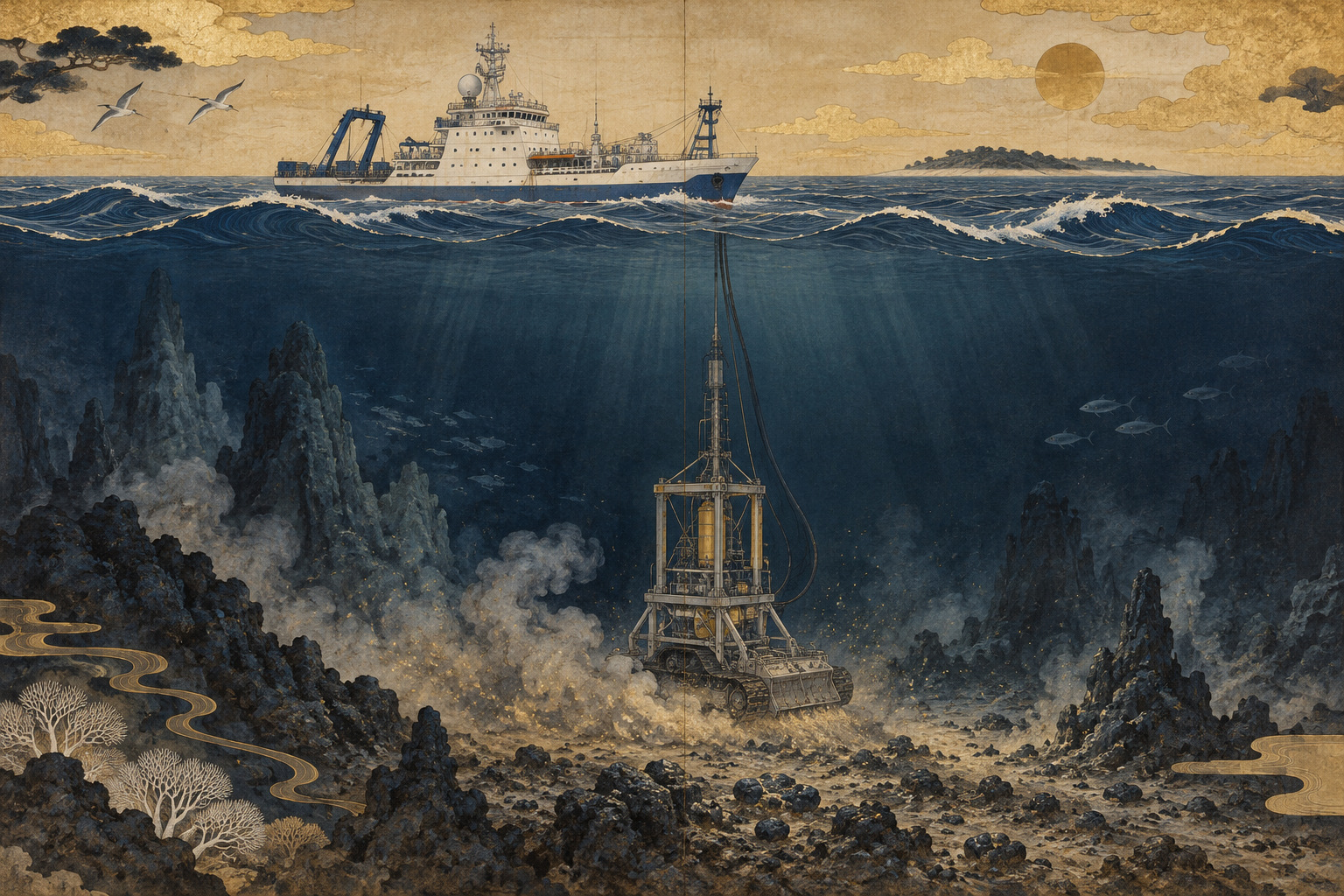
Fifty tonnes from six kilometres down
The cargo that came aboard Japan’s deep-sea research vessel was not a glittering collection of rare-earth metals. It was sediment mixed with seawater. But its recovery transformed an alluring geological proposition into a measurable engineering achievement. On July 24, the Japan Agency for Marine-Earth Science and Technology (JAMSTEC) reported recovering approximately 50 tonnes of rare-earth-bearing mud during a January–February 2026 trial near Minamitorishima, calculating the weight after excluding water added in the collection process.
This was not 50 tonnes of refined metal, nor an annual production rate. It was the amount of sediment recovered in a trial. That distinction frames the entire story: Japan has demonstrated an important piece of a supply chain that has yet to be built.
What the ship actually accomplished
The exercise was a system-connection test at approximately 6,000 metres depth, using the deep-sea scientific drilling vessel Chikyu. Recovery work began on January 30, and the first mud reached the ship early on February 1. The July report added sample composition and results from environmental monitoring.
The test addressed whether equipment could be lowered, connected and operated at extraordinary depth, and whether sediment could be brought to the surface. Commercial production requires far more: continuous operations, maintenance, transport, dehydration, chemical separation, refining, reliable output and a credible balance sheet.
An island with an unusually consequential seabed
Minamitorishima is a remote Japanese island administered as part of Tokyo’s Ogasawara Village. Its surrounding exclusive economic zone contains deep-sea sediments enriched in rare-earth elements. Researchers have explored their distribution through geological cores, surveys and laboratory analyses over years, not through a sudden 2026 discovery.
JAMSTEC researchers describe a geological history involving ocean circulation, biological productivity and sedimentation over immense spans of time. The resource is not simply ore beneath the island. It lies under deep water in the surrounding seabed, where distance and pressure determine whether it can ever become economically usable.
The engineering problem is a six-kilometre pipeline
The system builds on riser technology used in offshore oil and gas drilling, modified into a closed-circulation approach. A seabed collector disturbs and gathers the mud; the system is designed to move the resulting slurry up to the vessel while limiting the escape of suspended particles.
That architecture creates its own demands. Pipes and connections must tolerate the pressure and operating conditions; the vessel must maintain position; equipment must withstand wear; faults far below the surface are difficult and costly to diagnose. Proving each component over a short trial is different from proving that an integrated operation can run predictably for months.
The 54% figure that could easily be misunderstood
JAMSTEC found that roughly 54% of the rare-earth elements measured in the recovered mud belonged to the middle-to-heavy rare-earth group, including yttrium, gadolinium and dysprosium. It emphatically does not mean that 54% of the mud was rare-earth metal. The percentage describes the composition of the rare-earth fraction.
That chemical profile matters because some of these elements are important in high-performance industrial magnets and advanced technology. Yet a commercially useful product must still be separated, purified and refined from sediment. Recovery yields, reagent requirements, energy consumption and final specifications will help decide whether this is a competitive source.
Why Japan cares: an old supply-chain wound
Japan’s focus on rare earths predates this voyage. The supply shock and diplomatic tensions of 2010 demonstrated how quickly concentrated processing and export channels could become a strategic vulnerability. Since then, diversification, recycling, substitution and materials efficiency have become recurring policy and corporate themes.
Deep-sea extraction offers a possible additional route, not a substitute for all those measures. Having a domestic seabed source does not establish independence if processing capacity, equipment or key chemicals still depend on vulnerable external suppliers. The chain must be assessed as a chain, not merely as a mine.
An environmental result is not an environmental clearance
JAMSTEC deployed the seabed monitoring system COEDO, environmental-DNA sampling equipment and a hydrophone, alongside shipboard biological assays and remotely operated observations. The agency said the trial’s bioassay suggested a low risk of mineral-derived environmental contamination under the conditions observed. It also said the analysis of monitoring data and samples was continuing.
These are valuable initial measurements, but they do not establish that continuous commercial extraction would be harmless. Sediment disturbance, impacts on bottom-dwelling organisms, ecological recovery, noise, vessel activity and cumulative effects require study at the scale and duration of eventual operations. Independent scrutiny and publicly interpretable monitoring results are necessary to assess the trade-offs.
From the trial vessel to a factory: the missing middle
The next major step is planned for February 2027: an approximately month-long mining trial at the same site. JAMSTEC envisages transporting slurry to Minamitorishima, bringing it ashore and dewatering it into “mud cake.” It would then travel to mainland Japan for process testing covering separation, purification and smelting/refining. Logistics, including personnel transport, are part of the plan.
An overall assessment, including economics, is scheduled by March 2028. That date is not a confirmed start of commercial mining. It is a deadline for evaluating whether the proposed industrial system can make technical, environmental and financial sense.
The economics no laboratory assay can settle
A marketable rare-earth material must carry the costs of ship deployment, energy, marine equipment, replacement parts, weather downtime, crew, island handling, bulk transport, dewatering, reagents, waste management and monitoring. Some elements command substantial strategic value, but valuable chemistry does not by itself make a mine profitable.
Public results from the 2026 test do not provide a verified commercial annual output, full cost per kilogram, project net present value or return on private investment. Claims of a near-term industrial gold rush need to specify assumptions about extraction rates, recovery efficiencies, commodity prices and public support.
A different legal geography from the high seas
The Minamitorishima trial site lies in Japan’s exclusive economic zone. An EEZ gives the coastal state sovereign rights for resource exploration and development, subject to applicable international law; it is not the same thing as territorial waters. That distinction is important when discussing who can regulate or authorize operations.
Japan’s marine policy documents also recognize the formidable logistics of a remote island and call attention to environmental and social considerations. The project is as much a governance test—transparent evidence, public expenditure and enforceable safeguards—as an engineering one.
The questions to ask before calling this a supply-chain breakthrough
For executives and investors, the critical metrics now are sustained mud-recovery throughput, equipment uptime, separation recovery and purity, energy and reagent needs, transport costs, environmental baseline measurements and credible cost comparisons against existing suppliers. For researchers, the ecological monitoring and geochemical data may be as consequential as the tonnage.
The achievement is tangible: sediment was lifted from extraordinary depth using a purpose-built system. The open question is whether the Japanese state and industry can turn this experimental success into an affordable, accountable and environmentally defensible end-to-end supply chain. The next decisive milestone is not another dramatic image of a vessel at sea. It is evidence that the entire system works.
Sources and further documentation
- JAMSTEC, July 24, 2026: connection test results
- JAMSTEC, February 2, 2026: first mud recovered
- JAMSTEC, December 23, 2025: test plans and objectives
- JAMSTEC, December 12, 2025: geological history and technical challenges
- JAMSTEC BASE, July 8, 2026: geology of rare-earth mud
- Cabinet Secretariat: Japan marine development strategy
- JAMSTEC, October 18, 2022: earlier sediment lifting test
Document verification cutoff: October 12, 2026. Later developments are not included.