- The Milky Way, star by star—but not a photograph of the sky
- Five trillion particles and a performance barrier broken
- The hardest part was not simply gravity
- The road from a 2023 experiment to exascale astronomy
- What a finer model might tell us about our galaxy
- What “highest resolution” does—and does not—mean
- A global supercomputer project with Japanese scientific leadership
- The beautiful picture is not the test
- A new instrument for questions we could not afford to ask
The Milky Way, star by star—but not a photograph of the sky
Imagine trying to follow the history of the city you live in by tracking every resident, every road and every storm over hundreds of millions of years. That is roughly the scale problem faced by astronomers who want to understand the evolution of our home galaxy. A galaxy is not just a collection of bright points. It is a system of stars, moving gas, exploding stellar remnants and an enormous unseen gravitational component.
On November 18, an international team led by researchers at the University of Tokyo announced a Milky Way simulation with up to five trillion computational particles. The team presented its results at SC26, the international supercomputing conference in Chicago, after developing a method capable of running efficiently across three different exascale GPU systems. University researchers describe it as the highest-resolution simulation of the Milky Way in its class.
The achievement is about the scale and computational feasibility of a model. It is not a literal photograph of the Milky Way from outside, nor has every synthetic star been individually matched to a catalogued real one. That distinction is essential: a more detailed experiment in a computer opens new scientific tests; it does not by itself solve the history of the galaxy.
Five trillion particles and a performance barrier broken
The University of Tokyo says earlier Milky Way simulations of this kind had generally been limited to about a billion particles. The new work reaches a maximum of five trillion computational particles representing the galaxy’s stellar, gaseous and dark-matter components. The particle count should not be confused with the number of actual stars the team claims to have discovered.
The implementation ran on Frontier and Aurora in the United States and JUPITER Booster in Germany—machines using GPUs from three different vendors. In the largest reported run, throughput reached 144 billion particles per second. The university says a calculation approximately 100 times larger than the previous class could be completed in less than 20 days. Those figures describe specific benchmarks and configurations, not a guarantee of identical performance for every astrophysical problem.
Why does portability matter? Supercomputers are rare and expensive. A research code tuned to only one processor generation can become obsolete while the underlying scientific questions remain unanswered. A method that performs across multiple GPU families could make long-running observational comparisons more durable.
The hardest part was not simply gravity
Gravity shapes spiral arms and stellar orbits, but galaxies also respond to gas turbulence, radiative cooling and the violent aftermath of supernovae. When a massive star explodes, fast-moving material drives a shock through nearby gas. The shock can disrupt a cloud, stir turbulence and sometimes help set the conditions for later star formation. Leaving that process out would risk making a beautiful but physically incomplete galaxy.
The challenge is computational time. A whole galaxy changes over millions of years, but a supernova remnant can change rapidly on a local scale. If the numerical calculation is forced to follow every short physical interval in every tiny region, one small part of the model can dictate how long the entire computation takes.
The team used an AI surrogate model to approximate the expanding gas response after supernova explosions. In the reported design, that avoids extremely short local time steps and improves efficiency. This is not generative AI inventing an astronomical picture. It is a learned approximation for a defined physical subproblem inside a larger numerical simulation. Its accuracy remains subject to validation, just like any other approximation in a scientific model.
The road from a 2023 experiment to exascale astronomy
The 2026 result has a history that makes it more significant than a one-day supercomputer headline. In October 2023, University of Tokyo researchers including Keiya Hirashima, Michiko Fujii and Kana Moriwaki reported a deep-learning technique for reproducing the evolving shells of supernova explosions. The project identified a computational bottleneck and explored replacing expensive repeated calculations with a trained predictor.
In November 2025, the team and collaborators reported major progress using Japan’s Fugaku supercomputer and AI to push Milky Way modeling toward individual-star resolution. University material described an approximately 300-billion-particle run, while a RIKEN account discussed simulations representing more than 100 billion stars. These are related but differently defined quantities: total simulation particles are not identical to individually modeled stars.
The 2026 advance extends that research into much larger calculations and demonstrates strong execution on different systems abroad. That continuity—from a particular physical shortcut, to a large Japanese machine, to a multi-architecture exascale experiment—is the story behind the record.
What a finer model might tell us about our galaxy
The Milky Way has a disk, a central bar, complex stellar streams and a history shaped by accretion and internal evolution. Astronomers study stellar motion, chemical composition and ages to reconstruct that history. A simulation can explore which physical assumptions would produce structures resembling those that telescopes measure.
At finer resolution, investigators can ask more precise questions about where stars form, how stellar populations disperse, whether the galactic disk thickens and how supernova-driven gas affects the large-scale pattern. These are examples of scientific tests enabled by detailed models, not discoveries that this single conference paper has already confirmed.
Observations offer a reality check. The key next step, according to the university, is to compare the synthetic galaxy with observations of the Milky Way and other systems. Agreement may strengthen a physical explanation; disagreement may show where assumptions about stellar feedback, dark matter or numerical approximations need revisiting.
What “highest resolution” does—and does not—mean
In a galaxy simulation, resolution concerns how finely mass and dynamical processes are represented. It is different from the number of pixels in a publicity image or the angular resolution of a telescope. Claims of a world record therefore depend on which kinds of Milky Way models and resolution measures are being compared. The university characterizes the result as the highest-resolution simulation in this research class; the article does not independently rank every possible galactic model.
There are trade-offs. Replacing detailed supernova evolution with an AI surrogate can improve speed, but the approximation must remain accurate across the range of interstellar conditions encountered. More particles can also expose modeling choices that were less apparent in coarse simulations. Numerical convergence, validation against independent calculations and comparison with the sky remain crucial.
The study is included in the SC26 proceedings under the title “Architecture-Agnostic Exascale Star-by-Star Simulation of Our Galaxy.” It was selected as a finalist for the ACM Gordon Bell Prize. Finalist status is not an award, and computational distinction is not the same thing as an observational discovery.
A global supercomputer project with Japanese scientific leadership
The collaboration includes University of Tokyo professor Michiko Fujii, visiting researcher Keiya Hirashima, assistant professor Kana Moriwaki, project researcher Naoto Harada and other specialists associated with the university’s Information Technology Center. Researchers from Kobe University, Hokkaido University, the University of Tsukuba, Tohoku University of Community Service and Science and the University of Barcelona also contributed, alongside additional collaborators named in the SC26 paper.
No single component could have delivered the result. Astrophysicists defined the stellar and gas processes worth representing; numerical specialists designed algorithms that could handle enormous particle populations; computer scientists and GPU experts made the implementation scale. Using major computing systems in the United States and Germany also illustrates that the accomplishment is international, even though Japanese institutions drove the astronomical research.
“Architecture-agnostic” does not mean that specialized GPU work becomes unnecessary. It means the research aims for a code and approach that can be effective beyond one machine architecture. That may prove valuable as scientific computing shifts among competing hardware designs.
The beautiful picture is not the test
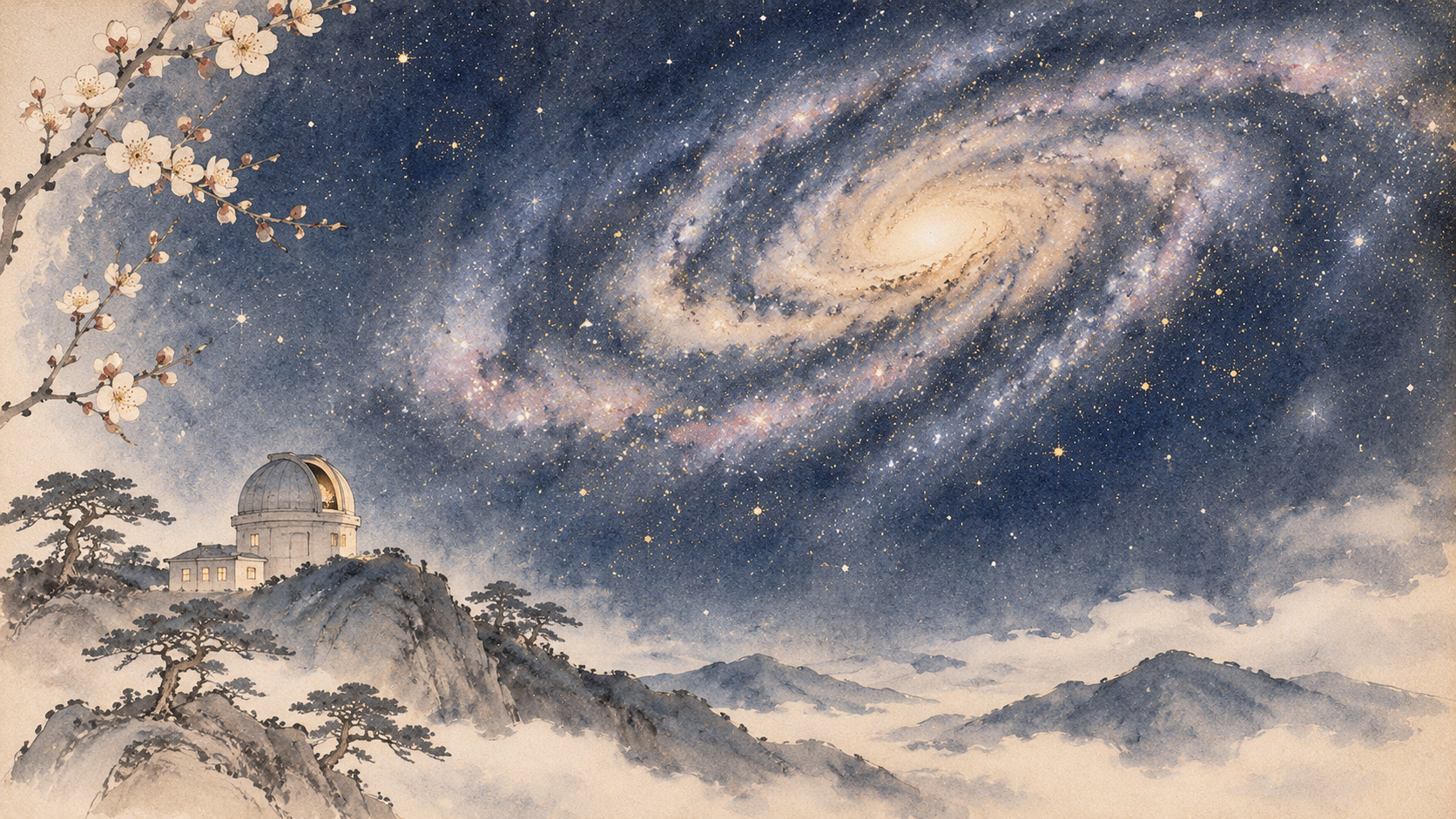
There is an understandable temptation to judge a simulation by a cinematic spiral galaxy. Visualizations help researchers see patterns and communicate results, but colors and brightness are choices made to display numerical data. They should not be mistaken for a camera view of our galaxy. The accompanying JAPAN.co.jp illustration, inspired by the historical painter Noguchi Shōhin, is a separate editorial interpretation—not footage or imagery produced by the researchers.
The meaningful comparisons are measurable: distributions of star positions and velocities, patterns of stellar populations, gas structure and their changes under different assumptions. How robust are those outcomes when the surrogate model is modified? Does the apparent agreement persist when numerical resolution changes? Can competing models be distinguished against observational uncertainties?
These questions can seem less spectacular than five trillion particles, but they define the boundary between computational power and new knowledge. The true payoff would be a model that makes specific, falsifiable predictions about the galaxy’s evolution.
A new instrument for questions we could not afford to ask
Researchers increasingly combine physical equations, learned shortcuts and high-performance computers to tackle problems with huge differences in scale. The Milky Way project shows why this combination can be attractive: it spends the most expensive direct calculation where it is necessary and uses a surrogate where a carefully evaluated approximation can suffice. The university suggests the method may inform simulations in fields beyond astronomy, but equivalent speedups elsewhere have not been demonstrated in this announcement.
The advance remains an enabling technology rather than the final word on galactic origins. Independent verification of the numerical approach, carefully documented uncertainty and direct comparisons with telescopic observations will determine its scientific reach.
The Milky Way is the galaxy in which we live, yet understanding its past requires the ability to test an extraordinary number of interacting processes. This new generation of simulations does not hand us the finished story. It offers a more powerful way to ask what happened—and to discover where our explanations fail.
Primary sources and reporting limitations
This independent analysis checks the University of Tokyo’s November 18 announcement and SC26 record against the team’s earlier 2023 and 2025 research. We did not rerun simulations, audit raw data, or interview the researchers. The superlative resolution claim is attributed to the research institutions. Gordon Bell Prize finalist status is not presented as a win.
- University of Tokyo School of Science: Nov. 18, 2026 research announcement
- University of Tokyo Information Technology Center: methods, team and publication
- SC26: Architecture-Agnostic Exascale Star-by-Star Simulation of Our Galaxy
- University of Tokyo: 2025 AI/Fugaku Milky Way simulation
- RIKEN: 2025 star-by-star simulation project
- University of Tokyo: 2023 AI surrogate for expanding supernova shells
- University of Tokyo: 2026 Gordon Bell Prize finalist announcement
- University of Tokyo ITC: SC26 presentation schedule