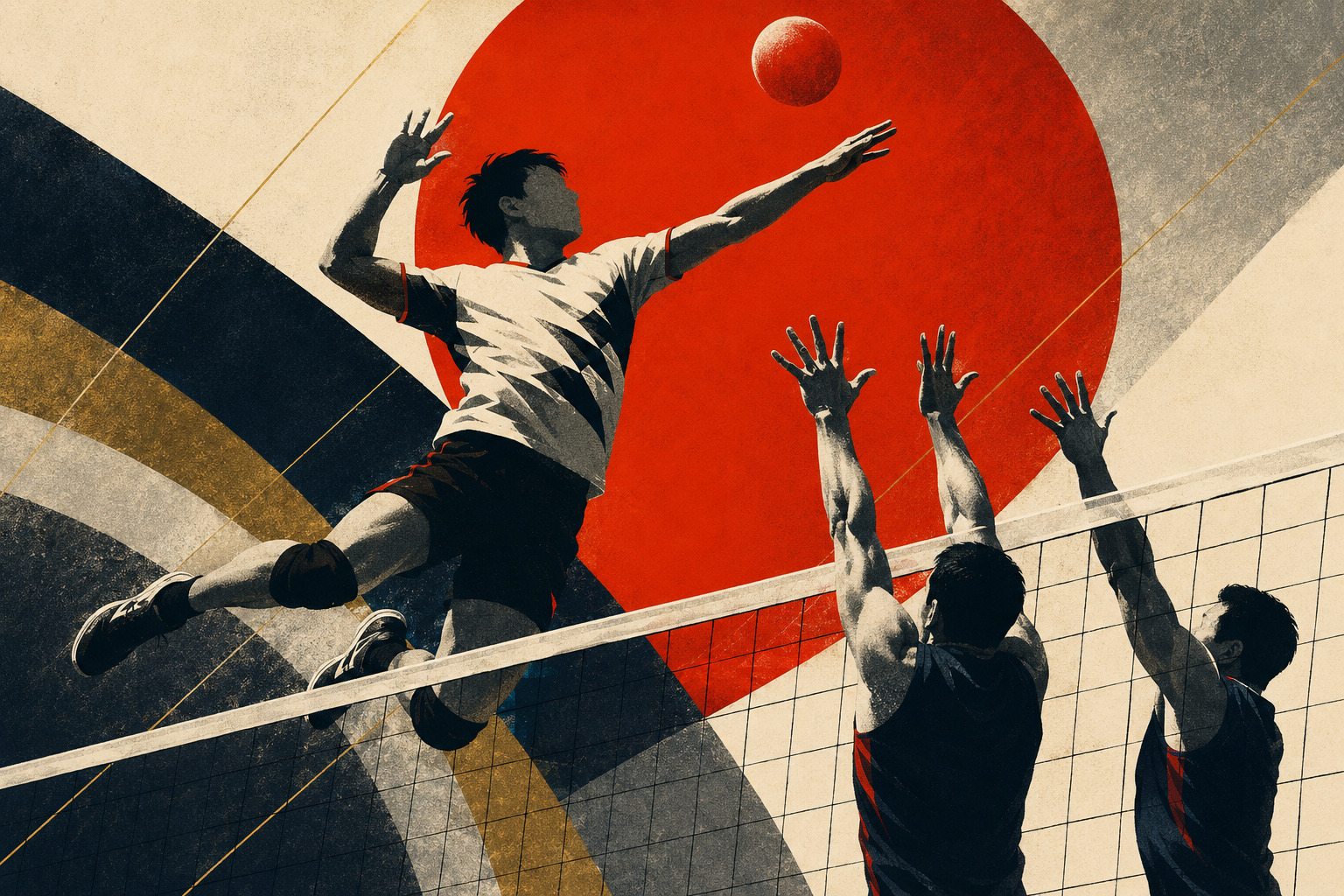
The server sends the ball upward. For an instant, the 36 square metres on Japan’s side of the court become one of the smallest, least forgiving spaces in sport. The American serve reaches the receiver in less than a second. A controlled pass leaves the setter with the middle, both pins and a back-row attack. A broken pass erases those futures one by one.
That first contact will shape the 2026 men’s Volleyball Nations League semifinal between Japan and the United States. Japan arrives with 13 wins from 13 matches. The Americans arrive after sweeping reigning world champion Italy. From a distance, it is undefeated precision against sudden momentum. Up close, the contest is more exact: Japan wants to use defense and ball control to keep building rallies; the United States wants its serve to narrow Japan’s offense before a rally has properly begun.
The teams have already met. On June 27 in the heat of Orléans, France, Japan prevailed 3–2: 18–25, 25–21, 20–25, 25–22, 15–13. The United States led 69–66 in attack points and 9–4 in blocks. Japan served one more ace, committed four fewer errors and owned the last two-point margin. No single overwhelming statistic decided the match. Japan was simply more precise when the available court became smallest.
Thirteen wins, but never a straight road
An unbeaten record can conceal how close defeat has come. Japan’s 12 preliminary-round victories were not a procession of easy evenings. During week two in Orléans, Japan defeated Serbia and then went five sets on three consecutive days against Iran, the United States and France. The French match went furthest into danger. Japan lost the first two sets and saved three match points in the fourth before escaping 28–30, 19–25, 25–17, 35–33, 15–12.
In Osaka, Japan edged world champion Italy in five and then recovered from two sets down against Canada. By the end of the Canada match, Japan was 10–0 and six of those wins had required a deciding set. Captain Yuki Ishikawa also passed 1,000 career VNL attack points that day. The perfect record is not proof that Japan avoided distress. It is a record of repeatedly meeting distress and still finding the final two points.
That experience is strength, and it is also a warning. Repeated fifth sets develop late-match composure, but one sustained American service run can create a semifinal deficit that no amount of calm can recover. If Japan tries to defend the number 13, its movement may tighten. If it treats those 13 wins as preparation for a 14th, the streak becomes evidence rather than weight.
China exposed the problem—and Japan solved it
Host China took the opening set of the quarterfinal 25–23 in front of nearly 6,000 spectators. Japan had nearly erased a six-point deficit, but China’s middle attack closed the set. The standings—Japan first, China 18th—had no value in a knockout match.
Japan trailed 14–11 in the second set before Ran Takahashi and Yuji Nishida used the Chinese block to turn the score and finish 25–23. Japan controlled the third 25–16. In the fourth, China recovered to 23–23 before Japan secured side-out and Shoma Tomita ended the match with a 108.2 km/h ace. Takahashi led with 21 points and a 59 percent attack success rate. Larry Ik Evbade-Dan supplied five kill blocks in a 13-point performance; Nishida also scored 13 and Tomita added 10.
The distribution matters. Takahashi’s scoring, Larry’s net defense, Nishida’s side-out work and Tomita’s final serve gave China several different problems. Remove one answer and another appeared. When Laurent Tillie took over in 2025, he spoke of combining an established core with new talent. Against China, that idea became visible rather than theoretical.
The American serve comes as a chain reaction
The U.S. quarterfinal was a lesson in how the serve can restructure an entire match. Facing reigning world champion Italy, the Americans delivered six aces in the first set, five in the second and 14 in all. They won 25–22, 25–21, 25–21. The teams were almost level in ordinary frontcourt scoring: USA led attacks 39–38 while Italy led blocks 4–3. The serve created the separation. It broke Italy’s reception, reduced the available offense and made the next American block or defensive read easier.
Opposite Jake Hanes stood at the centre of it. His 21 points included six aces, 13 kills and two blocks. In the third set, his serving helped reverse a 10–15 deficit. Veteran Matt Anderson scored 15, Ethan Champlin 10, and setter Micah Christenson added two aces while directing a highly efficient attack.
Japan does not need to pass every serve perfectly. Chasing a perfect ball to the centre of the net can create an overpass and immediate punishment. A high, controlled pass around the three-metre line can preserve a hittable ball, even if the ideal quick attack disappears. The second set, the high-ball swing, the block-out and the cover must be treated as part of the planned offense rather than emergency improvisation.
| Pressure point | Japan’s preferred shape | USA’s preferred shape |
|---|---|---|
| Serve and reception | Accept an imperfect pass if it preserves several attacking choices | Use sustained power from Hanes, Anderson and Christenson to simplify Japan’s offense |
| Middle attack | Establish Larry and Akihiro Yamauchi early to hold the American middle blockers | Serve the middle out of the play and load the block toward Takahashi, Ishikawa or Nishida |
| Transition | Use Tomohiro Yamamoto and Tomohiro Ogawa to turn touches and digs into another attack | End long exchanges with height, back-row force and high contact points |
| After 20 points | Rely on the error control and multiple scorers seen against USA and China | Move the score two or three points at once with a service run |
Two coaches, two kinds of gold-medal memory
Japan coach Laurent Tillie and U.S. coach Karch Kiraly both know the Olympic summit, but from different routes. Tillie led France for nearly a decade and coached the country to its first men’s Olympic volleyball gold at Tokyo 2020. He also coached professionally in Osaka, giving him direct knowledge of Japan’s league, players and daily sporting culture.
Kiraly won indoor Olympic gold as a player at Los Angeles 1984 and Seoul 1988, then won beach gold at Atlanta 1996. He later coached the U.S. women to world and Olympic titles before taking charge of the men after Paris 2024. After the Italy quarterfinal, Kiraly called Japan a great team with “amazing defense and ball control” and remembered stretches of the June match when the United States found its own rhythm.
The semifinal is therefore more sophisticated than the old shorthand of Japanese speed against American height. Modern Japan has high contact points and dangerous servers; the United States has skilled floor defense and a fast offense. The difference is not which abilities each side possesses. It is which ability each coach uses first to remove the opponent’s options.
From 1964, 1968 and 1972 to a different kind of revival
Japan’s men opened their Olympic medal history with bronze at Tokyo 1964, climbed to silver at Mexico City 1968 and reached gold at Munich 1972. Japan beat the United States in the first two of those tournaments—3–1 in Tokyo and 3–0 in Mexico City. Working against a height disadvantage, the Japanese system refined speed, combinations and repeated movement until it became a force that helped change the sport’s tactical imagination.
The world then grew taller, more powerful and more professional. Japan disappeared from the Olympic podium, while the United States won gold in 1984, 1988 and 2008 and bronze in 1992, 2016 and Paris 2024. Kiraly played on the first two American gold-medal teams and now stands on the opposite bench.
Japan’s modern return did not happen in one summer. The 2023 VNL bronze was the men’s first medal at a major global competition in 46 years, since silver at the 1977 World Cup. In 2024, Japan reached a major final for the first time since that tournament and took VNL silver after losing 3–1 to France. Weeks later, the Paris Olympic quarterfinal became a different kind of landmark: Japan led Italy two sets to none and held three match points at 24–21 in the third, yet lost 3–2.
The climb remained uneven. Poland stopped Japan in the 2025 VNL quarterfinal, and Japan exited the 2025 World Championship in pool play. That is why 13 straight wins in 2026 mean more than nostalgia for 1972. The streak belongs to a team that has passed through the 2023 bronze, the 2024 silver, three match points that escaped in Paris and a difficult 2025. Its identity is built around what happens one rally after disappointment.
1964: Olympic bronze in Tokyo, at the first Games to include men’s volleyball.
1968: Olympic silver in Mexico City, including a straight-set win over USA.
1972: Olympic gold in Munich—still Japan’s most recent men’s Olympic volleyball medal.
2023: VNL bronze, Japan’s first major global men’s medal in 46 years.
2024: VNL silver; a five-set Olympic quarterfinal loss to Italy after three match points.
2026: A 12–0 preliminary round, victory over China and a 13-match winning streak into the semifinal.
Five moments that will explain the semifinal
- Hanes’ first service turn: Can Japan absorb changes in depth and pace while keeping the middle available?
- Japan’s first broken reception: Which setter option survives, and how quickly do the hitters prepare to cover?
- Ran Takahashi against the American block: Can he use hands, angles and soft shots instead of challenging height every time?
- Serving after 20: Does each coach accept more risk or put the ball in play and trust the defense?
- The first three points of a possible fifth set: Which team applies what it learned in June before the other can adjust?
Not the streak—the next ball
Thirteen victories have already made Japan’s 2026 season exceptional. Yet the semifinal begins 0–0. Japan cannot carry those wins onto the scoreboard, just as the United States cannot carry over its 14 aces against Italy. What remains is confidence, fatigue, memory and the information each team has revealed.
Japan must do more than “stop” the American serve. It must rebuild the attack after an ugly first contact. The United States must create bursts of points before Japan’s defense can extend the rally and recover its shape. Both teams know what the other intends. Their five sets in June removed much of the mystery. The rematch will expose the depth of their preparation.
Gold is the only VNL medal Japan’s men have not won. They do not need to imitate the champions of 1972. This team has Ishikawa and Takahashi’s complete wing play, the left arms of Nishida and Kento Miyaura, Larry’s emerging presence in the middle, two international liberos and the accumulated memory of all those fifth sets. It is trying to build a period that belongs to itself.
The toss goes up. There is less than a second. The 13-match streak falls silent, and only the next ball remains.
Reporting notes and sources
Information was checked through July 31, 2026, at 2:05 p.m. Japan time. The semifinal time converts USA Volleyball’s published August 1 start of 4:30 a.m. Pacific Daylight Time to 8:30 p.m. JST. Rankings, records, scores and player statistics are from the organizer and national governing bodies.
- Volleyball World: Japan–China VNL quarterfinal report
- USA Volleyball: USA–Italy quarterfinal and semifinal time
- USA Volleyball: June 27 Japan–USA report and statistics
- Volleyball World: Men’s VNL Finals preview and preliminary standings
- Volleyball World: Japan’s 2026 VNL roster
- Volleyball World: Canada comeback and Ishikawa’s 1,000 VNL attack points
- Volleyball World: Japan’s comeback against France
- FIVB: Japan’s historic 2024 VNL silver
- Volleyball World: Japan–Italy at the Paris 2024 Olympics
- FIVB: Japan’s 2025 World Championship pool-stage elimination
- FIVB: Japan men’s Olympic appearances and medals
- USA Volleyball: U.S. men’s Olympic history
- Volleyball World: Laurent Tillie appointed Japan coach