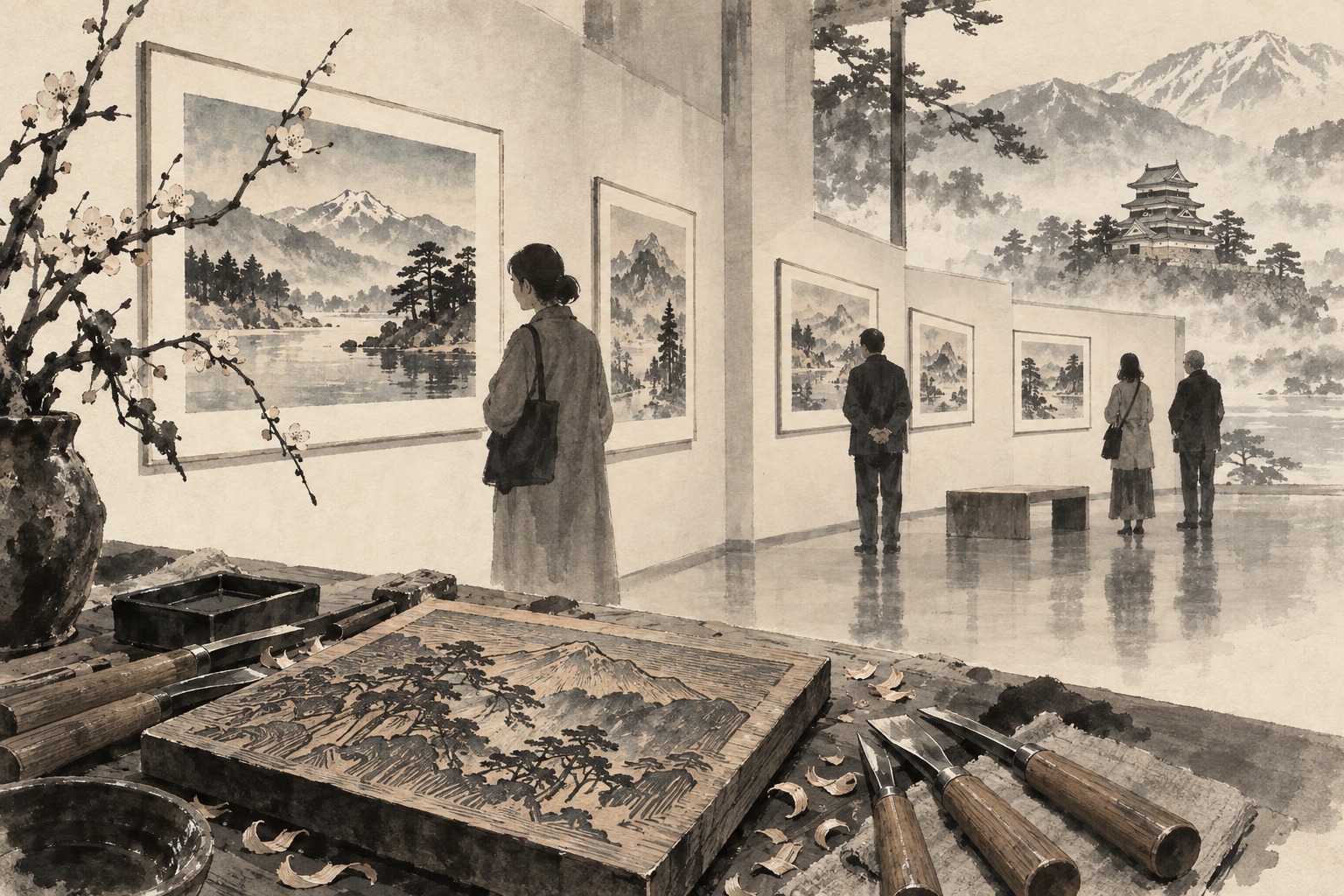
A new exhibition at Matsumoto’s Japan Ukiyo-e Museum traces how travel became landscape prints in the work of Kawase Hasui and Yoshida Hiroshi. “From Travels to Landscape Prints” runs from September 16 to December 20, examining the artists through their major series.[1]
Closed on September 24
The museum’s holiday notice says it opens September 21–23 and takes a substitute closure on Thursday, September 24—the date of this edition.[2]
From observation to a printed image
The museum places the artists within shin-hanga, the renewed woodblock-print tradition that flourished during the Taisho and Showa periods. Its focus is their use of travel and sketches as starting points for landscapes.[1]
The interesting question for viewers is what happens between seeing a place and making a print. Choosing a viewpoint, organizing shapes and deciding what to leave out all turn an observed scene into a constructed image. A familiar destination can be an entry point, but recognizing the location is not a prerequisite for looking closely.
The craft behind the artist’s name
The Adachi Foundation for the Preservation of Woodcut Printing describes traditional ukiyo-e as a collaboration among designer, carver, printer and publisher. Woodblocks, handmade Japanese paper and water-based pigments are integral to that process.[3] This is technical background, not a claim that every object in the Matsumoto exhibition was produced through an identical workshop arrangement.
For a visitor, it suggests a way to look beyond subject matter. Follow a contour, examine the boundary between two areas of color and consider how an image was transferred onto paper. The artist’s composition and the work required to realize it become connected questions.
Seen this way, renewal need not mean abandoning inherited methods. The exhibition offers a chance to consider how a traditional medium could carry an individual artist’s observation and reach another generation of viewers.
A continuing relationship with audiences
That relationship remains active today. In a separate contemporary practice, the Adachi Institute works with living artists using traditional woodblock techniques and presents the results internationally.[4] Its activity is not part of the museum exhibition, but provides a current example of preservation through new production.
The Matsumoto show offers a different kind of access: time with physical prints. For audiences accustomed to viewing art on screens, attending to paper and printed color can make craftsmanship more tangible.
Two displays, with a complete changeover
The first period ends November 1; the second runs November 3–December 20. The museum says every work will change between the two periods.[1] Anyone coming for a particular print should check its display dates rather than assume it remains on view throughout.
Regular hours are 10 a.m.–5 p.m., with last admission at 4:30 p.m. Standard admission is ¥1,000 for adults and ¥500 for junior-high, high-school and university students; elementary-school children and younger enter free. Mondays are generally closed, with holiday exceptions and substitute closures.[5] The specific September 24 notice takes precedence over the usual weekly pattern.
