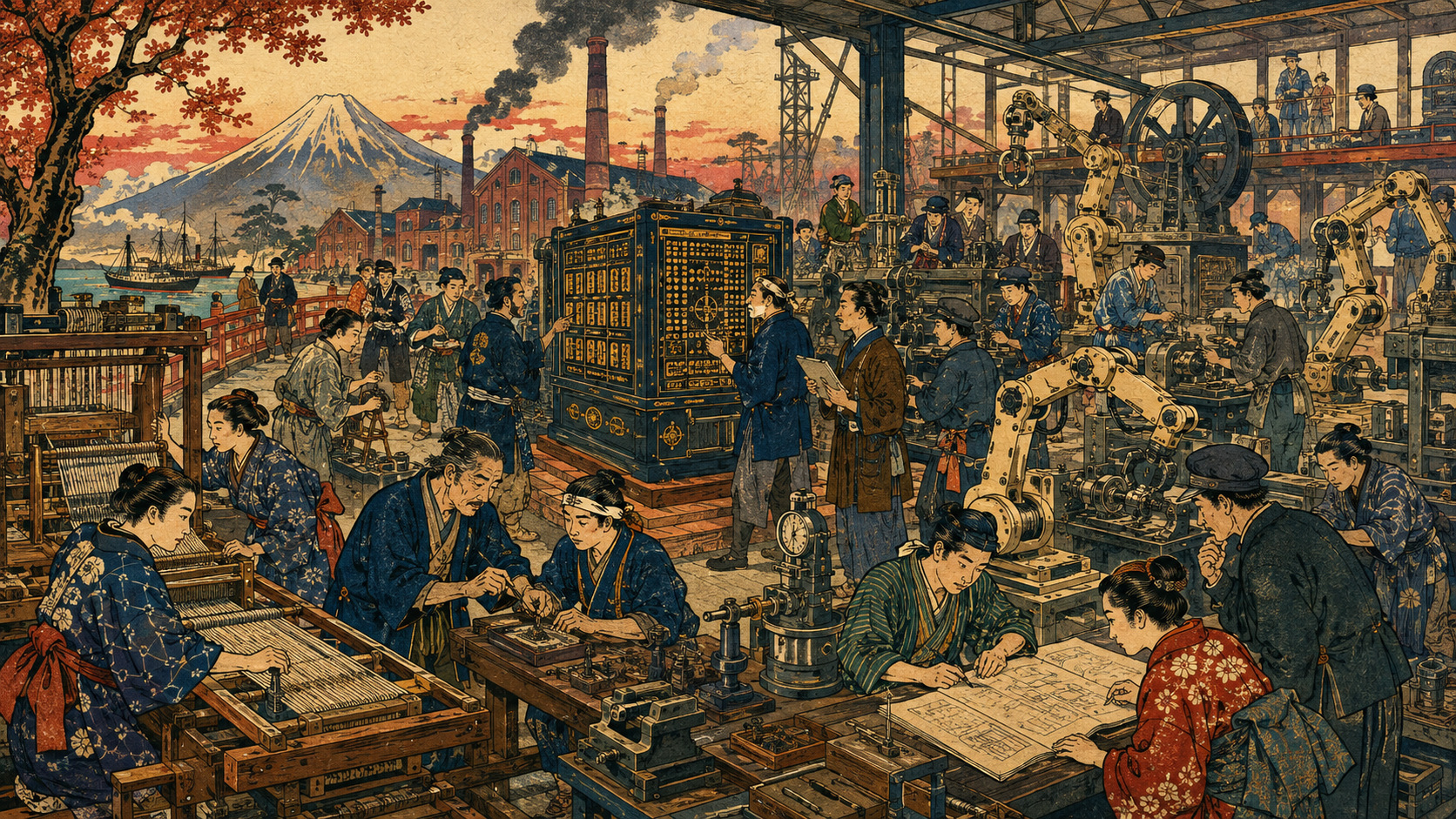
A veteran hears something change in the lathe before the instrument turns red. It could be a worn tool, a subtle variation in the metal or the beginning of a bearing failure. His hand adjusts the feed. The decision is not in the drawing. No operating manual fully explains it. Ask what happened and he may simply say, “The sound was different.”
Japan’s 2026 White Paper on Manufacturing Industries is, at its deepest level, a report on how little time remains to capture moments like this. Manufacturing employment slipped from 10.46 million in 2024 to 10.33 million in 2025. The number of workers aged 34 or younger fell from 3.84 million in 2002 to 2.58 million in 2025, while those aged 65 and older increased from 580,000 to 850,000. This is not merely a story about young people disappearing. The people, time, wages and data needed to pass skill from one generation to the next are all in short supply at once.
The white paper does not cast AI as a magical successor to the master machinist. It organizes policy around three connected themes: capital investment, AI and digital transformation, and economic security. Its signature proposal is a Manufacturing AX hub that would gather scattered factory data and support manufacturing platforms powered by shared AI. The harder message comes first: before buying AI, a company must decide what to measure, who acts on the result and how that action returns value to the business.
A report to Parliament, not a factory league table
The 2026 edition was approved by the Cabinet on May 29. Its formal Japanese title means “Measures to Promote Core Manufacturing Technology in Fiscal 2025.” The Ministry of Economy, Trade and Industry, the Ministry of Health, Labour and Welfare, and the Ministry of Education, Culture, Sports, Science and Technology prepared it jointly. Across 273 pages, the report joins business conditions and production to employment, education, research, capital spending, AI and economic security.
Its authority comes from the 1999 Basic Act on the Promotion of Core Manufacturing Technology. The law’s preamble already warned of a declining manufacturing share, industrialization overseas and the growing difficulty of transmitting skill. Article 8 requires the government to report every year to the Diet. Twenty-six reports have followed since 2001. The vocabulary has changed—from hollowing-out and globalization to DX, green transformation and economic security—but the core insight remains: productive capability lives not only in machinery, but also in people, supplier relationships and regional industrial clusters.
Monozukuri is a capability, not a national virtue
The word monozukuri is often made to carry an entire moral universe: craftsmanship, patience, pride, quality and devotion to detail. The legal definition is less romantic and more useful. It concerns broadly applicable technologies involved in designing, manufacturing or repairing industrial products. Its orbit includes software, design and mechanical engineering. The skilled hand, the engineer who designs the process, the maintenance record and the supplier consultation are all parts of manufacturing capability.
That distinction matters. Romanticizing dedication can preserve low pay, excessive hours and knowledge that remains trapped in one person’s intuition. In the white paper’s survey, raising wage levels was the most common retention measure, cited by 71.5 percent of companies. Improvements to air conditioning, lighting, noise and other working conditions also ranked highly. Respect for skill must be paid in wages, equipment and learning time. It cannot remain a speech about spirit.
1872: Tomioka began as an imported factory
Japan’s modern industrialization did not emerge from technological self-sufficiency. The government-run Tomioka Silk Mill, which began operating in 1872, imported French machinery and expertise. It connected silkworm eggs, sericulture, mechanized reeling and training in a single system. The objective was to make the quality and volume of raw silk predictable, earn foreign currency and diffuse the methods to producers across Japan. UNESCO describes Tomioka as a decisive center of innovation that helped Japan become the world’s leading exporter of raw silk.
The pattern recurs throughout Japan’s industrial history. Import a machine. Learn its operation. Adapt it to local constraints. Standardize the process. Train people and spread the practice. AI adoption in 2026 is another technology-transfer problem. Purchasing a model or a cloud subscription does not make it an internal capability. That happens only when a company understands its data, embeds the tool in the process and can improve it repeatedly.
Iron, ships and coal: the ability to make became state power
Twenty-three sites associated with the Meiji industrial revolution—including steelmaking, shipbuilding and coal mining—record how Japan transferred Western technology and adapted it between the mid-19th and early 20th centuries. Steel was the industry beneath other industries: railways, ships, machines, buildings and weapons. Manufacturing capacity was inseparable from transport power and military power.
That success also became entangled with empire and war. Technical capability is not automatically virtuous. A factory can make tools that improve life or weapons that destroy it. Economic security has returned to the center of manufacturing policy in 2026, making an old question urgent again. Japan must decide not only which capabilities it needs at home, but also the purposes and limits of those capabilities.
1950: quality moved from the master’s eye to a statistical system
After the war, Japanese goods often carried a reputation for low price and unreliable quality. One turning point came in 1950, when the Union of Japanese Scientists and Engineers invited the American statistician W. Edwards Deming to teach statistical quality control to executives, engineers and researchers. The Deming Prize followed in 1951. Quality began to move from a final inspector’s task of rejecting defective goods toward an organization-wide discipline for controlling variation.
Statistics did not abolish craft. It made observation reproducible. Measure, propose a cause, change the process and test the result. The cycle resembles modern machine learning, but computing speed is not the decisive issue. The question is whether the factory produces meaningful data and whether management can turn a numerical signal into changed behavior.
The Toyota Production System was more than an inventory technique
The Toyota Production System rests on Just-in-Time and jidoka, often rendered as automation with a human touch. Kiichiro Toyoda’s insistence that necessary parts arrive when needed and Sakichi Toyoda’s work on looms that stopped when something went wrong were translated into postwar automobile production by Taiichi Ohno and others. The system’s foundations were laid through trial and error in the late 1940s and 1950s, expanded across Toyota plants from 1960 and spread to suppliers from the late 1960s.
It is misleading to treat the system as a contest to eliminate inventory. It is an information architecture designed to expose rather than conceal abnormality. A downstream process withdraws what it needs; a machine or worker stops when a defect appears; a visible signal calls help while the problem is still small. Andon lights and kanban cards were a real-time data system built from paper and lamps. An AI factory should learn the same lesson: predictive accuracy matters less than the closed loop determining who receives a warning, who can stop production and how the result returns to learning.
1973: the oil shock converted efficiency into strategy
The oil shocks exposed the weakness of an industrial country poor in natural resources. Japanese companies invested in fuel switching, waste-heat recovery, lighter products, shorter processes and tighter materials management. A defensive response to scarcity became a long-lived source of lower costs and product innovation.
Risk-management investment in 2026 faces the same test. Semiconductor plants, battery supply, critical-mineral stockpiles, cyber defenses and domestic production sites cannot survive forever on the argument that security justifies any cost. They must also improve yield, speed, energy efficiency or revenue in ordinary times. Otherwise the capability will decay as soon as public support ends.
1988: the next weakness was already inside the triumph
Japanese companies dominated automobiles, consumer electronics, machine tools, precision equipment and semiconductors. Their share of global semiconductor sales reached 50.3 percent in 1988. By 2019 it had fallen to about 10 percent. The center of competition moved from memory-chip volume and manufacturing yield toward design, software, standards, foundry specialization and platforms.
The cliché that Japan excels at making but not conceiving explains too little. U.S.-Japan trade friction, the strong yen, overseas production, the collapse of the asset bubble, prolonged stagnation and restrained capital spending all overlapped. A factory can improve every day while the architecture of an industry shifts value somewhere else. AI creates the same danger. If Japan optimizes the shop floor but surrenders models, cloud infrastructure, data standards and customer relationships, it can once again do the difficult manufacturing while someone else captures the margin.
A strong shop floor and weak investment
During decades of slow growth, Japanese companies learned to extract more output from existing equipment through care and incremental improvement. That is a real strength. It also left legacy core systems, isolated data and aging machines that should have been replaced. Continuous improvement sometimes became a rationale for postponing discontinuous renewal.
The white paper finds that manufacturers with EBITDA margins of at least 10 percent are more likely to invest in labor-saving equipment, added capacity, legacy-system replacement and both tangible and intangible assets. They also tend to record higher labor productivity and wage growth. This does not prove that investment automatically creates profitability. Profitable companies can afford investment, and investment can reinforce profitability. Companies outside that cycle often spend only enough to keep old systems alive. The policy challenge is not merely to accelerate firms already in front, but to lower the fixed cost of entry for those left behind.
| The divide | Reinforcing cycle | Declining cycle |
|---|---|---|
| Equipment | Automation, expansion and renewal | Repairs and minimum maintenance |
| Data | Connected across processes and decisions | Isolated by machine and department |
| People | Paid time for learning and teaching | Too busy to teach; experienced staff leave |
| Profit | Higher value supports reinvestment | Price competition removes investment capacity |
Productivity is not a verdict on worker effort
In a detailed explanation of the white paper, METI’s manufacturing strategy chief said nominal labor productivity per worker in Japanese manufacturing was about $75,000. That was roughly one-third of the U.S. level of $226,000, about 70 percent of Germany’s $117,000 and 20th among 34 OECD countries. Manufacturing remains more productive than many Japanese domestic industries. Its weak international value nevertheless reflects more than the exchange rate: it also captures industrial mix, pricing power, capital intensity and the thickness of high-value sectors such as aerospace, semiconductors and software.
Productivity is not simply the number of screws a worker tightens in an hour. It includes product price, brand, design, services, intellectual property, utilization and management’s allocation of capital. Telling the line to move faster will not necessarily create more dollar-denominated value. The strategic task is to make something that sells for more in the same hour and return the gain to people and equipment.
2040: four million missing, 4.4 million surplus
METI’s employment-structure scenario estimates a manufacturing labor shortage of about four million people by 2040. It projects shortages of around two million in production work and 3.4 million people able to use AI and robotics, while clerical occupations could have a surplus of approximately 4.4 million. These categories should not be added mechanically, but the shape of the problem is unmistakable. Japan faces not just fewer workers, but a mismatch between the location of people and the skills required.
A crude instruction to transfer office staff to factories will not solve it. Companies must design roles that translate between the physical process and the digital system: process analysis, quality data, procurement, maintenance, customer service and AI operations. Foreign workers accounted for a rising 6.1 percent of manufacturing employment in 2025. Treating them as temporary plugs wastes capability. Training, safety, language support and promotion must become part of a long-term skill system.
The greatest shortage in skill transfer is the teacher
Among manufacturing establishments reporting problems with workforce development, 62.8 percent said they lacked people able to instruct, 54.4 percent said workers left after being trained and 45.4 percent lacked time to train. The most common skill-transfer measure, cited by 54.8 percent, was keeping older employees through reemployment or extended service. That buys time, but moving a retirement date does not by itself move knowledge.
The white paper highlights Sanfu Seimitsu, a Yamagata metal processor that links skills tests and allowances to a personnel system that rewards veterans for teaching and younger workers for expanding what they can do. Kiryu Meiji, a precision-parts company in Gunma, created an internal technical university, broadened learning from production flows to quality and cybersecurity, and made skill levels visible in eight stages. Their shared innovation is not simply filming a veteran. It is turning teaching from an after-hours favor into recognized work.
- Outcome: Keep good parts, defects, yield and downtime.
- Conditions: Synchronize temperature, vibration, tool, material lot and work sequence.
- Decision: Record who saw which signal and what was changed.
- Reason: Explain the rejected alternatives and the safety boundary.
- Learning: Let a trainee reproduce the work, fail safely and receive feedback.
Seven in ten collect data; only four in ten realize benefits
About 70 percent of manufacturers collect production-process data. Roughly half use data or digital technology, and only about 40 percent report obtaining benefits. Two cliffs separate sensor installation from business value. Timestamps and units do not match. Machine identities are not linked to product lots. No one owns the response to a prediction. Maintenance has no budget even when a warning is accurate. The model may work while the process remains unchanged.
The leading AI barriers were obtaining knowledge and know-how, cited by 57.2 percent of surveyed companies, and securing people for implementation, cited by 47.9 percent. Unclear benefits followed at 28.9 percent, investment cost at 27.4 percent and difficulty connecting legacy systems at 26.0 percent. The constraint is less a shortage of impressive models than a shortage of capability to design adoption as a management project.
Among companies that consciously treated geopolitical risk as a management issue, 32.3 percent had formulated an AI or DX strategy. The rate was 10.6 percent among companies that did not. Risk awareness can unlock investment, but fear is not a strategy. “Install AI” must be translated into a measurable question: reduce unplanned downtime by a certain percentage, cut inspection escapes to a defined level, or shorten quotation time by a set number of hours.
Manufacturing AX: turning isolated machines into a learning resource
The white paper’s Manufacturing AX hub would gather and integrate machining, operating and quality data from factories, then support development of manufacturing platforms containing AI models. The aim is to let smaller firms without teams of data scientists or large computing budgets use capabilities such as failure detection, optimal equipment placement and quality improvement.
The proposal moved toward implementation in July, after the white paper’s publication, when the National Institute of Advanced Industrial Science and Technology announced a virtual hub. Two joint proposals—DMG Mori with WALC and AIST, and Komatsu with AIST—were selected through the GENIAC program to build a manufacturing-data ecosystem. This is a subsequent development, not an achievement recorded in the May report. Its success will depend less on the number of connected machines than on contracts, standards and benefit-sharing that let companies contribute data without surrendering competitive secrets.
Japan’s legacy equipment contains a weakness and an opportunity. Much of it is difficult to network, yet it embodies long operating histories and a wide range of failure experience. Retrofitted sensors, maintenance records and veteran judgment could turn delayed replacement into unusually deep training data. But scanning a paper diary does not automatically give an AI the context needed to understand it.
Why does a robot superpower still lack labor?
According to the International Federation of Robotics, Japan installed 44,500 industrial robots in 2024 and had 450,500 operating units. It was the world’s second-largest market and produced 38 percent of the global robot supply. Robot density in Japanese auto factories reached 1,531 units per 10,000 workers in 2023, fourth in the world. By those measures, Japan is already an automated nation.
Labor remains scarce because a robot rarely replaces an entire job. Product changes, fixture design, setup, maintenance, exception handling, safety and translation of customer requirements still require people. As automation increases, the value controlled by one worker rises, making skill more important rather than less. Physical AI seeks to move beyond robots repeating fixed paths toward machines that can use vision, language and force sensing to handle variation. It also expands the problems of safety, liability, training data and cybersecurity.
Economic security is not completed by building a domestic factory
The share of manufacturers taking some form of economic-security action rose from about 40 percent to about 60 percent in fiscal 2025. Yet roughly half collected international information while only 10 to 20 percent advanced to risk analysis, strategy and implementation. More than 40 percent of highly vulnerable goods had China as the top supplier in survey responses. China is also projected to exceed half of global capacity in legacy semiconductors by 2030.
A domestic plant can still stop when its cutting tools, controllers, chemicals, electricity, cloud service or engineers disappear. The manufacturing base is not a building; it is a bundle of materials, equipment, software, data, people and finance. Resilience therefore requires more than a second supplier. A company must qualify substitute materials, measure days of inventory and rehearse recovery with business partners.
Small factories need lower fixed costs, not merely smaller AI
It is unrealistic to ask a small manufacturer to replicate the DX division of a global corporation. The share of establishments giving formal off-the-job training to regular employees was 65.5 percent among workplaces with 30 to 49 employees and 98.7 percent among those with at least 1,000. Overall, 83.7 percent supported employees’ self-development, but large establishments offered much richer systems. The fixed cost of learning time and implementation widens the gap between firms.
The answer is neither grants alone nor an inexpensive generative-AI account. Regional technical colleges, public training centers, equipment makers, chambers of commerce, banks and research institutes need to pool data preparation, model evaluation, cybersecurity and contracting. A study discussed at RIETI associated AI and IoT use with gains of about 7 percent in labor productivity and 6 percent in total factor productivity. An average effect indicates potential, not a guaranteed return for every plant. That is why implementation should begin with one process, one product and one cause of downtime.
Nine measures a factory leader should know tomorrow
| Measure | Why it matters | First question |
|---|---|---|
| Unplanned downtime | Turns predictive maintenance into money | What are the top three causes? |
| Yield and rework | Captures quality and hidden labor | Can results be linked to material lots? |
| Setup time | Determines high-mix competitiveness | How large is the veteran gap? |
| Single-holder skills | Finds processes that vanish at retirement | Which jobs can only one person do? |
| Teaching hours | Makes transfer a formal investment | Is the instructor’s time recorded? |
| Data connection rate | Exposes the collection-to-use gap | Do product, machine and quality IDs connect? |
| Investment payback | Stops pilots from drifting forever | Was a termination condition set? |
| Single-source exposure | Measures supply vulnerability | How many days to qualify an alternative? |
| Value added per hour | Measures earning power, not speed | Why will the customer pay more? |
From Tomioka to Manufacturing AX
1872 The government-run Tomioka Silk Mill begins operation with French machinery and expertise, becoming a center for technology transfer and training.
1901 The government-run Yawata Steel Works starts production as steel, shipbuilding and coal support heavy industrialization.
1950–51 Deming teaches statistical quality control in Japan; the Deming Prize is established the following year.
1950s–60s The Toyota Production System takes shape and spreads across plants and suppliers.
1973 and 1979 Oil shocks accelerate energy efficiency, process redesign and resource productivity.
1988 Japanese companies reach 50.3 percent of global semiconductor sales.
1990s The bubble collapses as the strong yen, overseas production and information-industry restructuring usher in prolonged investment restraint.
1999 The Basic Act on the Promotion of Core Manufacturing Technology takes effect.
2001 The government submits the first manufacturing white paper to the Diet.
2011 The Great East Japan Earthquake exposes concentration and recovery risks across supply chains.
2020 The pandemic disrupts materials, workers and logistics simultaneously.
2024 Japan installs 44,500 industrial robots, remaining the world’s second-largest market.
2026 The 26th white paper centers investment, AI and DX, economic security and the Manufacturing AX proposal.
AI does not save a skill; it can help build a company that passes skill on
Return to the lathe. Record the sound the veteran recognized. Synchronize vibration and temperature. Link the tool and material lot. Preserve the adjustment that restored good output. An AI can search for similar patterns and suggest possibilities to a trainee. But the company must still define what is dangerous, when production stops and who is responsible.
Japanese manufacturing became powerful by digesting outside technologies and transforming them into standards and education: French machinery at Tomioka, Deming’s statistics, Toyota’s kanban and industrial robots. This history is not a mystical tale of intuition unique to Japanese hands. It is the history of converting learning into organization.
The 2026 danger is not only that AI will take jobs. It is that veterans will leave before their judgment can be measured, low-return companies will fail to renew equipment, valuable data will remain trapped and foreign platforms will capture the value. The opportunity is to turn the factory’s long memory into data while moving people toward safer and more valuable judgment.
AI cannot preserve the memory of a hand intact. It can, however, support a company willing to ask why that hand moved, measure the answer, teach it and improve it. The 2026 Manufacturing White Paper is not ultimately a dream of a factory without people. It is a plan for a factory where learning continues even as the workforce shrinks.
Reporting notes and principal sources
Public information available through August 7, 2026, 9:02 a.m. JST was reviewed. We cross-checked the complete report, its summary and the MHLW workforce section. Charts use different years, samples and respondent counts, so the text preserves approximations and methodological cautions. International productivity is nominal and dollar-denominated; 2040 labor supply is a projection. Company examples are not generalized, and the July Manufacturing AX selections are identified as developments after the white paper’s publication.
- METI: White Paper on Manufacturing Industries 2026 Released
- METI, MHLW and MEXT: White Paper on Manufacturing Industries 2026
- Complete 2026 Manufacturing White Paper
- Official white-paper summary
- MHLW workforce and skills summary
- RIETI: METI manufacturing strategy chief’s white-paper briefing
- e-Gov: Basic Act on the Promotion of Core Manufacturing Technology
- UNESCO: Tomioka Silk Mill and Related Sites
- UNESCO: Sites of Japan’s Meiji Industrial Revolution
- Union of Japanese Scientists and Engineers: Establishment of the Deming Prize
- Toyota: Basic concept and development of the Toyota Production System
- METI: Japan’s global semiconductor sales share
- International Federation of Robotics: World Robotics 2025
- AIST: Launch of the Manufacturing AX hub