A mechanical failure deep below a living city
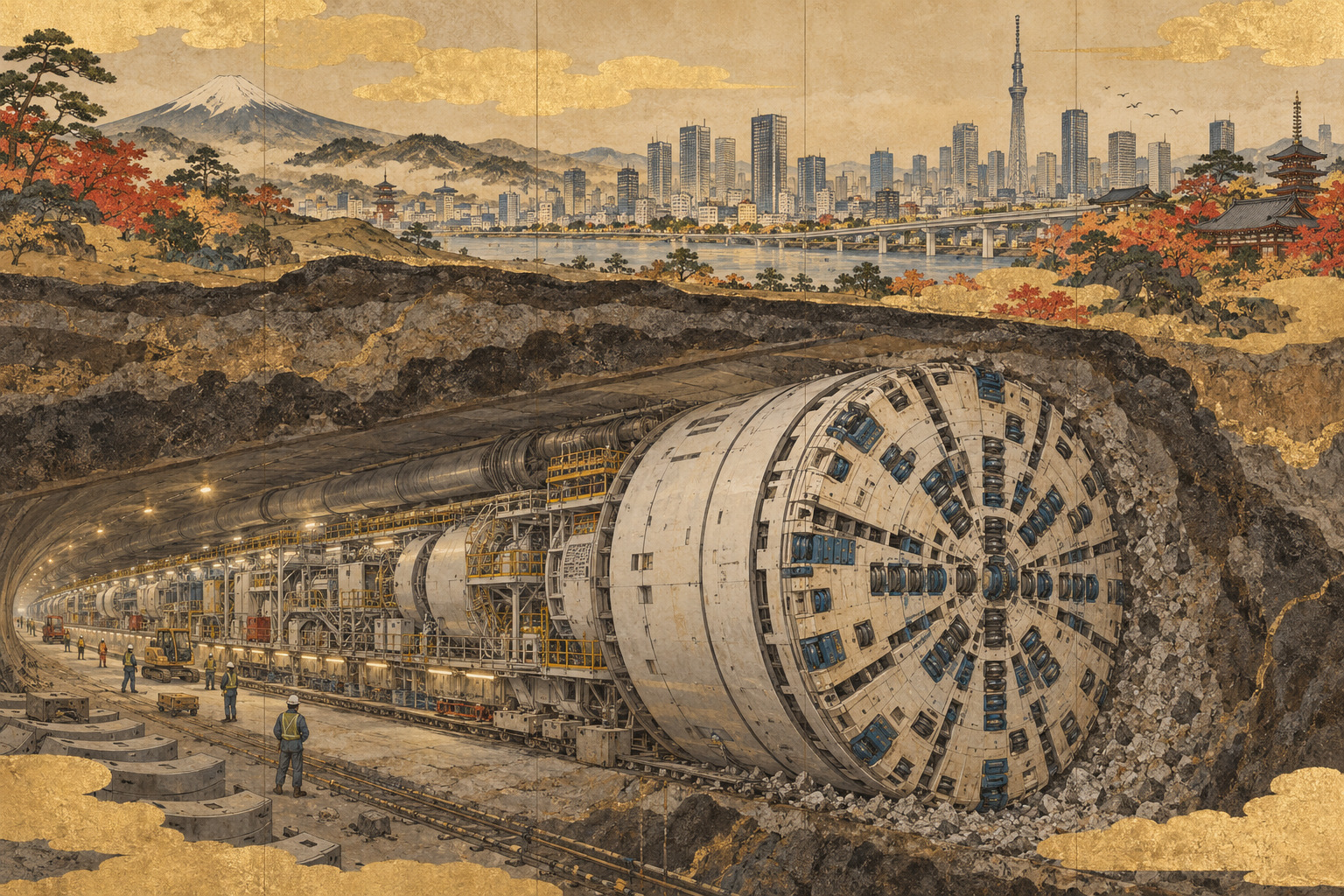
Tokyo’s streets have not stopped, but a crucial machine far beneath them has. On July 29, workers on the Linear Chuo Shinkansen’s North Shinagawa tunnel section detected an abnormal noise from the shield tunnel-boring machine and halted excavation. On October 8, Central Japan Railway Company, known as JR Central, disclosed damaged components in the enormous mechanism that drives its cutting face. A project imagined in terms of 500-kilometer-an-hour trains is confronting a slower, less glamorous challenge: maintaining and repairing a gigantic machine imprisoned deep underground.
What investigators have actually found
Japanese television and wire-service reports based on JR Central’s briefing describe a chipped gear connected to the cutterhead drive, along with damaged bearings. TBS reported damage in 11 of 19 inspected bearing locations. The cutterhead measures about 14 meters across. Those findings explain why inspection is more than a routine maintenance stop; they do not yet explain why the damage happened. A failed component can be the initiating fault, the consequence of another malfunction, or part of a larger sequence. The company’s final causal assessment remains outstanding.
Six months of inspection is not six months added to opening day
Ota Ward’s October 8 notice describes the resumption of excavation as undetermined. Reports say the deeper investigation and inspection could take at least six months, with further work needed before boring restarts. But JR Central has said the incident is not expected to produce an additional change to the railway’s overall opening timetable. Those propositions can coexist: one construction section can be delayed without yet becoming the controlling constraint on a large project. No responsible account should turn the inspection estimate into a confirmed six-month postponement of passenger service.
Why a shield machine is hard to fix
A shield tunnel-boring machine is a moving underground construction plant. Its rotating face cuts through ground ahead while tunnel lining is assembled behind, allowing work beneath dense urban districts without excavating an open trench through their streets. That advantage carries a trade-off: large mechanical systems lie deep below the surface, access can be constrained, and the surrounding soil and groundwater must remain controlled during a stoppage. Engineers must establish the extent of damage and a safe route to inspecting or replacing components. The particular method JR Central will use here has not been publicly established; these are general engineering considerations, not a description of an approved repair plan.
A resident’s view of the ground overhead
The latest incident is not occurring in a vacuum. On October 8, Shinagawa Mayor Kyoko Morisawa formally asked JR Central for a reliable investigation, prevention of recurrence, timely disclosure and clear explanations to residents. The company says it has found no environmental impact from this equipment incident. Yet the ward has earlier reasons to insist on transparency. A local road heaved in October 2025; JR Central subsequently acknowledged a causal connection with tunneling and issued its explanation of causes and countermeasures in December. Nothing verified establishes that the gear damage and the earlier ground heave share a cause. They are separate events that nevertheless shape the same public trust problem.
From a 1962 laboratory ambition to a national project
Research into superconducting magnetic-levitation railways began at Japanese National Railways’ Railway Technical Research Institute in 1962. The Miyazaki test line opened in 1977, followed by the Yamanashi test line in 1997. In April 2015, a manned test run reached 603 kilometers per hour. The government approved JR Central’s construction implementation plan for the Shinagawa–Nagoya section in October 2014. More than half a century of vehicle development has given Japan an extraordinary technological achievement; building its permanent right-of-way through populated cities and difficult mountains remains a different class of task.
The engineering behind a 500-kilometer-an-hour promise
The planned commercial maximum speed is 500 km/h. Superconducting magnets aboard the trains interact with coils installed along the guideway to propel, lift and guide the vehicles. To achieve the line’s promised journey-time reductions, the route must be comparatively direct and its civil works highly exacting. Long tunnels shift construction risk toward geology, groundwater management, excavated material, underground structures and local acceptance. Speed is the purpose of the railway, but it is not a meaningful description of the pace at which those conditions can be safely resolved.
A project already beyond its original opening target
The initial ambition of opening between Shinagawa and Nagoya in 2027 is no longer attainable. The railway’s broader timetable has faced substantial uncertainty, including prolonged construction-related challenges in Shizuoka. The Shinagawa machine problem must be assessed within that existing context, not presented as the original source of the larger delay. JR Central’s assurance that this incident does not additionally change the opening outlook is a company assessment. It does not, by itself, disclose the North Shinagawa section’s remaining float, precise replacement plan or alternative construction sequence.
The financial question has no reliable price tag yet
Lost production time, forensic inspection, component replacement and prolonged support of a worksite can create costs. Whether those costs are borne by particular contractors, the project owner, insurers or some combination depends on agreements and the eventual fault assessment. The official material reviewed for this report does not establish the cost of this machine failure, any insurance recovery or a revised project-wide budget attributable to it. The responsible investor question is not “How many billions has it cost?” but “When will the company quantify the loss, identify who bears it and update its schedule and capital requirements?”
What a city should be able to see underground
The machinery cannot readily be inspected by residents looking out of their windows. Public understanding therefore depends on records: when warnings appeared, why operations were suspended, what parts failed, how ground conditions are monitored and what criteria will authorize a restart. Technical detail matters, but clear explanations matter just as much. Shinagawa’s request for prompt and appropriate disclosure is an important distinction between a private engineering difficulty and a public-infrastructure accountability test.
Questions the next briefing should answer
Investigators must determine whether the damage originated in a manufacturing defect, an operating load, an alignment problem, or a combination of factors. They should explain the extent of component inspection, whether repairs can be completed underground, and the independent checks required before cutting resumes. Investors need the revised North Shinagawa work schedule and attributable costs. Residents need evidence supporting conclusions about surface stability. Those are reporting questions, not facts that can be inferred from the initial photographs or press summaries.
The future may depend on the willingness to stop
Japan’s maglev research took decades to reach its most dramatic speed records. Its final achievement will be judged not simply by how fast the trains travel, but by the quality of the underground engineering and public accountability that put them there. The July decision to stop on detecting an abnormal noise was a safety response, not an embarrassment to erase from the story. A trustworthy infrastructure project is one that can identify a fault, resist premature certainty and explain what must happen before work restarts.
Sources and further reading
- JR東海:2026年10月8日シールドマシン設備変状(品川区による公式発表へのリンク)
- 品川区:2026年10月8日区長申し入れ
- 大田区:北品川工区シールドマシン一部設備の変状
- TBS NEWS DIG:2026年10月8日報道
- 共同通信:掘削機の損傷、10月8日報道
- JR東海:山梨リニア実験線の歴史
- JR東海:超電導リニアのしくみ
- 品川区:事業認可、地表隆起などの経緯
Sources reviewed October 12, 2026 (JST). Root cause, repair costs and resumption date remain unresolved. Section-level and overall opening schedules are distinct.