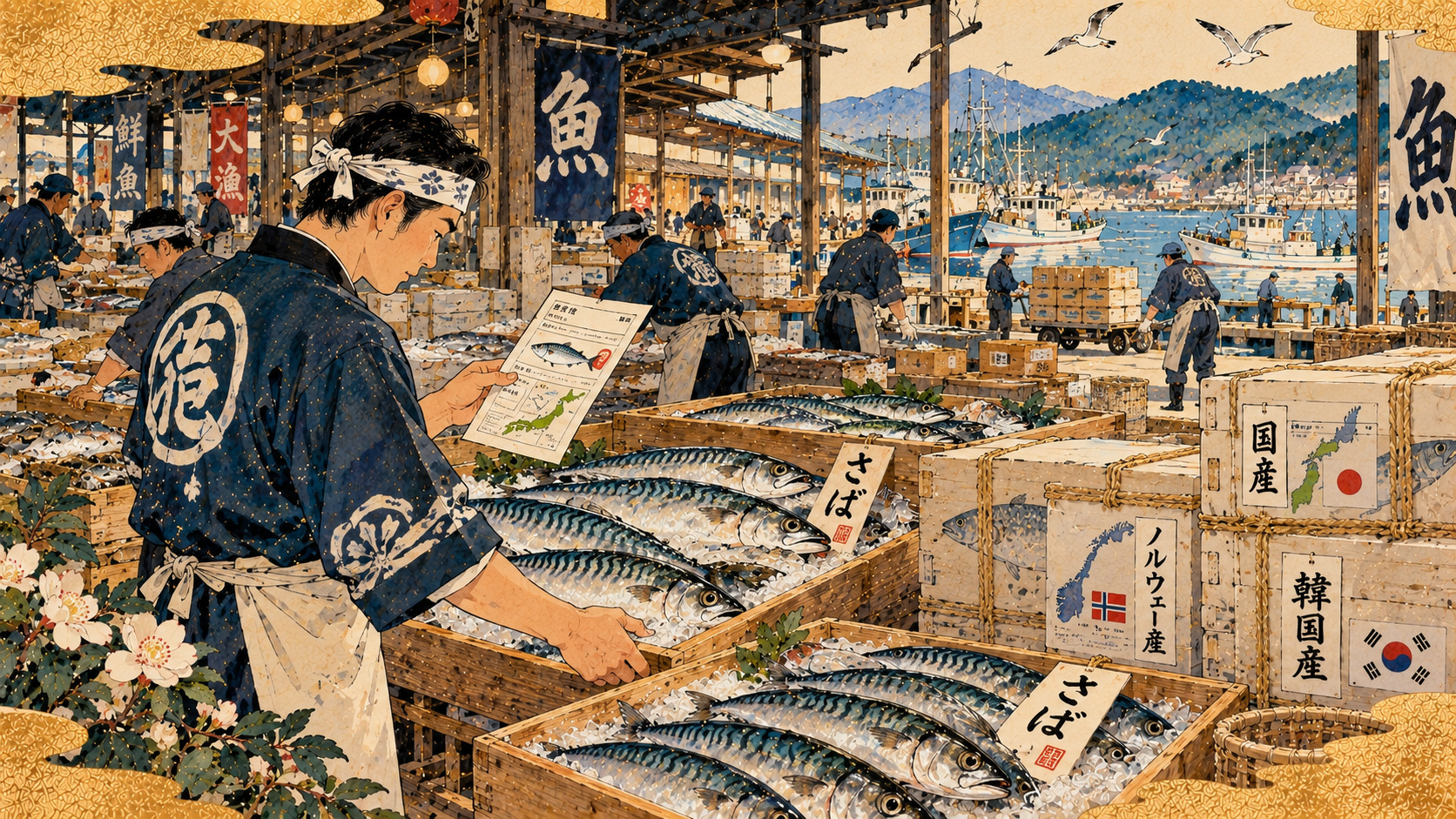
A shipment can cross borders; the label must keep up
The allegation sounds simple: the wrong country appeared on cartons of salted mackerel. Yet the details reveal a much harder problem. Fish can be caught in one country, processed in another, moved through a distributor and sold to a company that repackages or cooks it. Every handoff depends on a reliable distinction between the origin of the raw fish and the country where a product was manufactured. On October 27, Japanese regulators said that distinction had repeatedly failed in mackerel sold by Tokyo-based seafood company Tsurihachi.
What regulators actually found
Japan’s Ministry of Agriculture, Forestry and Fisheries (MAFF) issued a formal direction to Tsurihachi Co., Ltd. on October 27 under Article 6(1) of the Food Labeling Act. It said the company sold 19,215 kilograms of incorrectly labeled business-use processed food between July 31, 2025 and January 31, 2026. The product was boneless salted mackerel fillets intended for cooking. Regional inspectors conducted examinations from March 9 to October 2, 2026. The total refers to sales associated with labeling violations; it is not the amount of fish found contaminated or unsafe.
Three examples that reveal the problem
In one case, the raw mackerel should have been identified as originating in Norway and the United Kingdom, but was labeled only as British. Another declaration should have identified Indonesia and Vietnam as countries of manufacture, but gave only Vietnam. In other cases, products manufactured in Japan carried country-of-origin labels naming Indonesia, Vietnam or China. The ministry’s attachments document additional combinations across six categories. These examples concern two different data fields—raw-material origin and the country of manufacture. A fish caught in a Norwegian sea and processed in Japan does not acquire a Japanese catch origin merely because the factory is Japanese; similarly, a manufactured product should not be assigned a foreign processing country when production occurred domestically.
Why a business-to-business label can reach the dinner table
The reported buyers were retailers and food processors, not simply individual consumers picking up finished packs at a supermarket. That matters because commercial ingredients move through another layer of packaging, specification sheets and product development. If a processor receives incorrect origin information, the error could be reproduced in downstream records or consumer packaging. But potential transmission is not proof that a particular finished retail item was mislabeled. The ministry release does not establish the precise number of consumer packages affected or identify all final destinations. Those remain reporting questions.
Who is Tsurihachi?
According to its own company history, Tsurihachi was established in Tokyo’s Tsukiji district in March 2001 and now operates seafood importing, distribution and processing businesses. Its listed Japanese branches include Hachinohe, Choshi, Osaka and Fukuoka; it also reports overseas subsidiaries or operations including in China and the United States. The company’s published revenue for its fiscal year ended February 2026 was ¥31.397 billion. Mackerel is among its product categories. These are company-supplied background facts; neither company size nor the complexity of its international network establishes a cause for the labeling deficiencies.
A labeling enforcement case is not a food-safety scare
Food-origin labeling is consequential. Customers may choose products based on geography, price, sustainability, procurement commitments or confidence in a supplier. Nevertheless, the ministry’s action concerns compliance with food-labeling standards. It did not report contamination, foodborne illness or injury in this announcement. It did not establish that mackerel from any of the countries named was inherently unsafe, nor did it announce a recall or mandatory destruction of 19 tonnes of fish. A fair account must not convert incorrect paperwork into an unsubstantiated health scare.
How Japan arrived at its labeling system
Japan’s modern food-transparency rules grew from a series of high-profile scandals involving misrepresented beef, processed meat and other products in the 2000s. The Consumer Affairs Agency was established in 2009. The Food Labeling Act, enacted in 2013, consolidated consumer-facing food information requirements, with the Food Labeling Standards taking effect in April 2015. A further expansion of raw-material origin labeling for domestically manufactured processed foods began in 2017, followed by the end of the transition period in March 2022. Government guidance also explains obligations affecting business-use ingredients and processed foods. The evolution matters because the Tsurihachi case is being handled under an established, specific compliance framework—not a newly invented standard.
What the government ordered—and what it did not
MAFF instructed Tsurihachi to immediately inspect labels across all food it sells and correct noncompliant labels before further sale; thoroughly investigate and analyze the reasons for failures; clarify accountability and strengthen cross-checking; train executives and employees on food-labeling rules; and compile a report on its measures by November 27, 2026. The ministry identified deficient review and management processes and inadequate recognition of labeling obligations as potential principal causes. The formal response is an administrative direction to correct and prevent recurrence. It should not be confused with an announcement of a criminal conviction.
The company’s own standards create a public test
Tsurihachi’s corporate website emphasizes accurate descriptions of ingredients and place of origin, routine factory monitoring and consumer confidence. Its website also lists an October 27 notice about improper labeling of products it sold. These statements provide the company’s published position on responsible supply management, but independent confirmation of corrective implementation remains necessary. The most meaningful evidence of improvement will be whether origin records can be traced through lots, shipments, suppliers, processing sites and customers without contradictory entries.
The question after November 27
The most important follow-up is not a photograph of a fish box. It is a documented account of how the discrepancies arose, how affected customers were informed, whether downstream records were corrected and what changed in the approval workflow. MAFF’s reporting deadline creates a measurable next checkpoint. Modern seafood commerce spans oceans and borders; buyers should not have to reconstruct that journey from contradictory labels. The case is about whether the paperwork accompanying food is as dependable as the supply chain it purports to describe.
Sources and verification
Based on Japanese government notices, the company’s published information, and official legal guidance. No original interviews with the company or downstream buyers were conducted.
- MAFF enforcement notice (Oct. 27, 2026)
- Kanto Regional Agricultural Administration Office
- Tsurihachi company profile and history
- Tsurihachi business operations
- Tsurihachi labeling and quality statement
- Consumer Affairs Agency: origin-labeling rules
- MAFF: background on food trust and labeling
- Consumer Affairs Agency: Food Labeling Act