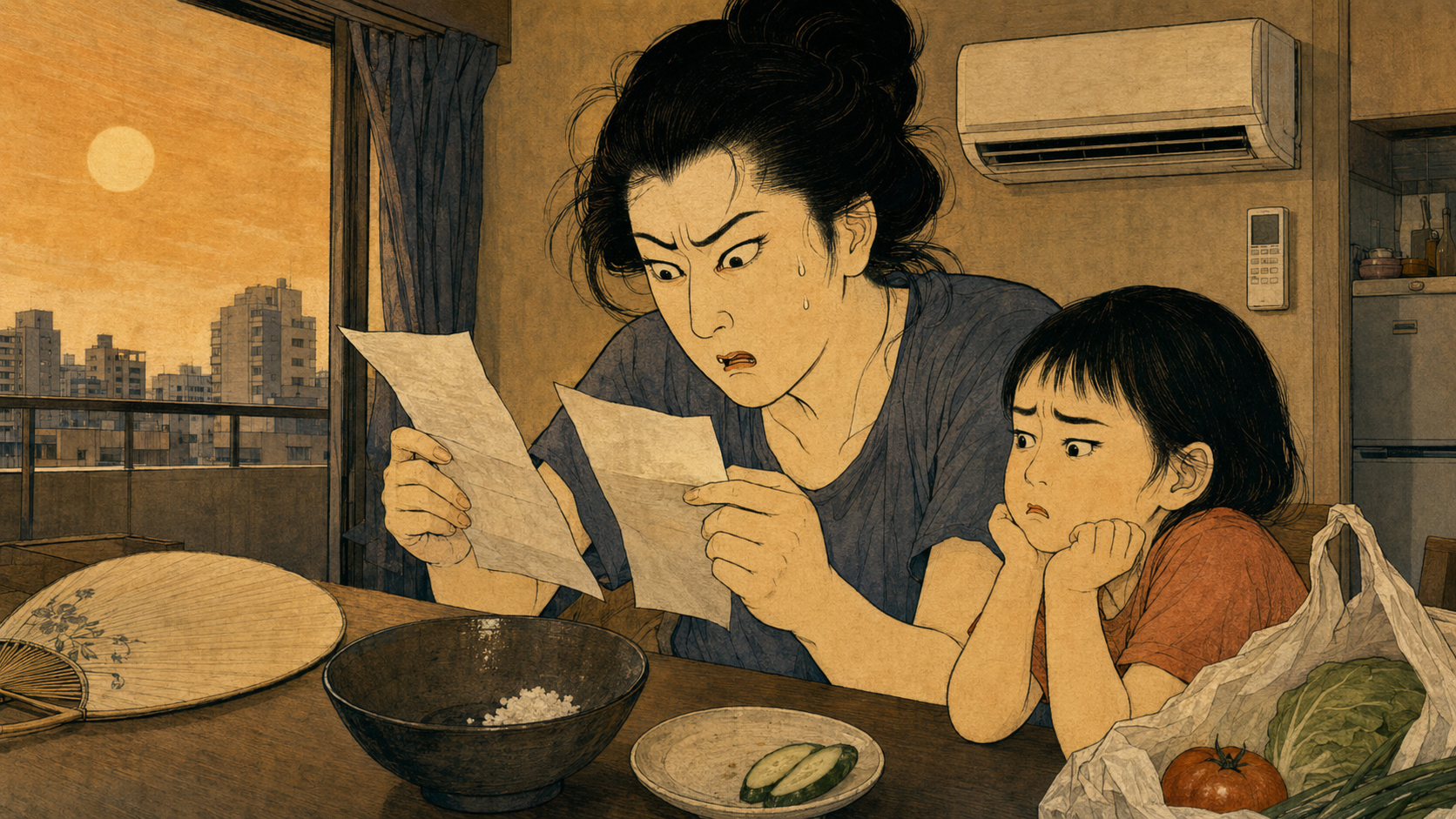
On the first day of summer vacation, more than lessons disappear from a Japanese child’s life. A nutritionally planned lunch, an air-conditioned classroom, the attention of teachers and nurses, and a supervised place among friends all vanish at once. For many families, the roughly 40-day break is a release. For a household with no financial margin, it adds one meal per child every weekday and a full day of electricity while the children remain at home.
That gap has opened during heat Japan once would have called abnormal. On July 21, the country recorded its first day under the new official 40-degree-Celsius category, kokushobi—literally a “cruelly” or “brutally hot day.” Heatstroke alerts covered much of the country the next day, and authorities urged people to use air conditioning liberally. Between July 6 and 12 alone, 4,580 people were taken to hospital with heat illness and seven died. More than 100,000 people required emergency transport during the summer of 2025.
But a June 2026 survey by the certified nonprofit Kidsdoor found that nearly half of the families connected to its support network planned to severely restrict cooling even when needed, barely use it, or live without a working unit. In many of the same homes, school-lunch closure was expected to shrink portions and remove meat or fish from the table. Japan’s government can correctly tell citizens to press the air-conditioner switch. Some households do not have the money to keep it on.
This is not a poll of every Japanese family
Accuracy begins with the sample. Kidsdoor surveyed households registered with its Family Support program from June 1 through June 8 and received 1,449 responses, a 42% response rate. Families lived across Japan, with the largest group in southern Kanto and others in Kansai, Tokai, Kyushu-Okinawa and every major region. But this was not a random, nationally representative survey of all parents.
Ninety-four percent of respondents were single-mother households. More than 80% expected annual household income below ¥3 million, and about half expected less than ¥2 million. Thirty-seven percent had no savings; 42% had debt. Part-time or temporary workers made up 39%, full-time regular employees 26%, and nonregular employment exceeded half of the sample. The survey does not describe the Japanese average. It measures the depth of hardship among families already near the boundary between public assistance and nonprofit support.
- What they show: the concrete food, cooling, health and isolation risks facing support-connected low-income families in the summer of 2026.
- What they do not show: the percentage of all Japanese households in the same condition. The results cannot simply be projected across the population.
- Why they still matter: policy must find where danger is concentrated, not merely describe the average family.
Cooling “severely limited” even when necessary
Asked how they planned to use air conditioning, 38% said they would severely limit it even when needed. Six percent expected to use it hardly at all. Four percent had no unit or one that was broken. Only 7% said they would use cooling without restriction. Among households with annual income below ¥1 million, the severe-limit, nonuse and unavailable categories together approached 70%.
This is not a difference in comfort. Children regulate body temperature less effectively than adults and can be exposed to more heat close to the ground. Humidity prevents sweat from evaporating efficiently. At night, Japanese buildings release heat accumulated through the day. The Environment Ministry’s 2026 guidance says heatstroke occurs indoors and at night and can be fatal; people should avoid excessive electricity saving and use air conditioning properly through the night.
Yet there is no physical separation between lifesaving electricity and the bill. Run the unit and the next charge grows. Turn it off and health deteriorates. A family can seek a library or shopping center, but daily travel costs money, and moving with infants, disabled children or several siblings is not always possible. Older rental homes may have weak insulation, so poorer tenants can pay more electricity to achieve the same safe temperature.
When lunch disappears, every meal gets smaller
Among respondents with children in elementary or junior high school, 64% expected each meal to become smaller once school lunch stopped. Sixty-one percent expected more days without meat or fish; 47% expected more days without vegetables; and 44% expected an increase in days when children could not eat three meals. In households below ¥1 million, 75% anticipated smaller portions and fewer days with meat or fish, while 61% expected more days without three meals.
Food and cooling are not separate crises. A post-vacation Kidsdoor survey in 2025 recorded a parent who kept air conditioning on for the child’s health, then reduced side dishes and served single-item noodle meals to cover the electricity. Both expenses come from the same wallet. Hotter weather makes the refrigerator and air conditioner work harder while the cost of food continues to rise.
The previous summer also shows that the 2026 expectations are not rhetorical. During the 2025 break, 58% of surveyed households had reduced a child’s meal size or frequency for economic reasons at least once a week. Thirteen percent did so five or more days a week, 16% three to four days, and 29% one to two days. Among families below ¥1 million, the share reached 71%.
The survey’s written responses describe children sleeping longer so a parent could hold the day to two meals, children failing to gain weight over the break, and a student weakened by inadequate nutrition who suffered heatstroke during club activities and eventually quit. Hunger, heat and shame reinforce one another: a poorly nourished child tolerates heat less well, while the bill for a cool room reduces what can be eaten.
School lunch began in 1889 as poverty relief
Japanese school lunch has always carried two identities: education and protection from poverty. According to the education ministry, its origin is traced to 1889 in Tsuruoka, Yamagata Prefecture, where a private elementary school served rice balls, salted salmon and pickles to poor children who could not bring lunch. The practice spread, then was interrupted by war.
Amid postwar food shortages and child malnutrition, the government set a course to restart school meals at the end of 1946, and service resumed in urban areas in 1947. The 1954 School Lunch Act turned meals from emergency relief into an educational institution intended to support healthy development and understanding of food. Today, lunch coverage is nearly universal in elementary schools and above 90% in junior high schools.
That success created a blind spot. Once a stable weekday meal became normal, both household budgets and public systems came to depend upon it. The School Lunch Act, however, does not automatically replace meals during long holidays. The lunch first offered to a poor child more than 130 years ago disappears every summer on a predictable date.
The summer cliff is larger than food
A school is bundled social infrastructure. Lunch, heating and cooling, safety checks, exercise, study, friendships and adults who can notice distress sit in the same building. During a closure, a family must repurchase those functions separately: prepare lunch, cool the home, find childcare, supervise study and keep children safe while the parent works.
Families with money add travel, camps, tutoring and visits to grandparents. Low-income children may spend longer inside an overheated home because nearly every outing costs something. In the 2026 survey, 89% had reduced spending on children’s clothes or shoes, 80% on savings for the future, 79% on play and experiences, and 61% on school, club, cram-school or lesson expenses. Fewer than 1% said there was nothing they were cutting.
The result is an educational divide as well as a health crisis. Hunger and poor sleep weaken concentration. A hot room is not a quiet study environment. Kidsdoor found that concern about waking, late bedtimes and insufficient sleep rose as the frequency of inadequate food increased. When students return in September, the same 40 days have not passed for everyone.
The poverty rate improved, but the deepest hole remained
“Child poverty” entered the center of Japanese policy relatively recently. The relative poverty rate measures people whose disposable income, adjusted for household size, falls below half the national median. It captures not only literal starvation but exclusion from what society considers an ordinary life. Japan’s child rate reached 16.3% in 2012, drawing widespread attention.
The Act on the Promotion of Policy on Poverty among Children passed in 2013, followed by the first national policy framework in 2014. A 2019 amendment strengthened planning and attention to children’s circumstances. The Children and Families Agency began work in 2023. In 2024, lawmakers changed the statute’s name to the Act on Promotion of Measures toward the Elimination of Child Poverty—language that shifted the declared goal from managing poverty to eliminating it.
On the latest official measure, covering 2021 income, the child poverty rate fell to 11.5%. That progress is real. But the rate for households with children and only one adult was 44.5%. Among single-parent homes, 21.1% had experienced an inability to buy food. The fact that single mothers make up 94% of the Kidsdoor sample shows where weakness inside the national average is concentrated.
Employment does not guarantee escape
Unemployment cannot explain these families. Most respondents worked, and more than one in four held regular full-time positions. The pressure comes from low pay in nonregular jobs, unstable hours, the constraints of raising children alone, rent, and rising food and energy costs. Taking time off for a sick child cuts wages; taking more shifts creates new childcare and meal costs.
Japan expanded its child allowance in October 2024 by removing the income ceiling and extending coverage through high-school age. Children from age three generally receive ¥10,000 per month, with ¥30,000 for a third or subsequent child. That is an important floor, but a flat payment cannot fully capture differences in housing, disability, geography, family size and the time restrictions of single parenthood.
In the Kidsdoor sample, 49% received the full single-parent child-rearing allowance and 30% a partial allowance, yet 98% still described their finances as difficult. Only 5% received public assistance. Eligibility rules, asset tests, fear of family inquiries, stigma, administrative burden and a belief that employment makes a person ineligible can all stand between hardship and support. Application-based programs often demand the most paperwork from the parent who has the least time and emotional energy left.
12,602 children’s cafeterias fill part of the gap
Food banks, study programs, social-welfare councils, nonprofits and kodomo shokudo—community children’s cafeterias—have built a parallel safety net. The national support organization Musubie counted at least 12,602 cafeterias in fiscal 2025. That is approaching 70% of the number of public elementary and compulsory-education schools, with a cafeteria operating in roughly four out of ten elementary-school districts.
These spaces provide more than food. They reduce isolation, connect families with adults in the community and can reveal trouble early. But most are not daily lunch systems. Operators depend on donated food, volunteer labor, venues and grants. They cannot necessarily receive every child through an entire heatwave. Transport, schedules, capacity and fear of being identified as poor can still keep a family away.
Kidsdoor delivered rice, noodles, snacks and other food worth about ¥7,000 per household to 3,361 families in fiscal 2025. Its 2026 campaign aims to reach 3,500 households with roughly ¥8,000 each. Doorstep delivery reaches families unable to travel and protects privacy. But a one-time box financed by donations cannot be expected to carry 40 days of lunches and the electric bill as well.
Government now recognizes heat and food as one problem
In 2026, the Children and Families Agency asked municipalities nationwide to combine extreme-heat measures and food support during the summer break. Its model links cool public spaces—after-school clubs, community facilities and children’s cafeterias—with meals, while using delivery and other outreach for children who cannot reach a site. Treating food and cooling as one intervention against health risk and isolation is a meaningful advance.
Implementation, however, depends on local decisions and capacity. A change of address can mean a different meal program, facility schedule or eligibility rule. A service cannot help a parent who never hears about it, and limited places can fill. Now that 40-degree heat has its own official name, Japan must decide whether a child’s access to cooling and lunch should still depend so heavily on municipal initiative and charity.
A safety net designed to switch on every summer
| Measure | Why it matters |
|---|---|
| Automatic summer food benefit | Use existing school-aid, tax and single-parent allowance records to provide the equivalent of lost lunches through cash, electronic benefits or food without a new application. |
| Minimum cooling guarantee | Subsidize electricity for eligible homes during heat-alert months and prevent disconnection. Treat cooling as preventive health protection. |
| Air-conditioner installation, repair and insulation | A bill credit cannot make a home safe when the unit is absent or broken, or when inefficient housing leaks cooled air. |
| Cool space plus daily lunch | Combine schools, libraries, children’s centers, after-school programs and cafeterias so meals, cooling and supervision arrive together. |
| Home delivery and outreach | Reach families blocked by disability, illness, infants, transport or the parent’s work schedule, while checking welfare. |
| Measure outcomes in autumn | Use anonymized data on missed meals, heat illness, weight, absence and requests for help to improve the next summer’s response. |
The central design shift is from “please apply” to “if you qualify, support will arrive.” Schools and municipalities already hold information through school-expense assistance, tax status and single-parent allowances. With privacy safeguards, they can notify families before vacation without making an exhausted parent repeatedly prove the same income.
Support should also avoid creating a visible line for “poor children.” A public facility that offers every child a free or inexpensive lunch and cool place, with costs automatically reimbursed according to income, reduces stigma. School lunch became a durable institution partly because it stopped separating poor children and instead made eating together part of education.
This is a design choice, not a parental choice
Seen from the outside, a parent cutting meals or switching off air conditioning can be told to budget better. But a household living on less than ¥2 million, with no savings, debt, several children and one adult working nonregular hours has few discretionary costs left. What looks like a choice is often a decision about which of two dangers to accept.
Japan has not been idle. In 1889 it began the small innovation of feeding poor children at school. In 1954 it made lunch a national educational institution. After child poverty reached 16.3% in 2012, it enacted laws and reduced the official rate to 11.5%. The country expanded child allowances, created a dedicated agency and built 12,602 community cafeterias.
But climate has changed faster than the safety net. Forty degrees is no longer an unimaginable outlier; it is a condition the government has formally named. If closing the school door removes food and safe temperature from the same home, summer vacation is no longer only a private family season. It is a question of public health and children’s rights.
To a child, hunger and heat are not separate ministries, budgets or application forms. They are one life: what can be eaten in the morning after a night too hot to sleep. The next Japanese institution must be as integrated as that experience. Preventing a sad summer memory does not begin by asking parents to make the right choice. It begins by building a country in which no family has to choose between feeding a child and cooling the room.
Sources and references
The Kidsdoor surveys cover households registered for support and are not representative samples of all Japanese families. Denominators, target groups and question wording were checked and kept separate from national poverty statistics.
- Kidsdoor: 2026 Summer Survey of Child-Raising Households
- Kidsdoor: Survey briefing and emergency recommendations
- Kidsdoor: Post–Summer Vacation 2025 Survey
- Reuters: Japan records its first 2026 “brutally hot” days
- Environment Ministry: 2026 heatstroke and nighttime cooling guidance
- Children and Families Agency: Summer heat and food support
- Children and Families Agency: 2026 White Paper on Children
- Children and Families Agency: 2024 amendment to the child-poverty law
- Education Ministry: School Lunch and Food Education in Japan
- Musubie: 2025 national count of children’s cafeterias
- Children and Families Agency: Child Allowance System
- Statistics Bureau: June 2026 Consumer Price Index