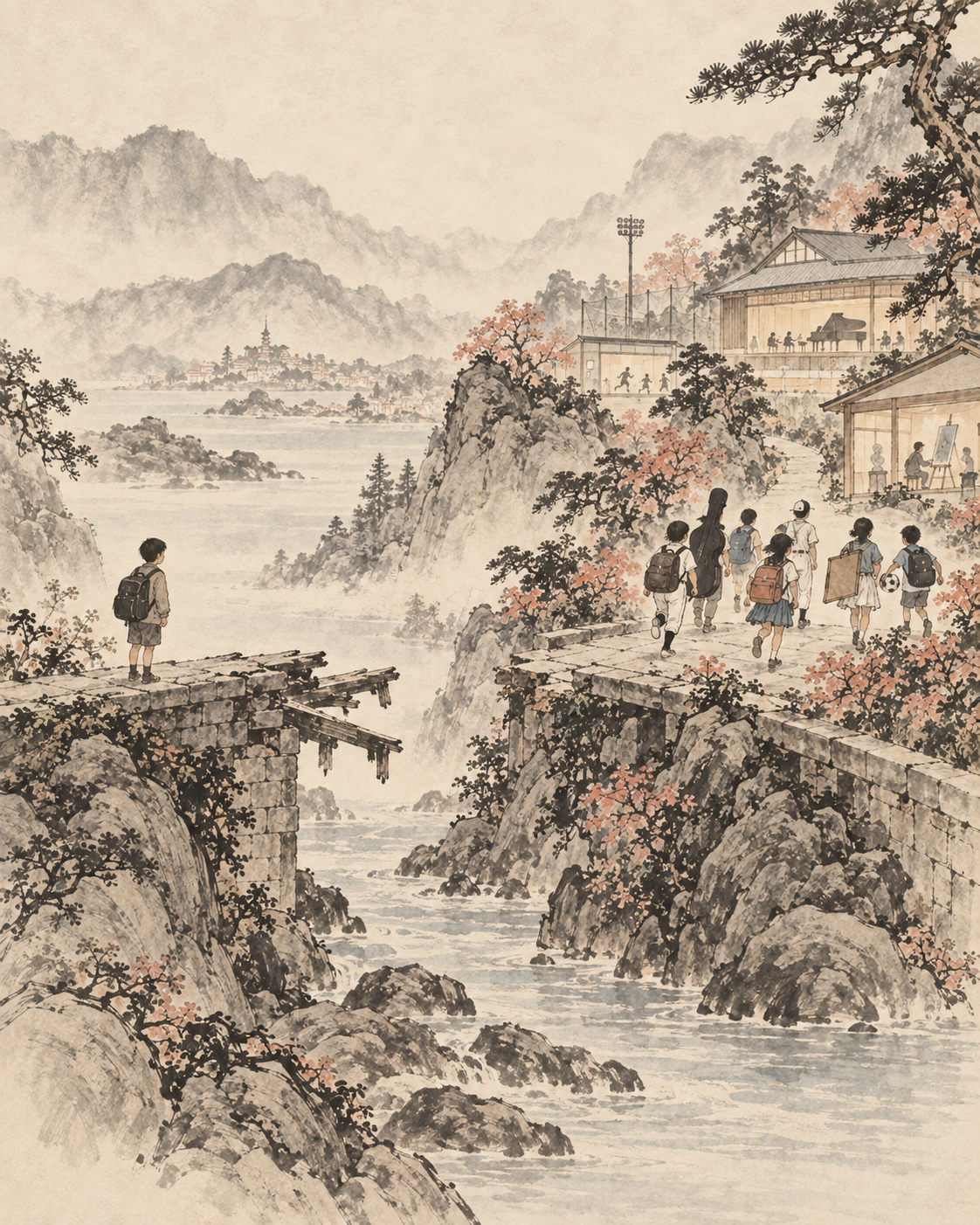
Japan’s education gap is visible not only in classrooms, tutoring and university admissions. It also appears in a quieter question: what did a child get to experience during the past year?
A nationwide survey by the public-interest association Chance for Children found that 30.5% of children in households with annual income below ¥3 million had participated in none of the extracurricular “experience activities” covered by the survey during the previous year. Among households earning ¥6 million or more, the corresponding share was 14.1%.[1]
The March 2026 online survey covered 7,374 parents of children from first grade of elementary school through the third year of high school. Its definition of experience activities included sports, arts and cultural activities, school clubs, nature experiences, travel, festivals, volunteering and cultural outings. It did not include ordinary play with friends, household chores or activities inside the formal school curriculum.[2]
The finding is therefore broader than a gap in paid lessons. It concerns access to occasions when children encounter unfamiliar places, adults, skills and communities—and the extent to which household finances shape that access.
For elementary pupils, the gap was 24.8% versus 8.8%
Chance for Children, or CFC, placed particular emphasis on elementary-school experience activities. Among elementary pupils in households below ¥3 million, 24.8% had participated in none of the covered activities in the preceding year. For households at ¥6 million or more, the figure was 8.8%—a 2.8-fold difference.[3]
The pattern continued at later school stages. Non-participation was 31.2% versus 14.5% among junior-high students and 37.0% versus 20.8% among high-school students. Across all school stages, the figures were the headline 30.5% and 14.1%.[2]
Among elementary-school families that did spend on experience activities, median annual expenditure was ¥30,000 for households below ¥3 million and ¥110,000 for those at ¥6 million or more. The divide is therefore visible both in whether children participate and, once they do, how much room families have to choose among activities.[3]
Rising prices are squeezing the easiest spending to postpone
The survey also connects the gap to household inflation pressure.
Families were asked whether rising prices had caused them to cut spending on out-of-school learning and experience activities. Lower-income households were more likely to report reductions. Among households below ¥3 million that had reduced education-related spending, 76.5% cited higher prices for necessities such as food and daily goods.[1]
Japan’s national consumer-price index was 1.9% higher year on year in August 2026. A national CPI does not describe the burden on any particular family, but it is consistent with the broader environment in which households told CFC they were protecting necessities by trimming education and experience spending.[4]
Rent, groceries and utilities are difficult to stop paying. Lesson fees, trips, equipment, admission tickets and transportation can look more postponable—even when their developmental value is meaningful.
The ¥3 million group is not the same thing as Japan’s official poverty population
One statistical distinction is essential. CFC used annual household income below ¥3 million as its lowest-income analytical group. It does not say that every household in that category meets Japan’s official definition of relative poverty.
The report explains that the threshold was informed by the national relative-poverty line, but actual poverty status depends on household size, taxes, social-insurance contributions and benefits. CFC also warns against treating the ¥6 million-and-above category as a formal “high-income” class; some households in it remain below the average income of households with children.[5]
So the 30.5% figure describes a survey income group. It is not an official estimate saying 30.5% of all Japanese children in relative poverty have no extracurricular experiences.
Japan’s official child relative-poverty rate is 11.5%
The latest official child relative-poverty rate used in government policy material is 11.5%, based on the Ministry of Health, Labour and Welfare’s 2022 Comprehensive Survey of Living Conditions. It fell from 14.0% in 2018, but still represents roughly one child in nine.[6]
That improvement matters. But an income-based poverty rate does not directly measure whether a child joined a sports club, visited a museum, went camping or traveled beyond the local area. Children at the same income level may have very different opportunities depending on transport, community programs, relatives, number of siblings and where they live.
That is why an “experience gap” can reveal something a conventional poverty statistic cannot.
CFC saw the same broad problem in its 2023 report
CFC previously surveyed 2,097 parents of elementary-school children in October 2022 and published a major report on the experience gap in 2023. In that survey, average annual spending on experience activities was ¥38,363 in households below ¥3 million, compared with ¥106,674 among households at ¥6 million or more.[7]
The two studies should not be treated as a clean trend series. The earlier survey was conducted while pandemic effects were still influencing family activity, and the questionnaire design and populations are not identical. CFC itself cited those limitations as reasons for taking a fresh measurement in 2026.[5]
What the earlier work does show is that the relationship between household resources and children’s out-of-school experiences did not suddenly appear this summer.
Government education statistics tell a similar story about spending
Japan’s Ministry of Education also finds a strong association between household income and spending outside school.
In the fiscal-2023 Survey of Household Expenditures on Children’s Education, annual out-of-school activity spending for a child at a public elementary school averaged ¥163,000 in households earning under ¥4 million, ¥199,000 in the ¥6 million–¥7.99 million group and ¥382,000 in households earning ¥12 million or more. For public junior-high students, the comparable figures were ¥203,000 and ¥550,000 at the bottom and top of those income bands.[8]
The ministry’s “out-of-school activity” category is broader and includes supplemental academic study, so it cannot be directly equated with CFC’s experience-activity spending. But both data sets point in the same broad direction: family income is strongly associated with the educational resources available outside ordinary school hours.
The gap widens around entrance exams too
CFC’s 2026 survey also examined cram school, tutoring and other out-of-school academic activity.
Among third-year junior-high students—the year of high-school entrance examinations—36.8% of children in households below ¥3 million participated in such learning activities, compared with 70.9% in households at ¥6 million or more. Among participants, median annual spending was ¥240,000 versus ¥360,000.[1]
Parents were also asked what level of education they realistically expected their children to reach. The share answering university or graduate school was 40.7% below ¥3 million and 75.2% at ¥6 million or above. Among reasons for the realistic expectation, 14.4% of the lowest-income group cited a lack of financial room at home, compared with 3.5% in the ¥6 million-and-above group.[2]
Experience activities, tutoring and educational expectations are distinct outcomes. The survey does not establish that one causes another. But taken together, they show several channels through which economic circumstances may shape the choices that surround a child long before a final education outcome appears.
Japan’s poverty law now explicitly mentions access to diverse experiences
Japan created a statutory framework for child-poverty policy with the 2013 Act on Promotion of Measures against Child Poverty. A 2024 revision changed the law’s title and expanded its stated purpose. The amended language explicitly says policy should prevent poverty from denying children appropriate upbringing, education and medical care—or “opportunities for diverse experiences.”[9]
That wording matters. It recognizes that equal opportunity is not limited to school fees and textbooks.
The Children and Families Agency’s 2026 White Paper also highlights policies that support children’s living conditions, learning and experiences, while the government-backed Children’s Future Support movement funds local organizations providing learning, meals, safe places and activities.[10]
A free event alone may not remove the barrier
One response to an experience gap is to offer free sports, cultural programs and trips. Cost matters, but participation can still fail when transport is expensive, parents cannot provide rides, equipment is required, siblings need care, or families never receive the information.
CFC operates an “experience scholarship” program called Hello Culture, or Harokaru in Japanese, for children who have difficulty accessing activities because of family finances. The approach gives children a choice among local sports, arts, nature and cultural opportunities rather than limiting support to a single invited event.[11]
The geographic problem remains. An urban neighborhood may offer dozens of programs within a short train ride; a rural child may have little to choose from even with a subsidy. Income inequality intersects with transport, information and regional inequality.
What the survey cannot tell us
A sample of 7,374 is substantial, but the survey was an online panel survey rather than a simple random sample designed to mirror Japan’s household population exactly. CFC intentionally constructed roughly comparable respondent numbers across school stages and three household-income groups so it could analyze differences among them.[5]
Nor can income alone explain why any individual child did not participate. A child may not have wanted a particular activity. Health, family responsibilities or lack of local programs may matter.
But the income differences in participation were statistically significant, and the same broad gradient appeared in inflation-related spending cuts, entrance-exam learning activity and educational expectations. The appropriate reading is not a diagnosis of every household but evidence of a structural pattern.
Not only what children can buy, but what they can encounter
Poverty policy is easiest to visualize when the shortage is material: food, housing, clothes or school supplies. Experiences are less tangible.
A first trip to the sea. A theater performance. Joining baseball practice. Sleeping away from home at camp. Helping adults at a neighborhood festival. It is difficult to assign a causal effect to any one event.
Yet if the chance to have those experiences is consistently divided by family income, the difference itself becomes a policy question.
CFC’s survey suggests Japan needs to examine childhood inequality not only through what families can afford to own, but through the worlds children have a chance to encounter.
