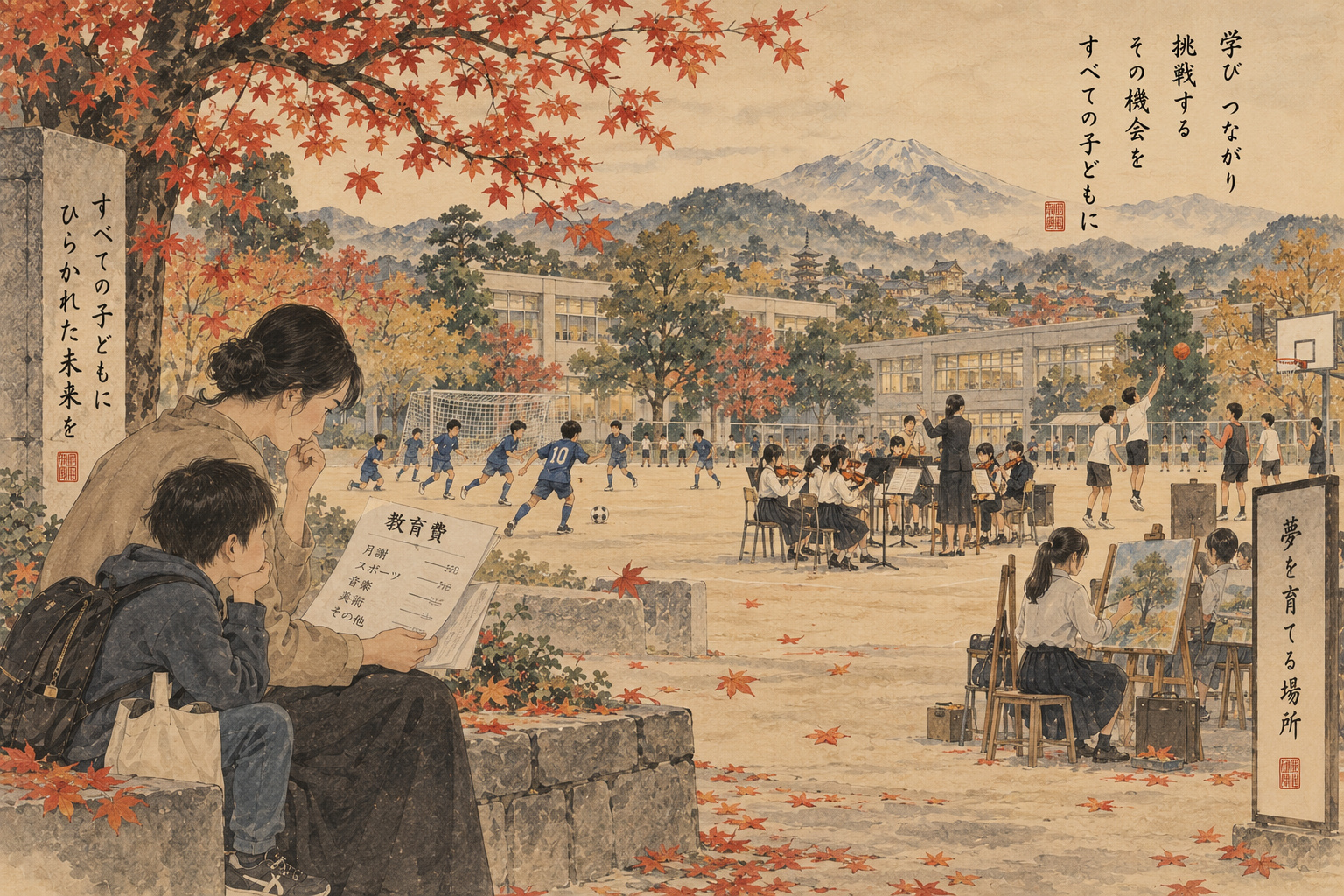
When a household budget stops balancing, some expenses cannot be postponed. Food, rent, utilities and transportation come first. Piano lessons, swimming classes, soccer, summer camp, museum visits, travel and tutoring occupy a more vulnerable category: valuable to a child, but easier to cut this month.
A national survey by the public-interest incorporated association Chance for Children, conducted in March 2026 among 7,374 parents of students from first grade through the final year of high school, shows how strongly those decisions vary with income. Among elementary-school children in households earning less than ¥3 million a year, 24.8% had taken part in none of the surveyed out-of-school “experience activities” during the previous year. In households earning ¥6 million or more, the figure was 8.8%. The low-income rate was 2.8 times higher.[1]
The headline “30% miss out” needs context
Jiji Press, drawing on broader tabulations in the survey, reported that about 30% of children in households below ¥3 million had taken part in no extracurricular activity such as lessons, clubs, volunteering, trips or cultural events during the previous year.[2] Chance for Children’s primary public summary highlights a narrower elementary-school measure: 24.8% participated in none of its defined “experience activities.” The two figures use different age and activity scopes and should not be treated as interchangeable.
In the CFC study, experience activities include sports and cultural lessons, clubs, nature activities, travel and local festivals. Ordinary classroom lessons and curriculum-based school trips are excluded, although some secondary-school clubs are included. The authors explicitly caution that this is an analytical definition, not a complete definition of childhood educational opportunity.[3]
Even among participants, spending differs sharply
For elementary pupils who did take part in experience activities, median annual household spending was ¥30,000 in the under-¥3 million group and ¥110,000 in the ¥6 million-and-above group—a difference of more than threefold.[1]
That gap can alter the meaning of “participation.” ¥30,000 a year averages only ¥2,500 a month. Sports may require equipment and travel in addition to fees. Music can involve instruments and recital costs. Trips require transportation and lodging. Two children can both be recorded as participating while one has a much wider range and intensity of opportunity.
Japan’s Ministry of Education has formally tracked school and out-of-school education spending since 1994. Its 2023 Survey of Household Expenditures on Children’s Education found that out-of-school activity spending at public schools peaks around major examination periods; public junior-high third-year students averaged about ¥446,000 annually in out-of-school activity costs, with supplementary academic study becoming increasingly dominant at older ages.[4]
Before high-school entrance exams, participation nearly doubles with income
The CFC survey found one of its largest gaps among third-year junior-high students. Participation in tutoring, private instruction, online or correspondence learning and similar academic activities was 36.8% among households below ¥3 million, compared with 70.9% among households at ¥6 million or more.[1]
Among those who participated, median annual spending was ¥240,000 in the lower-income group and ¥360,000 in the higher-income group. At the point when Japanese students are preparing for high-school entrance examinations, access to additional instruction, practice tests and structured study time diverges considerably by household resources.
Japan’s national curriculum and public-school system provide a common core education, but entrance examinations create a large market for private supplementary education. The CFC report draws on education-sociology research showing that socioeconomic differences in Japanese education are not a new post-pandemic phenomenon: differences in out-of-school learning, academic expectations and eventual educational attainment have appeared across generations.[3]
For families cutting education, grocery inflation is the biggest reason
The distinctive contribution of the 2026 survey is its focus on prolonged inflation. Among 599 respondents in households under ¥3 million who said they had reduced some out-of-school education spending because of higher prices, 76.5% cited rising prices of essentials such as food and daily necessities. That response was more common than higher utility bills or increases in the cost of the educational activities themselves.[1]
Japan’s nationwide consumer-price index in August 2026 was 1.9% higher than a year earlier, with core inflation at 1.7%. But a family experiences inflation through the cumulative level of prices, not simply the latest year-on-year rate. Several years of higher food, household-goods, utility and housing costs can leave little discretionary margin even after headline inflation slows.[5]
Income also changes what parents think is realistically possible
The divide extends beyond this year’s lessons. Asked what level of schooling their child would realistically reach, 40.7% of parents below ¥3 million answered university or graduate school. Among households earning ¥6 million or more, 75.2% gave that answer.[1]
This is a measure of parental expectation, not an observed university enrollment rate. Yet parents in the lower-income group were more than four times as likely as those in the higher-income group to cite a lack of household financial room when explaining their realistic educational expectation.
If a family decides early that university is financially unrealistic, that can shape choices years before any tuition bill arrives: which high school to target, whether to pay for entrance-exam preparation, which subjects to prioritize and whether a child treats university itself as a realistic goal.
Beyond Japan’s 11.5% child-poverty rate
Japan’s official relative child-poverty rate was 11.5% in the 2022 Comprehensive Survey of Living Conditions, based on 2021 income. Among working-age households with children and only one adult, the relative-poverty rate was 44.5%. Relative poverty is defined through equivalized disposable household income below half the national median; the poverty line in that survey was ¥1.27 million per equivalent person.[6]
Those figures remain essential, but the CFC findings illustrate something a single poverty threshold cannot. Its under-¥3 million category includes families who may not meet the technical definition of relative poverty. Yet clear differences still appear between income groups in activities, spending and educational expectations. Opportunity changes along a gradient of financial room, not only at a binary poverty line.
The “experience gap” was visible before this survey
CFC surveyed 2,097 parents of elementary-school children in October 2022 and published its final “experience gap” report in 2023. Roughly one in three children in households below ¥3 million had no out-of-school experience activity over a year. Participation in sports, arts, nature and cultural activities generally rose with household income.[7]
In that research, 56.3% of lower-income parents who had been unable to provide an activity their child wanted cited lack of financial room. About half said inflation had reduced, or might reduce, their children’s experience opportunities.[8]
The 2026 study was designed partly to move beyond pandemic-era conditions and expanded the sample from elementary pupils to elementary, junior-high and high-school families. Its definitions differ, so the percentages cannot be treated as a clean time series. But the direction of the income gap persists.
How much of childhood should depend on the household?
This creates a difficult policy boundary. Public schools cannot and probably should not provide every sport, instrument, trip, museum visit or tutoring experience a child might want. Yet those activities do more than entertain. They build skills, confidence, social networks, interests and sometimes the first idea of a future occupation.
The Education Ministry’s own spending survey categorizes sports, arts, experiential activities and other lessons as out-of-school activity expenses aimed at acquiring knowledge and skills, cultivating sensitivity and supporting healthy mental and physical development.[9]
If access is determined overwhelmingly by disposable household income, characteristics children did not choose at birth begin to influence the range of experiences from which later interests and opportunities can develop.
Japan has gradually written educational opportunity into poverty policy
Japan enacted the Act on Promotion of Policy on Child Poverty in 2013. A 2024 amendment renamed it the Act on Promotion of Measures to Eliminate Child Poverty and strengthened its principles, including both eliminating children’s current poverty and preventing poverty in adulthood, with continuous support from pregnancy and birth through the transition to adulthood.[10]
The Children and Families Agency explicitly describes child poverty as more than lack of money: it can affect learning, living conditions and psychological well-being, with consequences later in life. National policy therefore includes educational support alongside support for stable living, employment and household finances.[11]
But public systems naturally concentrate on essentials—school attendance, tuition, meals, welfare and basic living security. Universal entitlement to music lessons, sports teams, travel or cultural activities remains far more limited.
Coupons are one experiment in closing the gap
Chance for Children provides “study coupons” that eligible children can use for tutoring and lessons, as well as an experience-support program called Hello Culture. CFC says Nagano City later launched an experience-support initiative covering roughly 28,000 elementary and junior-high students, drawing in part on this model.[12]
Restricted-use vouchers involve a policy tradeoff. They provide less household freedom than cash, but they can guarantee that public or charitable support reaches a child’s learning or activity rather than being absorbed by rent, groceries or overdue bills. That makes them one possible answer when policymakers decide that out-of-school opportunity deserves support in its own right.
For some families, food comes before education because it has to
Discussion of canceled lessons can sound like a debate over optional consumption. The reality for the poorest households is harsher. A 2026 Save the Children Japan survey of economically struggling families found widespread difficulty buying enough food. When asked how an additional ¥10,000 a month in child allowance would be used, 54.9% said they would increase the quantity of food purchased, while only percentages in the 30s said they would put it toward tutoring, lessons or school supplies.[13]
Under those circumstances, asking a parent to preserve piano lessons or exam tutoring can be unrealistic. Reducing educational inequality therefore cannot be separated from food costs, housing, utilities, employment security and support for single-parent households.
What the survey cannot prove
The CFC study is valuable evidence of association, not a randomized experiment proving that income alone causes every difference in participation, school performance or well-being. Children may not want particular activities. Availability varies by community. Health, parental work schedules and transportation matter. Internet-panel surveys also have limits in representing the entire population.
More activity is not automatically better. Children also need unstructured time, rest and ordinary play with friends.
The core concern is narrower: when a child wants to try something, the probability that money removes the option appears to differ substantially across income groups.
Inflation removes more than this month’s purchase
A parent cancels swimming lessons. A family skips the summer trip. A museum visit does not happen. A ninth-grader enters exam season without tutoring. Each can look like one ordinary household decision.
For a child, however, it becomes a year in which an experience did not occur: a chance not taken to discover an aptitude, meet a mentor, see another place, join a team or imagine university as attainable.
That is why Japan’s cost-of-living problem cannot be measured only at the supermarket checkout. When families lose financial breathing room, what disappears is not merely consumption. Some of the choices from which a child builds a future disappear with it.
Sources
- Chance for Children, 2026 Survey on Children’s Educational Opportunities (Aug. 26, 2026)
- Jiji Press / The Japan Times, Sept. 28, 2026
- Chance for Children, full 2026 survey report
- Ministry of Education, 2023 Survey of Household Expenditures on Children’s Education
- Statistics Bureau of Japan, August 2026 CPI
- Children and Families Agency, child-poverty and single-parent statistics
- Chance for Children, 2023 “Experience Gap” final report
- Chance for Children, 2022 interim Experience Gap findings
- Ministry of Education, definitions used in the Survey of Household Expenditures on Children’s Education
- Children and Families Agency, 2024 amendment to the child-poverty law
- Children and Families Agency, child-poverty policy
- Chance for Children, activity report on experience-support programs
- Save the Children Japan, 2026 survey of food and living conditions in economically struggling families