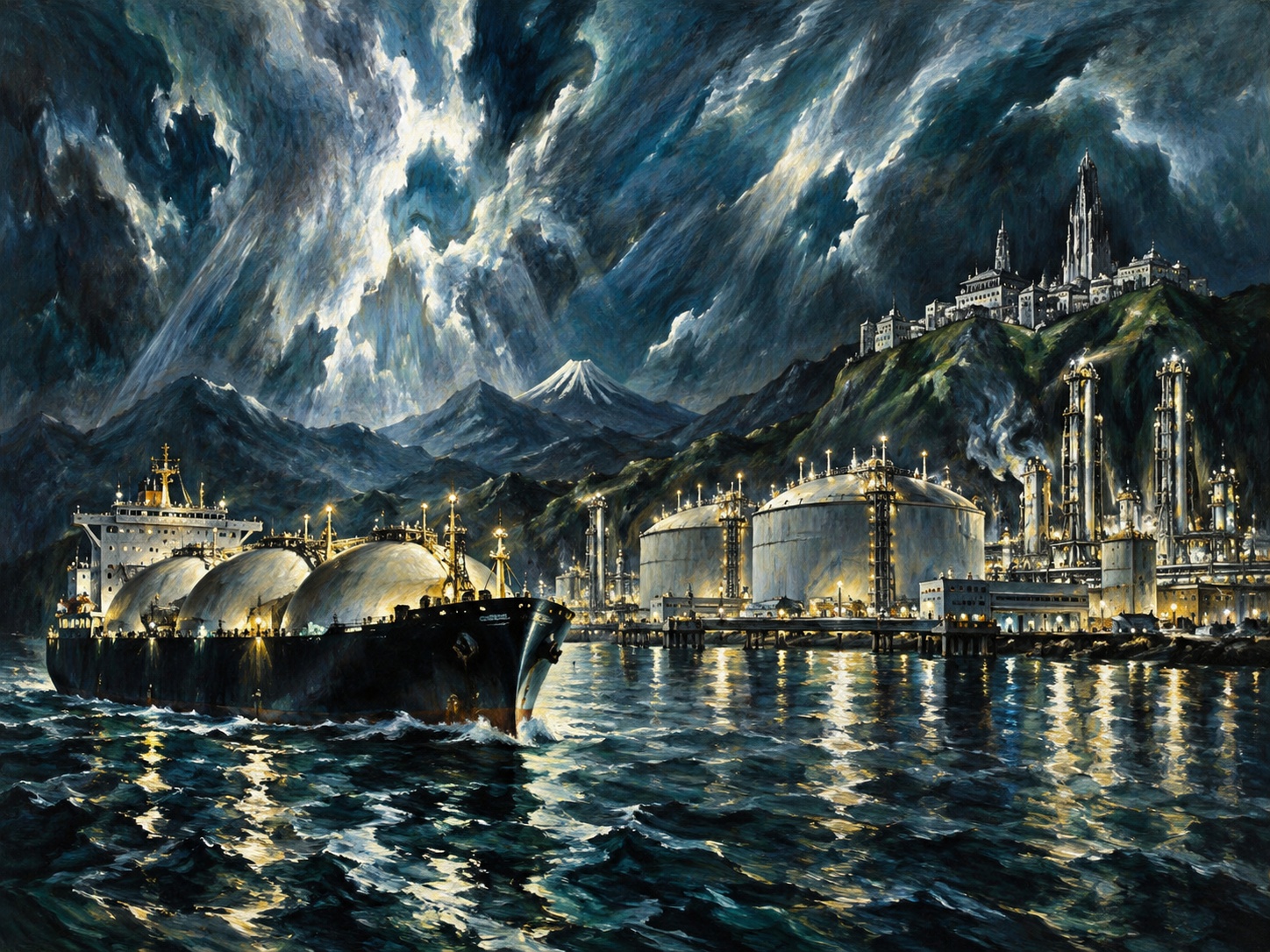
For an island economy that receives most of its natural gas by ship, energy security is not simply a question of how much fuel sits in a tank. It is also a question of whether another cargo can be redirected, whether a contract permits it, whether a vessel and terminal are available, and whether governments and companies can act before a shortage becomes a power-system problem.
That was the practical core of the 15th LNG Producer-Consumer Conference, held in Tokyo on September 11 and co-hosted by Japan’s Ministry of Economy, Trade and Industry and the International Energy Agency. The 2026 theme — “Advancing LNG for the Future: Resilience and Reliability” — reflected a market still absorbing the lessons of successive geopolitical shocks. In their joint summary, METI and the IEA said the latest Middle East crisis had again demonstrated the central place of energy security, while arguing that security and decarbonization should not be treated as competing objectives.[1]
Four priorities emerged from Tokyo
The co-chairs’ summary distilled the conference into four broad priorities. The first was deeper market participation and liquidity, supported by timely investment throughout the LNG value chain. The second was diversification of supply and sufficient investment to protect against future disruptions. The third was stronger interregional links, optimized trade and flexible infrastructure capable of redirecting gas when markets are under stress. The fourth was lower greenhouse-gas emissions across the LNG chain, especially methane, using measures that are practical and cost-effective.[1]
The significance lies in the combination. The conference did not present gas infrastructure as an alternative to renewables, efficiency or other low-emissions technologies. Instead, the co-chairs argued that a successful transition also needs a reliable system underneath it — and that this may require continuing investment in natural-gas and LNG infrastructure even as lower-emissions technologies expand.[1]
| Item | Detail |
|---|---|
| Date | September 11, 2026, Tokyo |
| Conference | 15th LNG Producer-Consumer Conference; fourth edition co-hosted with the IEA |
| Theme | Advancing LNG for the Future: Resilience and Reliability |
| Core issues | Investment, diversification, market flexibility, emergency response, regional cooperation and methane reduction |
The 2026 Middle East shock changed the security conversation
The IEA’s September report, Gas Reserve Mechanisms and Flexibility Options, places the conference in unusually stark context. It identifies two major gas-security crises in five years: the 2022-23 upheaval following Russia’s full-scale invasion of Ukraine, and the closure of the Strait of Hormuz during the 2026 Middle East conflict. The report’s conclusion is not that markets failed entirely. On the contrary, price signals and commercial incentives helped move LNG toward regions that needed it most. But extremely tight markets can still produce violent price swings and physical shortages, which means commercial reallocation alone may not be enough.[2]
The IEA therefore describes a layered system of protection. Physical reserves — underground storage, LNG tanks and floating storage — remain important. Yet commercial flexibility can be just as valuable: contracts that permit diversion, cargo swaps and other arrangements that allow supply to move quickly. Governments can add strategic reserves, buffer LNG schemes and coordinated emergency measures.[2]
- Physical molecules held in underground storage, LNG tanks or floating units
- Commercial rights that allow a cargo to be redirected or swapped
- Government-backed strategic or buffer arrangements for emergencies
- Cross-border cooperation that makes existing infrastructure work as a larger shared system
Japan cannot copy Europe’s storage model
Japan’s geography gives the debate a specific shape. It does not have the same large underground gas-storage system used by parts of Europe. Japan’s Seventh Strategic Energy Plan explicitly recognizes the difficulty of gas storage and instead emphasizes a mix of long-term procurement, flexible contracts, public-private coordination and emergency measures including strategic buffer LNG.[3]
That helps explain one of the most concrete announcements surrounding this year’s conference. JOGMEC and PETRONAS LNG announced a framework for cooperation to secure LNG supply during emergencies in which stable electricity or gas supply in Japan could be threatened. JOGMEC said the framework builds on a 2025 memorandum exploring strategic bilateral LNG arrangements and is intended to strengthen the energy security of both Japan and Malaysia.[4]
The wording matters. The announcement creates a cooperation framework; it should not be described as an unlimited stockpile or an unconditional guarantee of cargoes. Public materials do not spell out every trigger, volume, price mechanism or operational condition. Those details will determine how powerful the arrangement would be in a severe global shortage.
Why LNG acquired such weight in Japan
The history reaches back through the post-Fukushima energy shock. After the March 2011 earthquake and nuclear accident, the shutdown of nuclear reactors increased Japan’s reliance on thermal generation. LNG imports rose, and the cost of imported fuel became a major influence on both the trade balance and electricity costs.
Agency for Natural Resources and Energy data show how large the exposure became. LNG represented 9.3% of the value of all Japanese imports in fiscal 2014, the highest level in the historical series cited by the agency. By fiscal 2023 that share had fallen to 5.6% as LNG prices eased.[5]
Japan also diversified supply. In fiscal 2023, Australia accounted for 41.0% of Japanese LNG imports, while the Middle East accounted for 9.4%. Imports from the continental United States had begun in fiscal 2016. Japan took 16.4% of globally traded LNG in 2023 and ranked second behind China among LNG importers.[5]
Those figures are historical context rather than a description of the 2026 mix, but they explain the policy instinct: concentration is dangerous, yet diversification alone does not eliminate risk. A disruption at a strategic chokepoint, a liquefaction plant or a major shipping route can still tighten the entire market.
Long-term contracts and spot cargoes solve different problems
Japan’s LNG system has long relied heavily on long-term contracts. They can provide volume certainty and smooth some price volatility, particularly when pricing formulas differ from spot-market benchmarks. But long commitments can also reduce flexibility if demand changes or if a buyer needs to redirect cargoes.
Spot LNG provides the opposite set of strengths and weaknesses. It can fill an unexpected gap quickly when cargoes are available, but the buyer is exposed to prevailing global prices precisely when scarcity may be greatest. The lesson of recent crises is therefore not that one procurement model should replace the other. Security comes from the portfolio: contract tenor, supplier diversity, destination flexibility, shipping capacity, storage, and the ability to exchange cargoes with other buyers.
This is why the IEA’s emphasis on flexibility matters so much for Japan. A cargo that exists somewhere in the world is not yet secure supply. It becomes useful only if commercial and physical systems allow it to arrive where it is needed, on time.
Methane is now part of the security test
The Tokyo meeting also linked reliability to emissions performance. The IEA estimates that roughly 580 billion cubic metres of natural gas were exported as LNG in 2025, equal to about 13% of global gas consumption. Its latest work stresses that emissions from extracting, processing and transporting gas are a material part of LNG’s lifecycle footprint.[6]
The agency argues that existing technologies can substantially reduce supply-chain emissions, with methane detection and repair among the most important opportunities. The conference program reflected that focus. One technology panel included Kazutaka Kumeno, president and CEO of Satellite Data Services, whose work includes satellite-based monitoring intended to identify and quantify greenhouse-gas emission sources along the LNG value chain.[7]
This is more than a climate-policy side issue. Methane is the main component of natural gas. Leaks are therefore both an emissions problem and a loss of saleable product. Better measurement can improve environmental performance while tightening operational discipline.
At the same time, claims about “clean LNG” deserve care. Burning natural gas generally produces less carbon dioxide than coal for the same unit of energy, but upstream methane leakage, liquefaction energy, shipping and regasification all affect the full climate footprint. The relevant question is not the label on the fuel; it is the measured performance of the supply chain.
A conference that began in 2012 now faces a different market
The LNG Producer-Consumer Conference was launched in 2012 as a platform for producers and consumers to deepen cooperation. The 2026 meeting was the 15th edition and the fourth co-hosted with the IEA.[7]
The market it now serves is more connected than the one that existed when the series began. U.S. LNG exports expanded, spot trading deepened, European demand was transformed by the loss of much Russian pipeline gas, and Asian demand continued to grow. Cargoes can move farther and more flexibly than before.
Connectivity improves resilience because gas can be redirected. It also transmits shocks. A sudden European scramble for LNG can raise Asian prices. A cold winter in Northeast Asia can tighten Atlantic-basin supply. A shipping disruption can affect buyers far from the original crisis. Liquefaction plants, tankers and receiving terminals become as important as the gas reserves underground.
The cost of preparedness has to be made visible
Resilience is not free. The IEA is explicit that strategic reserves, unused capacity and contractual flexibility carry costs that must ultimately be borne by consumers, taxpayers or market participants. Those costs can look inefficient in a calm year. Their value is revealed during a crisis, when the alternative may be emergency purchases at extreme prices, industrial curtailment or threats to electricity and gas supply.[2]
For Japan, this creates a difficult policy question: how much insurance is enough? Too little leaves the country exposed to geopolitical shocks. Too much can burden consumers and lock capital into infrastructure that may be used less often as the energy transition advances.
The answer is unlikely to be a single reserve target. A flexible system can hold some protection in physical inventory, some in contracts, some in supplier diversity, some in shipping and terminal capacity, and some in diplomatic or institutional arrangements.
Three tests for Japan after LNGPCC 2026
The first test is operational clarity. In an emergency, which institution acts first, which companies release or acquire cargoes, and how are electricity and city-gas needs prioritized? Agreements are useful only if they can be executed quickly.
The second is transparency about the cost of security. Strategic inventory and flexible contracts should be evaluated as insurance, not simply as unused assets. Policymakers need to explain who pays the premium and what risk it is intended to cover.
The third is whether emissions performance becomes part of procurement rather than a separate environmental exercise. If Japan wants LNG to retain a role during a lower-carbon transition, measurement and reduction of methane and other supply-chain emissions will increasingly affect the credibility of that role.
The real product being bought is reliability
Japan’s LNG policy is often discussed in tonnes, contracts and prices. But the deeper product is reliability: the confidence that power stations, factories and households will still receive energy when the global system is under stress.
The September 11 conference did not offer a simple formula. It instead described a system built from diversity, investment, flexible trade, emergency coordination and lower emissions. That complexity is not a weakness. It reflects the reality that no single supplier, stockpile or technology can eliminate geopolitical risk.
For most consumers, an LNG carrier entering a Japanese terminal is invisible infrastructure. It becomes visible only when it does not arrive. The challenge after LNGPCC 2026 is to make sure the institutional machinery behind that ordinary arrival is ready for the next extraordinary disruption.
Sources & Reference Material
- LNGPCC 2026 Joint Co-Chairs’ Summary, METI and IEA, Sept. 11, 2026
- IEA, Gas Reserve Mechanisms and Flexibility Options, Sept. 9, 2026
- Agency for Natural Resources and Energy, Seventh Strategic Energy Plan
- JOGMEC, framework for cooperation with PETRONAS to ensure stable LNG supply in emergencies, Sept. 11, 2026
- Agency for Natural Resources and Energy, Energy Trends, natural-gas and LNG data
- IEA, Assessing emissions from LNG supply and abatement options, Sept. 10, 2026
- LNG Producer-Consumer Conference 2026 official site and program
- PETRONAS, PETRONAS and JOGMEC Strengthen LNG Collaboration through Master Agreement, Sept. 11, 2026
Sources checked through September 14, 2026. Analysis is by Japan.co.jp.