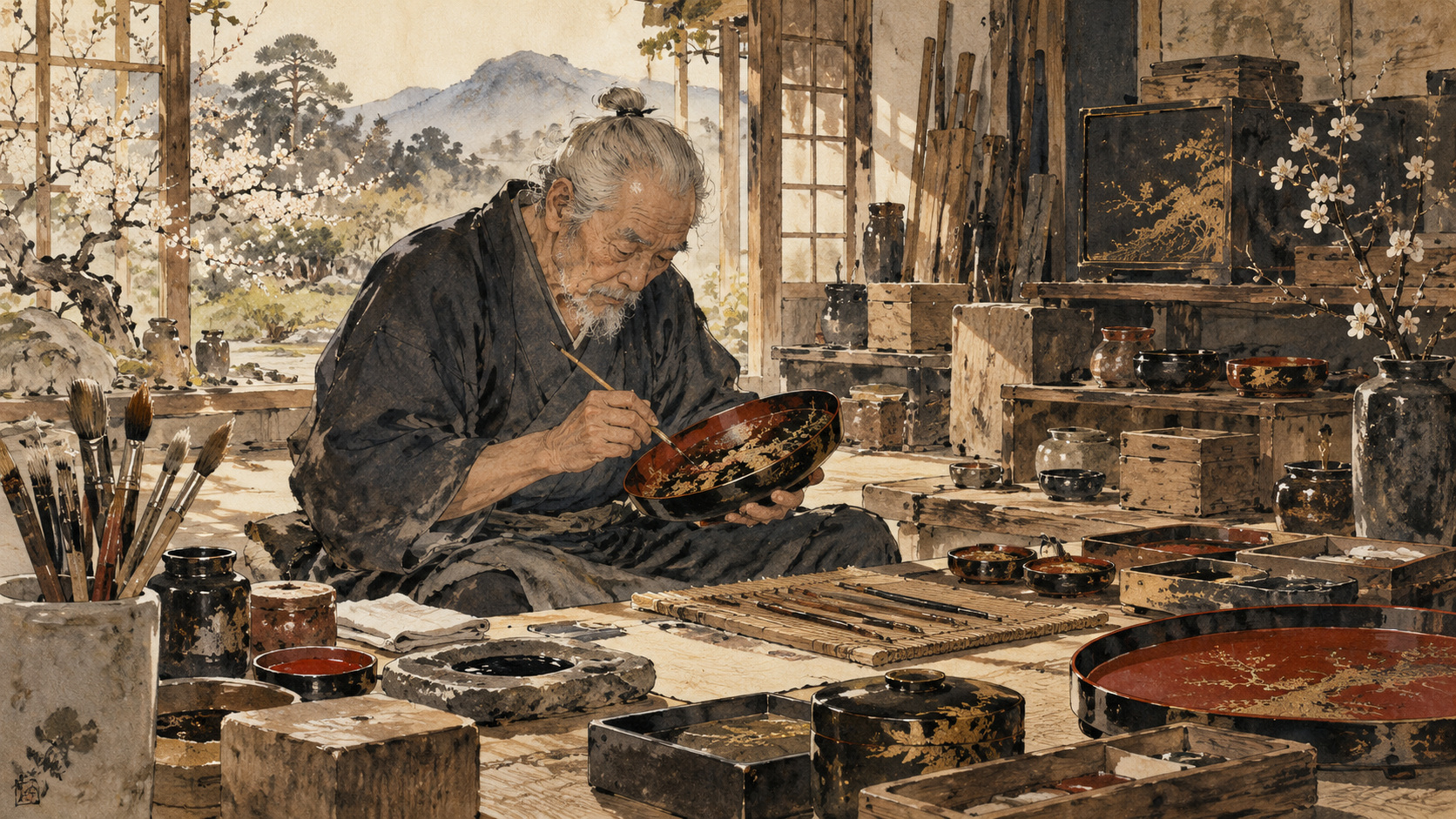
Japan has long protected its great temples and artworks. Now it is preparing to recognize something less tangible: knowledge kept alive in the hands of a chef, a brewer and a flower master.
The three crafts Japan wants to protect are hiding in plain sight
A meal in Kyoto, a carefully brewed glass of sake, an arrangement of flowers: all can appear effortless to the person enjoying them. Behind each is a body of judgment accumulated over generations. On October 16, 2026, Japan's Council for Cultural Affairs recommended a historic expansion of the country's most celebrated recognition for living masters of traditional skills.
The council proposed designating three practices as Important Intangible Cultural Properties: Kyoto cuisine (kaiseki), ginjō sake brewing and rikka, a classical school of flower arrangement. It also recommended three individual masters as holders: Eiichi Takahashi, 14th-generation proprietor of Kyoto restaurant Hyotei; Naohiko Noguchi, a veteran master brewer in Ishikawa; and Sen'ei Ikenobo, 45th-generation head of the Ikenobo school of ikebana. Contemporary Japanese reporting gives their ages as 87, 93 and 93 respectively.
They are candidates for what the public calls Living National Treasure status, not yet recipients of a completed formal designation. The council's recommendation must be distinguished from the subsequent government designation and recognition process. This is more than a formality: accurate reporting must not turn a pending designation into a finished legal act.
What makes a meal a national cultural property?
Kyoto cuisine draws on seasonal foods, highly developed preparation techniques and a close relationship among the dish, the vessel, the occasion and the person being served. A menu can record a sequence of courses; it cannot fully preserve a cook's knowledge of when a stock is ready, how far to heat an ingredient or why a particular vessel suits a particular season.
The proposed holder, Takahashi, represents the Hyotei tradition. His inclusion asks an interesting question of the cultural-property system: can Japan safeguard not only celebrated objects, but skilled acts that disappear as soon as they are performed? A meal is consumed. Its expertise survives only through teaching, repetition and the judgment of another generation.
International readers should be careful with terminology. The designated field is Kyoto cuisine (kaiseki), rendered in the original announcement as 京料理(会席). The term is easily confused in English with the similarly pronounced meal associated with tea gatherings, 懐石. Historical relationships exist, but they should not be treated as interchangeable labels.
The master brewer and the difficult art of fermentation
Ginjō brewing demands decisions throughout rice polishing, washing, steaming, kōji cultivation, fermentation and temperature control. Instruments can measure the process, but it remains a craft of choices made with experience and knowledge of changing biological conditions. Noguchi is among the best-known veteran tōji, or master brewers, in modern Japanese sake.
Recognition of ginjō brewing should not be misunderstood as an official endorsement of a particular bottle or producer. An Important Intangible Cultural Property concerns the historical and technical value of the practice, and the person who can transmit it. The future question is whether aspiring brewers can obtain the time, mentorship and practical experience required to become genuine successors rather than merely learn a list of procedures.
A landscape composed from stems and branches
Rikka, whose Japanese name means standing flowers, is one of ikebana's classical forms. Branches and flowers are organized to suggest landscapes, including mountains and waterways, within a single vessel. What looks spontaneous is built through relationships of direction, proportion, empty space and disciplined observation of nature.
Sen'ei Ikenobo's nomination recognizes the transmission of an artistic language that has changed across centuries. The challenge of preservation is especially visible here. A tradition must maintain recognizable principles without becoming a museum exhibit that cannot speak to new practitioners.
Why this decision breaks with decades of precedent
Japan's modern cultural-protection framework dates to the Cultural Properties Protection Law of 1950. Beginning in 1955, the government designated Important Intangible Cultural Properties and recognized holders of skills such as kabuki performance, Noh, ceramics, lacquerwork and textiles. The public phrase “Living National Treasure” became shorthand for people whose mastery was considered vital to the nation's heritage.
For decades, this system concentrated on performing arts and craft techniques. Everyday cultural practices occupied a more uncertain place. In October 2025, the Agency for Cultural Affairs announced revised designation and recognition criteria for living-culture traditions. The October 2026 recommendations now give that policy change human faces and concrete subjects.
The distinction between tangible and intangible protection matters internationally. Japan can restore a historic building or conserve an old painting. But a skill cannot be preserved simply by locking up its tools. Its survival requires communities of teaching and practice, supporting materials and places where the work still has meaning.
The economic life of culture
The nomination also raises questions about who can afford to learn. Serious training in cuisine, brewing or flower arrangement takes time, often years, and depends upon viable restaurants, breweries, teaching institutions and networks of apprentices. Rising operating costs, aging practitioners and uneven access to training can weaken a tradition even as public recognition grows.
According to the Agency for Cultural Affairs, individually recognized holders of Important Intangible Cultural Properties are eligible under an established program for an annual special grant of ¥2 million to support transmission. That policy should not be mistaken for proof that these three nominees have already received payments.
Nor is heritage limited to famous individuals. A designation honors exemplary mastery, while a living field depends on hundreds of less visible teachers, craftspeople and students. Government support and public attention ultimately need to reach the environments in which the next generation works.
Three names, a larger question
The immediate next step is formal confirmation of the designation and recognition following the council's recommendation. Beyond that, the test will be measurable and practical: how the techniques are documented; how successors are trained; whether younger practitioners can sustain careers; and whether the public understands why these skills matter beyond the prestige of a famous designation.
Japan's decision offers the world an unusually expansive definition of heritage. The legacy of a civilization exists not only in monuments and priceless objects, but also in a brewer's intuition, a chef's judgment and the placement of a single branch. Those acts are fleeting; the knowledge behind them need not be.