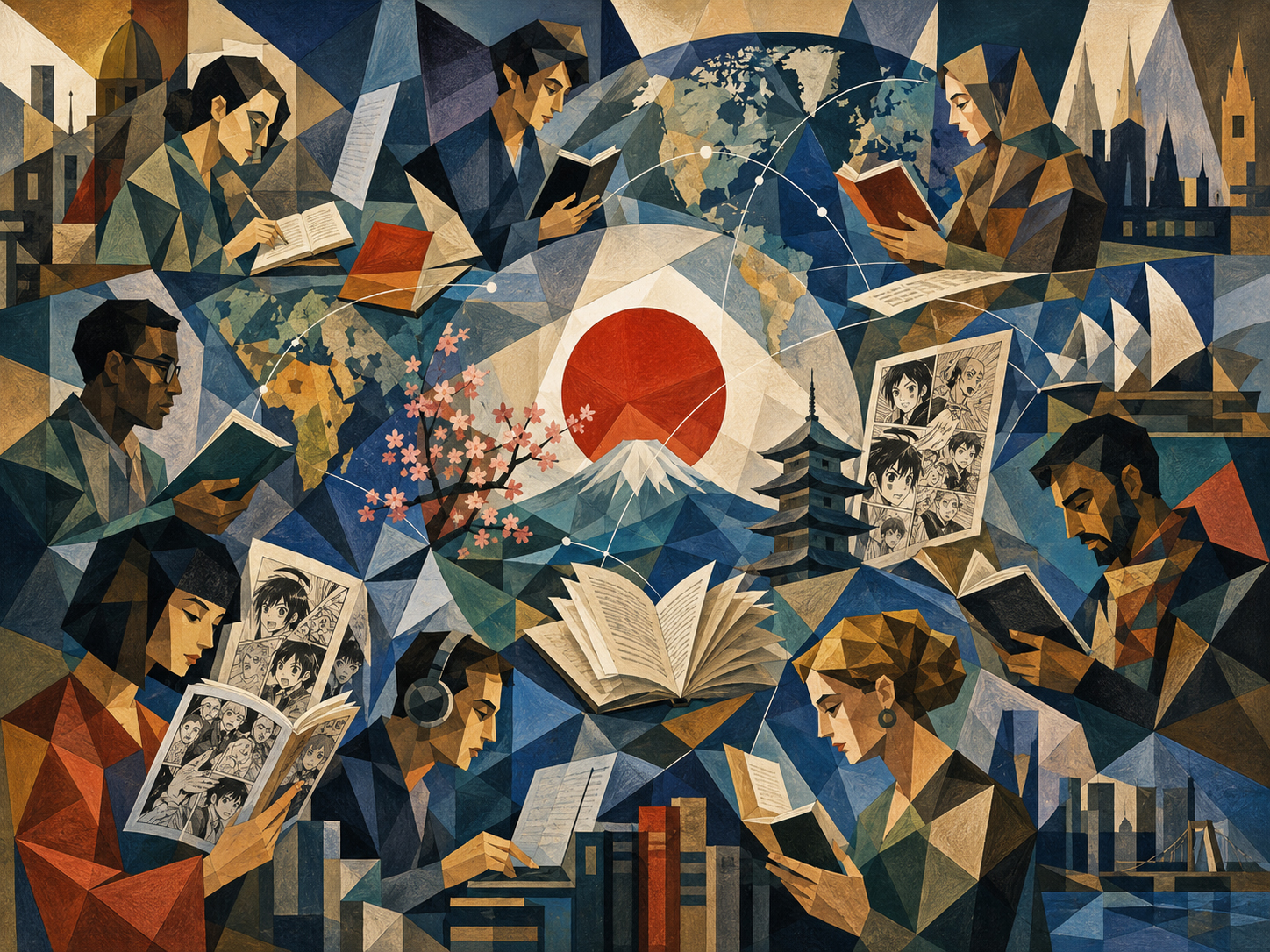
Japan’s manga, books and translations are being spoken about again in the language of national strategy. Once, “Japanese books abroad” meant prize-winning literary novels, cultural guides to Zen or tea, or academic titles for Japanese studies departments. In 2026, the field is broader: shonen manga, shojo manga, light novels, literary fiction, nonfiction, anime source material, stories that travel into games, and the translators and foreign publishers who make that travel possible.
The numbers now under discussion are large. Reports say Japan is weighing a goal of lifting overseas manga sales to 1 trillion yen, roughly $6.2 billion, by 2033. The government’s New Cool Japan Strategy sets a wider target of 20 trillion yen for the overseas market for Japan-originated content by 2033, with an intermediate target of 10 trillion yen by 2028. Manga is the easiest part of that ambition to understand: young readers love it, global demand already exists, and piracy shows just how much unmet demand remains.
This is not just a story about “Japanese culture becoming popular.” Japanese publishing now connects paper books, e-books, translation rights, anime streaming, film adaptation, merchandise, events, pilgrimage tourism, language learning and national image. A single manga page can change how a reader sees Japan more quietly than a trade mission, but often for much longer.
Japan’s story exports, by the numbers
Why manga and translation, why now?
One reason is simple: the demand is already there. Young readers around the world no longer see Japanese manga and anime as rare foreign culture. Through schools, phones, streaming platforms, social media, cosplay events, games and fan art, Japanese stories have become part of everyday life. Works such as One Piece, Naruto, Demon Slayer, Attack on Titan and Jujutsu Kaisen have become cross-border common language.
But popularity is not the same as value captured in Japan. Official translations often arrive late. Prices can be high. Access varies by country. Printed volumes take time to ship. Fans who cannot wait drift toward scanlations and piracy. Japan’s publishers face a strange contradiction: global popularity can create losses when the official market is slower than the unofficial one.
That is why today’s policy debate has two faces. One is the policy of selling more. The other is the policy of being stolen from less. Official distribution, AI-assisted translation, overseas marketing, rights clearance, anti-piracy enforcement and stronger returns for creators are not separate issues. They all ask the same question: can readers get the story legally, quickly, affordably and in their language?
From Edo popular print to global manga
Japan’s culture of combining image and text did not begin with modern manga. Edo-period publishing had kusazoshi, kibyoshi, ukiyo-e, yomihon and comic fiction. Woodblock printing brought stories and images to ordinary urban readers. Kabuki actors, famous places, monsters, jokes, romance and travel all moved through a lively visual publishing market. Edo media already had characters, series and fan culture.
In the Meiji era, Western newspapers, magazines, cartoons and novels entered Japan, while modern Japanese publishing took new forms. Translation was a tool of national modernization. Philosophy, law, science, politics and literature were imported through words. Japan used translation to build a modern state and, in the process, created new Japanese expressions.
After World War II, rental manga, weekly magazines, boys’ magazines, girls’ magazines, collected volumes and television anime converged. The story manga associated with Osamu Tezuka and later generations expanded rapidly. By the 1960s and 1970s, manga had moved beyond children’s entertainment into youth culture, women’s culture, social criticism, science fiction, sports, food, history and business. Japan built one of the world’s most segmented reader markets.
The translator as hidden protagonist
For readers abroad, Japanese books appear through translators. Yet translators often remain invisible. Manga translation is not merely replacing one sentence with another. It involves balloon space, sound effects, honorifics, dialect, gender and age nuance, jokes, historical background, vertical and horizontal writing, and the relationship between image and speech. In fiction and criticism, translators must carry voice, silence, rhythm, cultural terms, names and the balance between annotation and flow.
That is why Japanese literature abroad has long needed institutional support. The Japan Foundation provides grants for foreign publishers translating and publishing Japan-related books, covering part of translation and publication costs such as paper, plate-making, printing and binding. It is not glamorous industrial policy, but it is foundation work: without translation, Japanese books do not become books in another language.
Manga is different because commercial demand often arrives first. Major hits find their way abroad through private publishers and platforms. But midlist works, classics, women-centered stories, locally rooted works, literary manga and experimental titles are harder to export. If Japan wants a deeper publishing export economy, it must broaden what gets translated, not only push the biggest franchises.
Piracy is the shadow of demand
The scale of piracy is a painful measure of manga’s popularity. In early 2026, one of the world’s largest manga piracy networks was reported shut down. Bato.to and around 60 related sites recorded a combined 350 million visits in May 2025 alone, according to reports citing CODA. Piracy is not a few fans sharing files in a corner. It is an advertising business built on unlicensed translation, scanning and distribution.
Morality alone will not solve piracy. Readers do not always choose legal options even when they exist. But if the legal version is late, unavailable, expensive or hard to find, illegal sites will win. Japan’s manga-export plan therefore needs enforcement and access at the same time. Speed and usability are anti-piracy tools.
This is where AI translation enters the argument. AI may make translation faster and cheaper. But manga is not just text. It requires knowledge of who is speaking, what the image shows, emotional timing, sound effects, handwriting, dialect and character voice. Researchers describe manga translation as a multimodal problem more complex than ordinary document translation. AI can assist, but human editors and translators still carry the cultural judgment that makes a work feel alive.
Japanese literature rides the manga wave
Readers who begin with manga often move toward Japanese novels, essays, poetry, history, cookbooks and thought. Haruki Murakami, Mieko Kawakami, Yoko Ogawa, Yoko Tawada, Banana Yoshimoto, Yukio Mishima, Natsume Soseki, Junichiro Tanizaki and Ryunosuke Akutagawa already have global shelves. Manga and anime can bring new readers toward those shelves.
Japan should not divide literature and manga too sharply. One of Japan’s strengths is the mobility of stories across high and low forms. Classics become manga. Manga becomes novels. Novels become anime. Anime becomes stage productions. Games become novels. Stories migrate, and every migration finds new readers.
Translators, editors, foreign publishers, booksellers, librarians and fan communities support that migration. Government targets may set the headline number, but readers are created by good translations, strong covers, clear sales pages, reviews, events and conversations between fans.
The danger of treating culture only as export
There is a risk in treating culture purely as an export industry. Works are not government brochures. Writers are not public-relations officers. Manga and novels are loved abroad because they contain strangeness, loneliness, anger, humor, romance, defeat, violence, absurdity and criticism of Japan itself. If Japan exports only a clean promotional image, the work becomes weaker.
Labor conditions are also part of the issue. The more anime and manga sell abroad, the more pressure falls on manga artists, assistants, animators, translators, letterers and editors. If overseas markets grow, returns must reach the people who make, translate and deliver the work, not only the rights holders and platforms.
Past Cool Japan efforts were criticized for trying to sell culture from the top down. The 2026 challenge is different. The readers already exist. The task is to connect their enthusiasm to legal markets, creator returns and the next generation of work.
Japan.co.jp view
Japan’s manga and books are enormous diplomats. They do not wear suits. They sit in foreign libraries, streaming queues, bookstore displays, school bags and phones. A reader first loves a character, then learns a word, visits a city, eats the food and asks about history. Cultural export works on a long road.
Japan’s goal, then, should not be only to increase overseas sales. It should be to make official access faster, train translators, use AI without breaking the work’s voice, reduce piracy, create paths for smaller titles, and build an economy in which authors can make the next work.
Manga flies through images. Literature travels through voice. Translation is the bridge. Whether Japan reaches ¥1 trillion in overseas manga sales and ¥20 trillion in broader content exports will not be decided by slogans alone. It will depend on how quickly, widely and beautifully Japan can build official roads that readers actually want to use.
Reader and business guide
| Item | How to read it |
|---|---|
| What is happening | Japan is redefining manga, anime, games and books as a growth industry as well as soft power. |
| Targets | The government targets ¥20 trillion in overseas Japan-originated content by 2033; overseas manga sales of ¥1 trillion have been reported as a goal. |
| Key infrastructure | Translation, official distribution, rights clearance, overseas marketing, anti-piracy enforcement and creator returns. |
| AI’s role | AI may help with translation and piracy detection, but human judgment remains central to voice, context and cultural meaning. |
| Japan.co.jp view | Manga and books are long-term Japanese soft power. The contest is not only sales; it is whether readers and creators are connected fairly. |
Sources and references
This article draws on Japan’s Cabinet Office New Cool Japan Strategy, the Japan Foundation’s translation and publication support program, Mainichi Japan, The Verge’s reporting on manga piracy, CODA-related reporting, and recent academic research on multimodal manga translation. Market estimates, policy targets, piracy figures and AI translation tools may change.
- Cabinet Office: New Cool Japan Strategy, content industry scale and 2033 overseas market target.
- The Japan Foundation: Support Program for Translation and Publication.
- Mainichi Japan: Japan aims for $6.2 billion in overseas manga sales.
- The Verge: Bato.to manga piracy network shutdown and CODA figures.
- arXiv: Context-informed machine translation of manga using multimodal large language models.
- arXiv: Manga109-v2026 and modern manga understanding datasets.