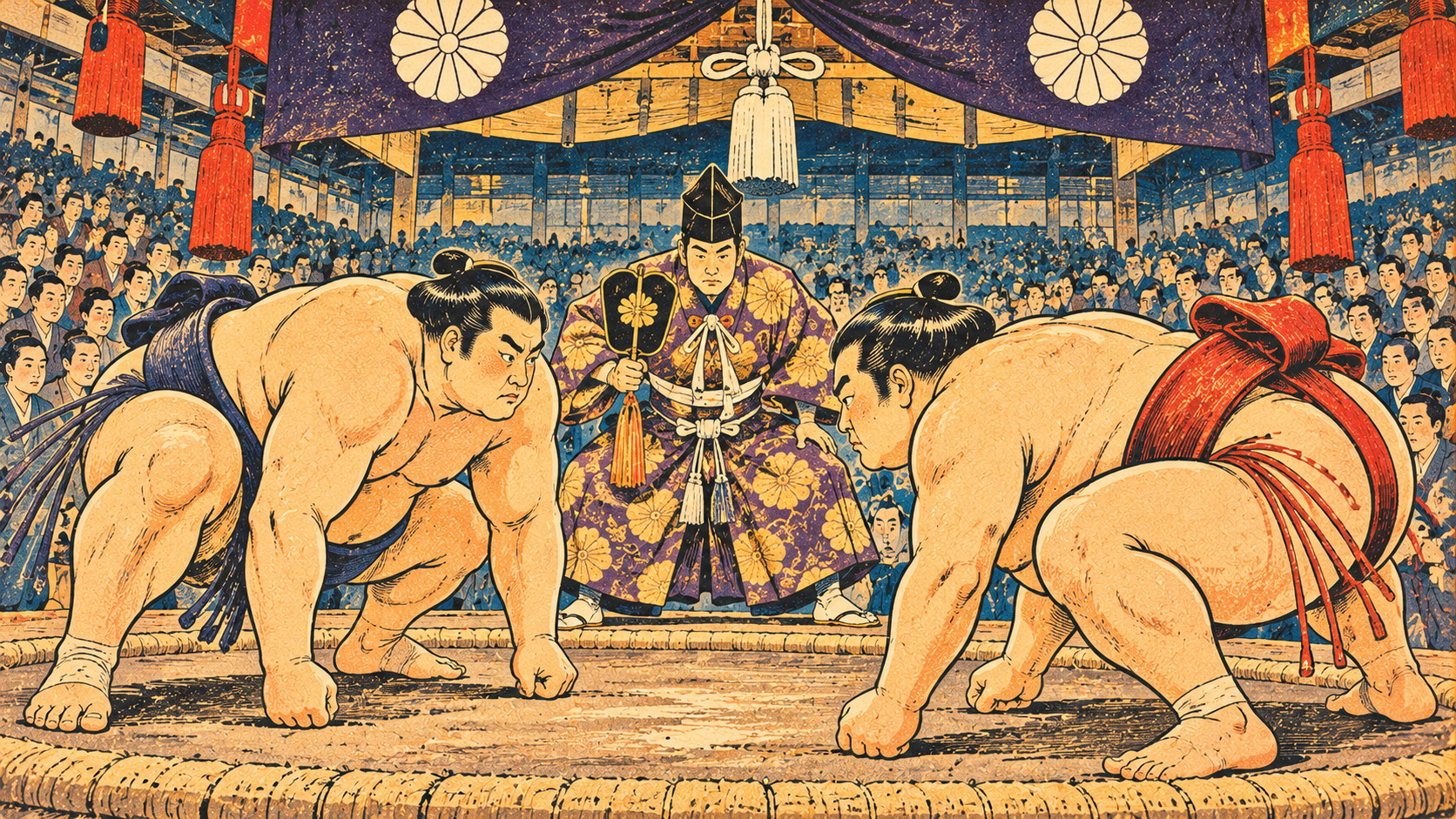
- The title race turns on one push to the edge
- The standings, and the mathematics of the final two days
- Ōnosato’s extraordinary ascent—and the expectations that followed
- Wakamotoharu: the experienced challenger from lower on the banzuke
- What the announced Day 14 matchups mean
- From ritual combat to Fukuoka’s November tradition
- Understanding yorikiri: the technique behind the turning point
- The wider tournament: another yokozuna and an annual wins leader
- What the final weekend must decide
The title race turns on one push to the edge
One bout in Fukuoka transformed the final weekend of the November Grand Sumo Tournament. On Friday, November 20, Yokozuna Ōnosato defeated Wakamotoharu, the sole leader entering the day, by yorikiri—a frontal force-out. The result left both men at 11 wins and two losses with two scheduled days remaining. The championship was neither clinched nor decided; the contest had become newly open.
Ōnosato used a forceful opening to deny Wakamotoharu his preferred inside position. Reports describe the yokozuna lifting his opponent’s posture and driving forward before the maegashira could settle into left-hand inside sumo. It was a tactical victory as well as a result on a scoreboard: the wrestler who had held a one-win advantage left the arena level with the man who beat him.
Two other contenders suffered setbacks. Sekiwake Atamifuji lost to Rōga, and Kinbōzan fell to Ōzeki Kirishima. Both moved to 10–3, one win behind. The Japan Sumo Association’s Day 13 leaders list confirms precisely these four wrestlers at the top. The remaining suspense was real, but the scores alone could not tell anyone what would happen next.
The standings, and the mathematics of the final two days
After Day 13 the leaderboard read: Ōnosato, East Yokozuna, 11–2; Wakamotoharu, East Maegashira 7, 11–2; Atamifuji, West Sekiwake, 10–3; Kinbōzan, West Maegashira 7, 10–3. A top-division sumo tournament normally gives each active wrestler one bout on each of its 15 days. Two victories can therefore change the picture dramatically.
If the two joint leaders were both to win their remaining bouts, they would finish level at 13–2 and ordinarily meet in a championship playoff. If either stumbles, the three-loss wrestlers may still have a route back. Such possibilities illustrate how tournament math works; they are not predictions of fixtures or outcomes.
This article is prepared for the November 23 edition, but its verified match results stop at November 20. Day 14 is scheduled for Saturday, November 21, with the final day on Sunday, November 22. A responsible final edition must replace this provisional account with the official champion, final records and any playoff details once available.
Ōnosato’s extraordinary ascent—and the expectations that followed
Ōnosato Daiki, born in Tsubata, Ishikawa Prefecture, is officially Japan’s 75th yokozuna and belongs to Nishonoseki stable. His rise was exceptional in pace: he entered professional sumo in May 2023, reached makuuchi in January 2024 and the ōzeki rank in November of that year. His promotion to yokozuna was approved in May 2025, with his tenure at that rank beginning in July.
His preferred styles, according to the Japan Sumo Association, include thrusting, pushing, right-hand inside grappling and driving forward. That variety matters. The best large wrestlers do not simply overwhelm opponents with body mass; they manipulate grip, balance and the timing of contact to make resistance difficult.
Ōnosato won the September 2026 tournament with a 12–3 record, his sixth top-division title. That made the Kyushu meet an attempt at consecutive championships. The designation of six previous titles is a completed historical fact; whether the November tournament would add another remained unknown at the November 20 reporting cutoff.
Wakamotoharu: the experienced challenger from lower on the banzuke
Wakamotoharu Minato, from Fukushima City, entered sumo in November 2011 and reached the top division in January 2022. A former sekiwake now ranked East Maegashira 7, he arrived at the final stretch with the strongest early record in the field. His career represents a different route from that of a young yokozuna who climbed the ranks in unusually short time.
The Japan Sumo Association lists his favored techniques as left-hand inside grappling and force-out sumo. That preference made his encounter with Ōnosato a struggle for the first decisive hand position. Wakamotoharu later described finding himself on the defensive once his opponent began to establish a right-side opening, according to Japanese match reporting.
His Day 13 defeat cost him sole possession of the lead, not a place in the championship race. At 11–2, he remained level with Ōnosato. Sumo creates moments in which wrestlers of sharply different ranks and career histories stand on the same numerical footing—until the next bout.
What the announced Day 14 matchups mean
The published schedule for Saturday’s Day 14 places Ōnosato opposite Kinbōzan, Wakamotoharu against Ōzeki Aonishiki, and Atamifuji against Ōzeki Kirishima. These are scheduled pairings, not completed results. Their significance lies in how the title contenders can influence one another’s remaining chances.
Ōnosato would immediately face a wrestler just one win behind, while Wakamotoharu would face a top-ranked opponent with a different set of pressures. Atamifuji, meanwhile, would attempt to keep pace against an ōzeki who had just beaten another contender. A late tournament does not reward a wrestler for managing headlines; it rewards the next successful bout.
The Japan Sumo Association posts official match schedules and bout records. Lineups can change because of withdrawals, and the final day is not yet reported here. Any publication dated after the final must verify that the scheduled matches actually occurred and accurately report their outcomes.
From ritual combat to Fukuoka’s November tradition
Sumo’s heritage runs through ancient ceremonies, court ritual and the professional wrestling culture that expanded in the Edo period. The sport retains its ring-entry processions, gyoji referees, banzuke rankings and ceremonial elements even as competitive outcomes are recorded with the precision of modern professional sport.
Fukuoka’s annual sumo season has a particular history. The Fukuoka City Museum records provisional tournaments in 1955 and 1956, followed by the establishment of the Kyushu November tournament as a full honbasho in 1957. The current competition at Fukuoka Kokusai Center runs from November 8 to November 22, according to the association’s 2026 calendar.
For Japanese fans, Kyushu is the year’s closing major tournament. For international readers, it offers a concise picture of sumo’s dual identity: highly physical elite competition staged in a setting where clothing, movement and ritual still carry centuries of cultural history.
Understanding yorikiri: the technique behind the turning point
Yorikiri is a frontal force-out, commonly achieved by maintaining close contact and advancing an opponent beyond the ring boundary. It is not simply a shove. A wrestler must control the other body’s center of gravity and prevent a reversal as feet approach the straw-bale boundary.
The battle between right-hand inside and left-hand inside positioning is fundamental to four-grip sumo. Ōnosato favors right-hand inside engagement, while Wakamotoharu prefers left-hand inside. At the opening contact, either fighter can deny the grip that makes the other’s signature offense work. Tiny changes in hand position can produce a dramatic difference in a bout lasting only seconds.
That is why a convincing Day 13 win does not eliminate the uncertainty of Days 14 and 15. A different opponent, angle or opening exchange can require a new solution. Sumo’s short bouts are intensely technical, and the tournament rewards the capacity to adjust repeatedly.
The wider tournament: another yokozuna and an annual wins leader
Ōnosato was not the only high-profile wrestler in action. On Day 13 fellow yokozuna Hōshōryū defeated Ōzeki Aonishiki with okurinage, a rear throw, to reach eight wins. Ōzeki Kotozakura also secured his eighth win. Their performances were consequential for rank and pride, even though the top championship positions belonged to four other men.
Kirishima’s defeat of Kinbōzan earned him his ninth win of this tournament and secured the calendar-year top-division wins distinction, according to Japanese coverage. That title measures sustained success across tournaments rather than the November championship alone. It illustrates why the sport has several valid measures of excellence.
Atamifuji and Kinbōzan still held 10–3 records after the day. Their opportunities depended on future wins and other wrestlers’ results. It would be inaccurate to describe either as eliminated merely because they trailed by one.
What the final weekend must decide
By November 20, the verified story was clear: the yokozuna had caught the tournament leader, and two challengers remained a win behind. Those facts are enough to explain why the Kyushu title race became gripping. They are not enough to declare a champion, forecast a playoff or credit a competitor with a match that has not happened.
The contrast between Ōnosato and Wakamotoharu lends the race its human dimension. One came to the professional ranks in 2023 and rapidly reached the highest title; the other entered in 2011 and built his place in the division across years of promotion and setbacks. The final two days place those careers on a common scoreboard.
For JAPAN.co.jp’s November 23 publication, a final editorial check is essential: confirm the November 22 results, the winning record, decisive kimarite and any championship playoff before updating the headline and article lead. Until then, the definitive image is the Day 13 contest that erased a one-win gap—and left Kyushu waiting.
Sources, reporting method and unresolved results
Based on Japan Sumo Association leaderboards, wrestler profiles and schedules; the Fukuoka City Museum’s historical account; and Japanese reports on November 20 bouts and the following day’s pairings. Results from November 21 and 22 were not available at reporting time; we do not identify a champion. Illustration is AI-generated and not documentary.