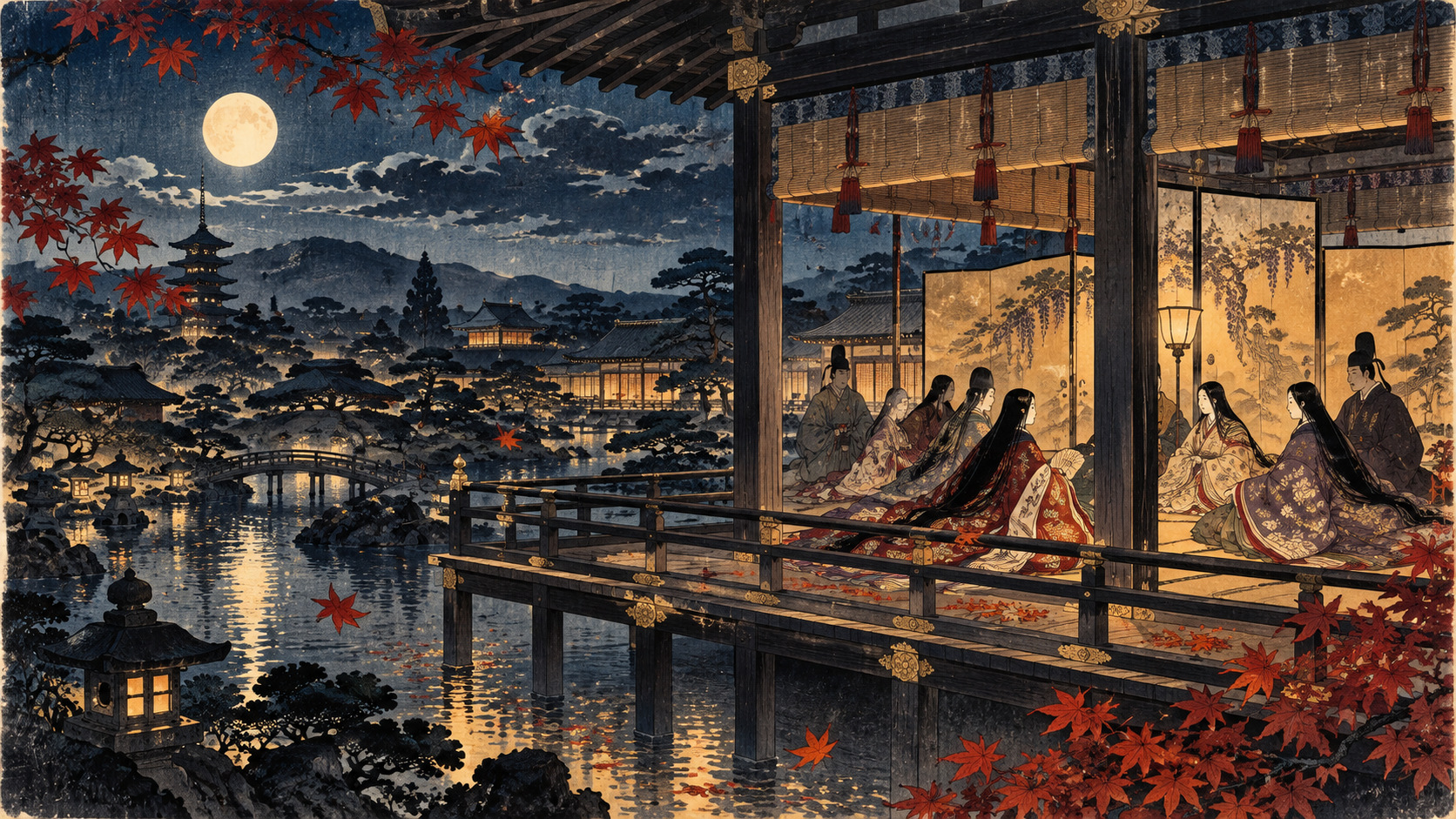
Meeting Genji again in Kyoto
The special exhibition “The Tale of Genji: The Splendor of the Royal Court,” which opened at Kyoto National Museum on October 6, is not simply a literary display. It is an argument about how a single work of fiction radiated across Japanese culture for more than a millennium. Starting from Murasaki Shikibu’s courtly masterpiece, the exhibition gathers paintings, manuscripts, commentaries, craft objects and material connected to performing arts and later popular reception. The result is not a museum lesson about one famous book. It is a portrait of how Genji became an engine of visual culture, interpretation and desire.
A practical October 12 story: the museum is open on the holiday
For readers on October 12, the exhibition is not an abstract cultural recommendation. It is open that day. Kyoto National Museum states that although Mondays are normally closing days, the museum is open on Monday, October 12, because it is a national holiday, and closed instead on Tuesday, October 13. The venue is Heisei Chishinkan, and the exhibition runs through November 29. Opening hours are 9:00 a.m. to 5:30 p.m., extended to 8:00 p.m. on Fridays. That practical detail matters because many cultural stories become useful only when they connect clearly to the reader’s real calendar. This one does.
The second life of a literary classic
The Tale of Genji occupies a central place in Japanese literary history, but the exhibition’s deeper insight is that the work’s importance cannot be explained by literature alone. Kyoto National Museum’s own description emphasizes the visual and material afterlives of the text: scenes and motifs from the story migrated into exquisite painting, decorative arts and other media. The exhibition traces that migration. In doing so, it shows that Genji’s history is also the history of readers turning a text into images, images into objects, and objects into new ways of thinking about beauty, longing and status.
Why Kyoto is the right place for this return
The phrase “returns to Kyoto” is not just poetic framing. Genji’s imaginative world is rooted in the courtly culture of Heian-kyō, and that connection gives the Kyoto venue unusual gravity. The exhibition will travel to Tokyo National Museum in 2027, but its first full expression in Kyoto carries symbolic weight. To encounter Genji here is to view a masterpiece near the cultural geography that first made its social world legible. That does not mean the story belongs only to Kyoto; Genji has long been national and global. But Kyoto remains the city where its atmosphere feels most resonant.
Masterpieces, yes—but not just masterpieces
The publicity materials foreground spectacular works, and rightly so. Among them is the National Treasure “Genji Monogatari Emaki: Hashihime” from the Tokugawa Art Museum, scheduled for display only in Kyoto from November 3 to November 15. Another highlight is the Important Cultural Property “Genji Monogatari Gachō: Wakamurasaki,” by Tosa Mitsuyoshi and Chōjirō, in the Kyoto National Museum collection. Yet the exhibition’s real ambition lies beyond isolated star objects. By bringing manuscripts, annotations, paintings, craft works and theatrical resonances into one narrative space, it asks viewers to see Genji not as a single artwork but as a cultural system.
Why rotation matters to the visitor experience
This is an exhibition built around change. The official information makes clear that there will be a major rotation between a first period, from October 6 to November 1, and a second period, from November 3 to November 29. Some objects will rotate at other times as well. That means no single visit can claim to have “seen the whole exhibition” in a simple sense. For visitors, this is not a minor logistical footnote. It shapes the meaning of the show. Genji itself has always been read differently depending on the era, the medium and the reader. The exhibition mirrors that multiplicity by making timing part of the encounter.
Why Genji still commands an audience now
The Tale of Genji has never stayed still as a cultural object. The 2008 millennium commemorations helped renew public engagement, but the work has also continued to live through modern translations, manga, film, scholarship, global teaching and repeated exhibitions. What this Kyoto show makes newly visible is how strongly Genji’s survival has depended on visual reinvention. The story continued to matter because people did not leave it in the realm of text. They painted it, staged it, annotated it, quoted it and redesigned it for new audiences. In that sense, the exhibition is not only about the past endurance of a classic. It is also about the mechanisms of cultural renewal.
A bridge between scholarship and public culture
Kyoto National Museum has designed an intellectual program around the exhibition as well. Memorial lectures in November focus on Genji and nō, and on the development and characteristics of Genji-related art. An international symposium on October 25 examines Genji and nō through the interpretive possibilities opened by English translation. These programs matter because they reveal the institution’s goals. The show is not just an arrangement of treasures for admiration. It is also a public forum for thinking about transmission: how a literary classic is studied, translated and made meaningful across languages and disciplines.
What visitors should know before they go
Practical details influence how a cultural story travels. General admission is ¥2,200, with reduced fees for university and high-school students; children in junior high school and younger enter free. The museum offers an on-site audio guide in Japanese and English for ¥700, and an app-based Japanese version as well. Visitors expecting a straightforward “picture-book of Genji” should also know that the exhibition ranges widely. It includes manuscripts and scholarly apparatus, not only beautiful courtly images. That breadth is precisely the point, but it can shape expectations and determine how rewarding a visit feels.
A classical masterpiece as current news
In contemporary media, exhibitions devoted to the classics are often treated as quiet cultural notices. This one deserves to be treated as current news. It shows a millennium-old work still active in the present tense—still generating scholarship, visual imagination, translation, tourism and public curiosity. In Kyoto, the city most closely associated with the world that gave Genji form, the exhibition makes a clear claim: the afterlife of a classic is not passive remembrance. It is a series of renewed encounters. To say that The Tale of Genji has returned to Kyoto is therefore not to describe a nostalgic homecoming. It is to describe a living conversation between historical memory and present-day cultural life.