A plant can have enough light and still be unable to use it safely. For researchers trying to understand cold damage, that creates a difficult question: when photosynthesis starts to fail, which protective system gives way first? A new Kyoto University study points to the stability of a molecular assembly inside the chloroplast—and offers a more precise target for investigating crop stress.
Published in New Phytologist on September 20 and announced by Kyoto University on September 25, the research examines the association between photosystem I, or PSI, and the chloroplast NADH dehydrogenase-like complex, abbreviated NDH. Its contribution is to connect cold-induced loss of protection with the breakdown of that association in cucumber.[1],[2]
The authors are Ko Takeuchi, now a specially appointed assistant professor at Kobe University’s Graduate School of Agricultural Science; Shintaro Harimoto, who completed Kyoto’s agriculture master’s program in the 2025 academic year; and Kyoto agriculture professor Kentaro Ifuku. Takeuchi and Harimoto share equal-contribution credit.[1],[2],[8]
A protective assembly comes apart
The paper’s abstract reports that chilling destabilizes the PSI–NDH supercomplex in cucumber, leaving NDH in a separate form with reduced activity. Damage to the light-harvesting antenna proteins that help connect the complexes is identified as a likely explanation. That wording matters: the proposed cause should not be strengthened into an unconditional finding.[2]
Kyoto’s detailed release says disassembly began within an hour of combined cold and light treatment. In a separate rice comparison, PSI activity after 24 hours was approximately 80% of its initial level in ordinary plants and 40% in an NDH-deficient line. The stated conditions were 4°C and light at 250 micromoles of photons per square meter per second. These are measurements of photosynthetic function, not harvest losses.[3]
Rice expressing flavodiiron protein, or FLV, provided another experimental route for accepting electrons downstream of PSI and avoided PSI photoinhibition under the tested conditions. This supports the importance of electron handling. It does not establish that the engineered plants are commercially available or that they deliver higher yields in farmers’ fields.[2]
Why a distinction between cold and freezing matters
Photoinhibition means a light-induced decline in photosynthetic function. The experiment’s temperature was above freezing: the relevant problem was not ice physically destroying a leaf. Kyoto describes excess electron accumulation at PSI and damage involving reactive oxygen species. A bright, cold environment therefore presents a different question from frost injury, even though both belong in a wider discussion of crop vulnerability.[1],[3]
The practical lesson is about defining the problem before promising a solution. A trait that helps protect photosynthetic machinery during one type of stress need not protect every other part of a plant, or work equally well at every stage of growth. “Cold tolerance” is too broad a label to convey what this experiment actually tested.
The story began with cucumber leaves in 1994
The historical starting point was a paper by Ichiro Terashima, Sachiko Funayama and Kintake Sonoike in Planta in 1994. After exposing cucumber leaves to 4°C in light for five hours, the researchers assessed the two photosystems separately. Their results identified PSI as particularly vulnerable under those conditions. That made it necessary to ask where damage occurred, rather than treating photosynthesis as a single undifferentiated process.[4]
Thirty-two years later, the new paper addresses a narrower question within that history: how a system that protects PSI can itself lose function. It should be understood as an advance within a continuing research program, not as the first discovery that cold affects photosynthesis. The distinction also helps explain why a molecular result can matter without immediately producing a new crop variety.
From differences between varieties to a molecular explanation
In 2022, Takeuchi and colleagues compared cucumber cultivars using measurements associated with P700, the reaction-center chlorophyll of PSI. Cultivars unable to develop the relevant oxidized state after chilling showed impaired growth, reduced chlorophyll content and smaller leaf area. The authors proposed the measurement as a useful indicator of chilling tolerance.[5]
That study connected an observable physiological response with differences between plants. A 2025 paper then examined NDH’s protective role; Kyoto’s accompanying announcement described a contrast between loss of NDH function in sensitive cucumber cultivars and greater stability in tolerant ones. The September 2026 paper moves further into the assembly’s physical stability. The 2025 and 2026 publications are distinct studies, with different titles and DOIs.[6],[7]
For breeders, this progression suggests a way to ask more discriminating questions about candidate plants. Instead of recording only whether seedlings look damaged, experiments can investigate which protective responses remain functional. But a useful research measurement becomes a useful selection tool only when it predicts an outcome that breeders and growers care about.
What would make this consequential for agriculture?
Japan.co.jp’s assessment is that the next decisive evidence would connect the molecular finding to performance across varieties, growing conditions and harvests. A promising experiment would need to establish whether maintaining the assembly helps plants recover after stress, whether the benefit persists under changing daylight and temperature, and whether there are costs under ordinary growing conditions. Those are questions for follow-up work, not results already established by this announcement.
The use of both rice and cucumber broadens the investigation, but it also requires careful reading. An experiment removing NDH function in rice and an experiment examining complex disassembly in cucumber answer related questions. They do not by themselves demonstrate that every crop suffers the same sequence of failure. Keeping the species and the intervention attached to each result prevents a useful general insight from becoming an unsupported universal claim.
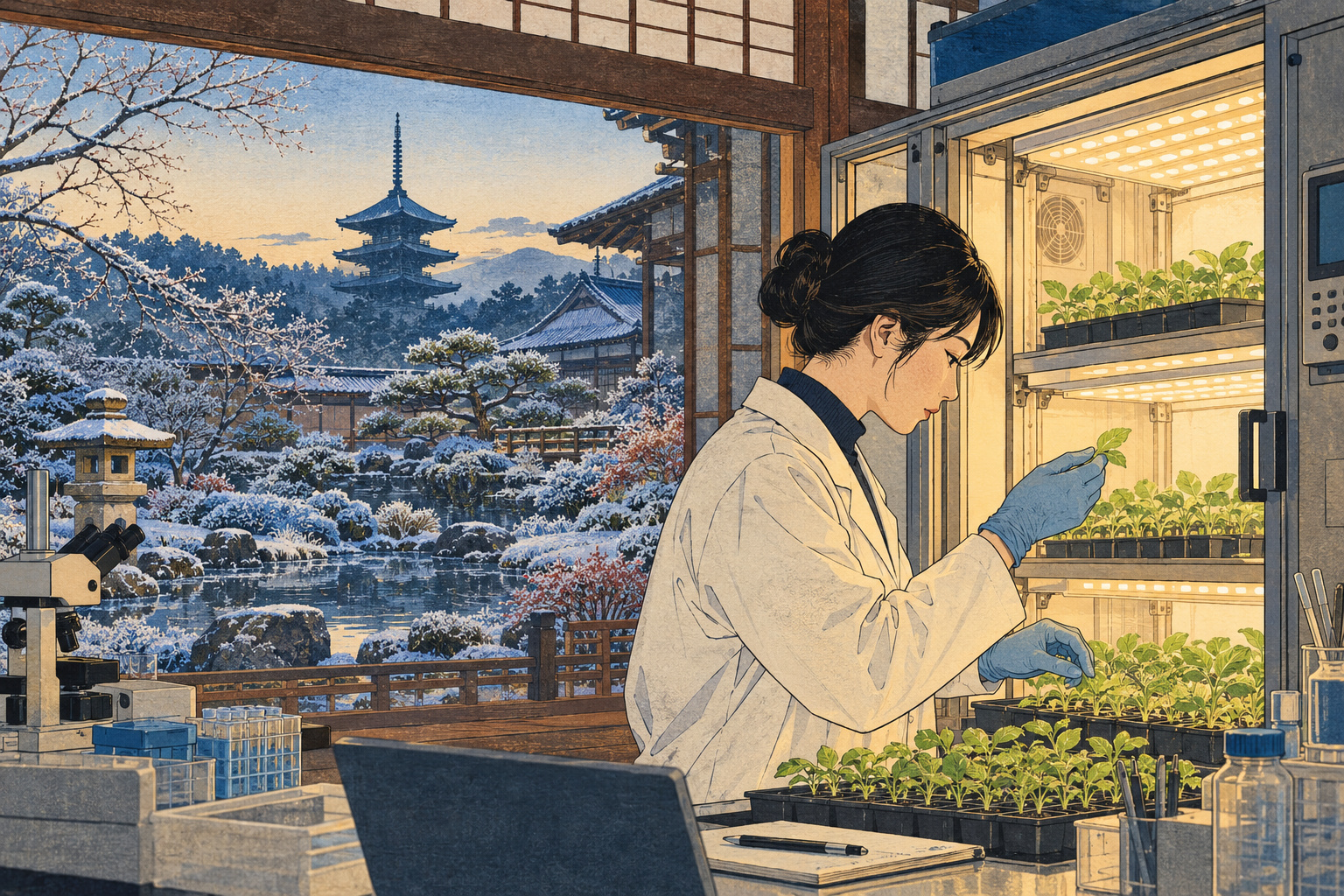
Greenhouse operators might eventually benefit if improved tolerance allowed crops to maintain quality and growth at lower temperatures. The present findings do not specify a safe reduction in heating temperature, a fuel saving or a financial return. Those would require cultivation trials that connect the trait to the whole production system. An illustration of a cold laboratory scene should likewise not be mistaken for a record of the actual experiment.
A better basis for the next investment decision
For seed companies and agricultural technology businesses, the immediate value is a more specific research question. Collaboration could investigate how reliably the relevant traits can be measured and whether they help rank candidate varieties. A commercial evaluation would then need to account for the time, cost and reproducibility of that testing, as well as eventual crop performance. None of those economics can be inferred from a favorable leaf measurement alone.
This is where the distinction between discovery and application becomes productive. Knowing which assembly fails gives researchers something concrete to test. Demonstrating that it can be preserved gives them a possible intervention. Showing that the intervention improves reliable production would supply the evidence growers need. Each stage asks for a different kind of proof.
The new study sharpens the first of those questions. Its importance lies in making the failure of a protective mechanism more intelligible, within a line of Japanese research extending back to 1994. Whether that understanding can help crops endure cold without sacrificing productive performance is now a clearer question to pursue.
