- A rivalry with a different purpose
- A development championship, not an under-24-only event
- Iguchi’s selection: arms, receivers and a short-term identity
- Korea brings its own generation of ambition
- The memory of 2023—and how not to misuse it
- How the middle innings can decide the game
- The rules that can rewrite an inning
- Tokyo Dome: a stage with its own physics
- How to follow the game in Japan and Korea
- What the game can tell us about Asia’s baseball future
A rivalry with a different purpose
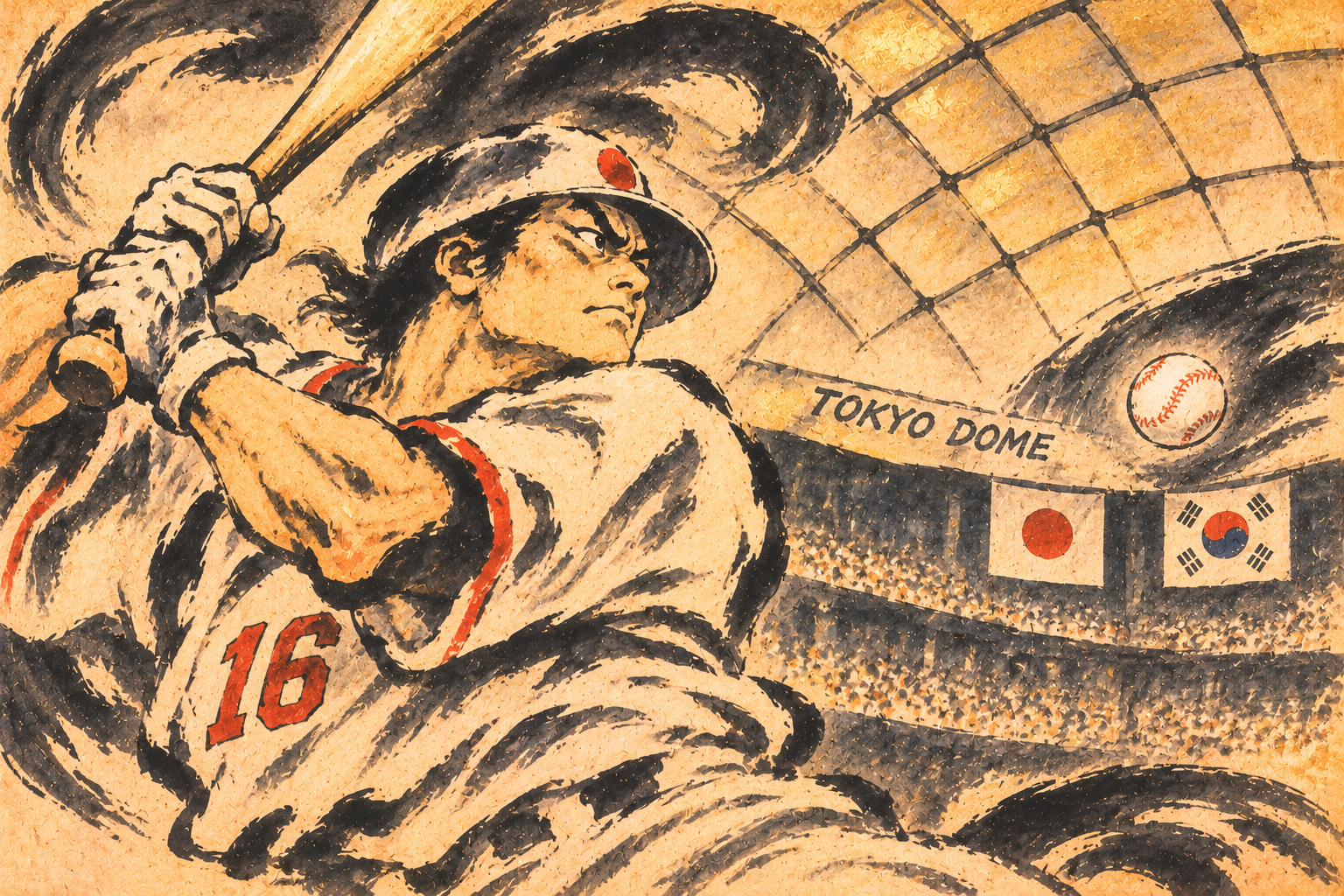
At 7 p.m. Japan Standard Time on Friday, November 13, Japan and Korea are scheduled to meet under Tokyo Dome’s roof. The pairing carries decades of baseball memories, but the Asia Professional Baseball Championship is not merely a miniature version of the World Baseball Classic. It is designed as a stage where emerging professional players learn to compete against different pitching, scouting conventions and national-team expectations.
The four-team competition runs November 12–15, bringing together Japan, Korea, Chinese Taipei and Australia. All four play a round-robin schedule before the third-place game and final on November 15. Japan plays Chinese Taipei on November 12, Korea on November 13 and Australia on November 14. This account is an advance feature based on confirmed announcements available November 10. It does not claim that the opening games have occurred or that a starting lineup has been named.
A development championship, not an under-24-only event
The tournament is jointly hosted by Nippon Professional Baseball, Baseball Australia, the Chinese Professional Baseball League and the Korea Baseball Organization. Its roster architecture is a statement of purpose: 28 registered players, principally those age 24 or younger or within their first three professional seasons, with as many as three overage players up to 29. The published rules also describe an agreed exception permitting some players age 25 or younger who were born on or after January 1, 2001 when roster construction proves difficult.
That is why the phrase “under-24 championship” would be misleading. Development here is measured partly by experience, not simply birth date. Unlike a club schedule, in which athletes can settle into familiar systems over months, managers must build a viable team from different organizations within days. International exposure is both the benefit and the challenge.
Iguchi’s selection: arms, receivers and a short-term identity
Japan’s announced manager is Tadahito Iguchi (井口資仁), supported by head and batting coach So Taguchi, pitching coach Akinori Otsuka and others. Their challenge begins well before first pitch. They must settle defensive alignments, communicate pitching plans and construct an effective bullpen without the rhythms of a full season.
The official October 7 player list includes pitchers Hiroto Takahashi (髙橋宏斗), Yumeto Kanamaru (金丸夢斗), Natsuki Takeuchi (武内夏暉), Yutaro Ishida (石田裕太郎) and Shunsuke Nakamori (中森俊介). Catchers include Shion Matsuo (松尾汐恩), Taiga Kojima (小島大河) and Yuya Shintoh (進藤勇也). Among the position players are Rui Muneyama (宗山塁), Ryuki Watarai (度会隆輝), Misho Nishikawa (西川史礁) and Seiya Watanabe (渡部聖弥). These are announced selections, not a prediction that any named player will start or appear in the Korea game.
Korea brings its own generation of ambition
Korea’s November 8 roster names manager Choi Won-ho (崔元豪). Listed infielders include KIA Tigers player Kim Doyeong (金倒永), NC Dinos infielder Kim Juwon (金周元) and Samsung Lions infielder Lee Jaehyeon (李在玹). Outfielders include KT Wiz’s Ahn Hyunmin (安賢民) and Hanwha Eagles’ Moon Hyunbin (文賢彬). The roster also lists several left-handed pitchers, including Lotte Giants’ Kim Jinuk (金晉旭) and SSG Landers’ Kim Keonwoo (金健優).
These details matter for a specific reason. Short tournaments magnify matchups. A switch-hitting shortstop such as Kim Juwon may complicate platoon calculations, while a manager with multiple left-handed arms has several ways to interrupt a sequence of opposing hitters. But handedness is not a scouting report by itself, and announced roster names should not be presented as confirmed availability, batting order or starting assignments.
The memory of 2023—and how not to misuse it
The Asia Professional Baseball Championship began in 2017 and returned in 2023 with four nations at Tokyo Dome. Japan beat Korea 2–1 in that year’s round robin. They met again in the final, when Japan won 4–3 in extra innings. The official tournament record names Makoto Kadowaki as most valuable player, and Japan finished ahead of Korea, Chinese Taipei and Australia.
It is tempting to reduce this Friday’s meeting to a replay of that final. That would miss the tournament’s point. The rosters are different; young professionals enter and graduate from the development cycle. The proper historical comparison is between the environments that test them: the pressure of one-run decisions, the scarcity of recovery time, and the need to execute against opponents whose tendencies have been studied in a different league.
How the middle innings can decide the game
International rivalry coverage often concentrates on who starts on the mound. Yet the crucial strategic moment may come when the starter leaves. A manager has to decide whether to protect a promising young pitcher, seek a left-on-left matchup, or save a reliable relief arm for the following day. Those choices become more consequential when a team plays three preliminary games in three days.
Japan’s announced pool of left-handers includes Kanamaru and Takeuchi; Korea’s includes Kim Jinuk and Kim Keonwoo. Neither fact tells us who will open the November 13 game. The more defensible preview is to follow the tactical questions: who can cover multiple innings, which defenders can shift positions, and whether the teams can handle speed on the bases and hitters who change sides of the plate. The answer will emerge from official lineups and actual play—not from speculative “probable starters.”
The rules that can rewrite an inning
The published tournament framework includes a designated hitter in every game, a pitch clock, permitted PitchCom use and replay review. It has no listed pitch-count limit. If a game is tied after nine innings, extra innings are scheduled to begin with runners on first and second and nobody out, using the continuing batting order. A ten-run mercy rule after seven innings does not apply to the final.
The organizers nevertheless note that details, including pitch-clock timing, were subject to final discussion by the four governing bodies at a November 11 managers’ meeting. It would be wrong to import the exact NPB or MLB clock settings without confirmation. Such details are not trivia. Starting an extra inning with two runners aboard changes the value of a bunt, the use of a pinch runner and the timing of an intentional walk. In a four-day tournament, tactical preparation has to be unusually precise.
Tokyo Dome: a stage with its own physics
Opened in 1988, Tokyo Dome is a distinctive venue in the history of Japanese baseball. Its enclosed roof makes weather interruptions less central, but produces its own rules. Official championship guidance addresses balls that strike the ceiling or suspended structures, including different consequences according to whether contact occurs above fair or foul territory.
The organizers specify that Japan occupies the first-base side in its games, and Korean baseball authorities have announced a traveling support section with trumpet and drum-led cheering. Japanese and Korean supporter traditions will share one building, but spectators should consult the organizers’ seating restrictions, including rules governing standing support and opposing-team merchandise. A baseball crowd is part of the contest’s atmosphere; it is not evidence for claims about the players’ motives or attitudes.
How to follow the game in Japan and Korea
The Japan–Korea first pitch is listed for 7 p.m. JST on November 13. In Japan, TV Asahi affiliates plan terrestrial coverage starting at 6:50 p.m., with availability varying by region. Prime Video’s scheduled stream begins at 6:30 p.m. Korea Baseball Organization announced a domestic lineup involving KBSN Sports, MBC Sports+, SBS Sports and SPOTV, with streaming through TVING. Access and territorial restrictions should be checked with the broadcasters.
Australia meets Chinese Taipei at noon on November 13, and Japan plays Australia at noon the following day. The final and third-place game are scheduled for November 15. This schedule makes the Korea matchup important, but not a championship final. It also means that the outcome of Thursday’s Japan–Chinese Taipei game should be inserted only after official scoring is available.
What the game can tell us about Asia’s baseball future
A development tournament is valuable partly because its answers do not fit neatly into one scoreboard. Players learn to prepare for unfamiliar pitching, catchers coordinate with new staffs, and managers discover who can perform when a game is compressed into a single decisive inning. The experience may influence future national-team selections, but one performance cannot credibly establish a player’s long-term ceiling.
For the final edition, JAPAN.co.jp should verify Thursday’s opening results, any revised player registrations, the November 13 starting pitchers and lineups, and the game’s official outcome once played. Until those facts exist, the useful service is to explain what is confirmed and what to watch. That approach makes the Japan–Korea contest more meaningful than a loud prediction about which side will prevail.
Primary documents and verification
Announced roster selections are not confirmed starters. Check Nov. 11 rule updates, Nov. 12 results and all Nov. 13 game information when released.