A poem is hanging in the autumn air
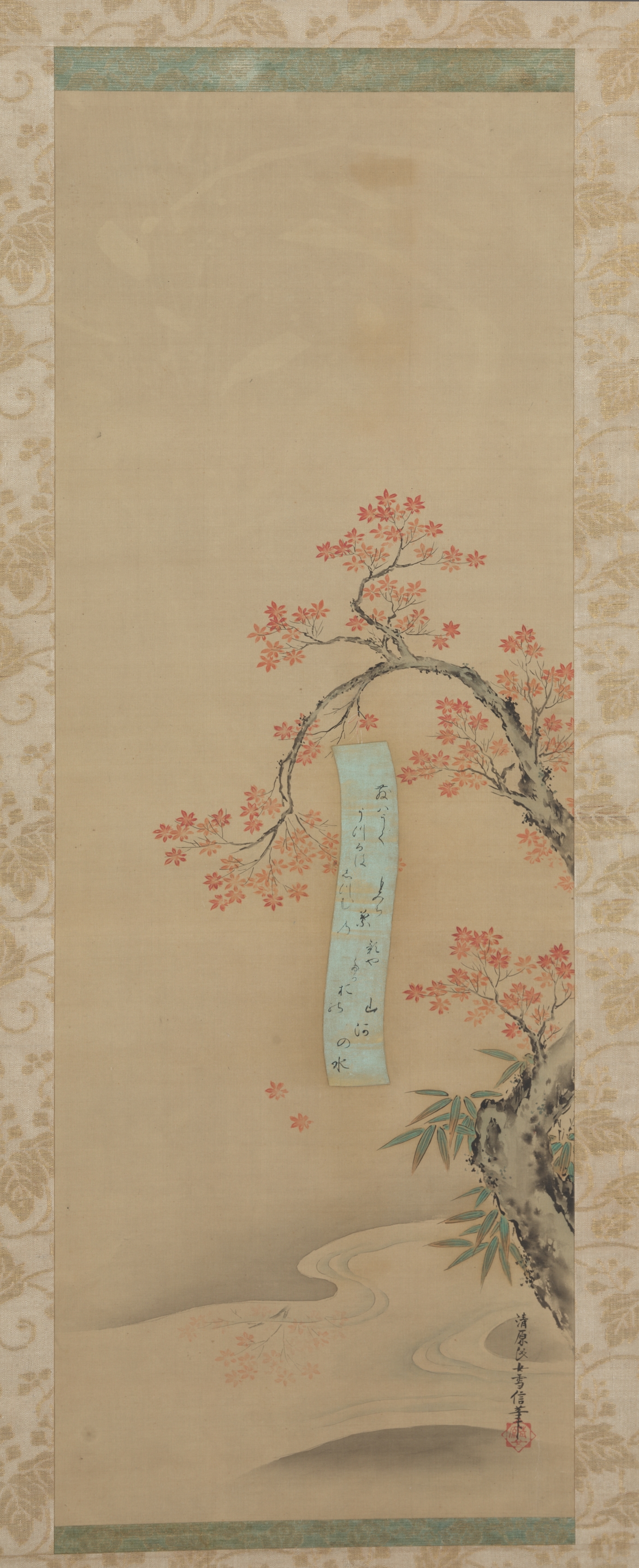
A maple tree bends across an almost empty field of silk. Its leaves have turned warm shades of orange and red. Bamboo gathers by a slender stream. Suspended from a branch is a pale blue poem slip, small enough to overlook but large enough to change the painting’s emotional temperature. Kiyohara Yukinobu’s Autumn in Takao, made in the late seventeenth century, seems at first to be a restrained seasonal landscape. Look longer, and the absent human figure becomes the most interesting presence of all.
The Cleveland Museum of Art suggests the hanging poem card may evoke the passage of a love affair. That is a curatorial interpretation, not a complete decipherment of the inscription. The museum record does not provide a verified text or author for the verse, and this article will not invent one. What remains is more compelling than an unsupported anecdote: a visible object that invites several forms of reading.
A very small picture with a very large silence
The work is an ink-and-color hanging scroll on silk, with the painted section measuring 89.7 by 32.7 centimeters. Its tall, narrow proportions matter. The eye follows the maple’s leaning trunk and then the gently suspended strip of paper before returning to the lower edge, where bamboo and water anchor the scene. Negative space is not a void to be filled with scenery. It is a structural element that lets every leaf and mark matter.
Cleveland identifies the setting as Takao, a celebrated foliage destination in the mountains outside Kyoto. Yet the painting is not a photographic itinerary, and its power does not depend on identifying an exact viewpoint or temple. It offers an imagined experience of the season, distilled through a few natural forms and the cultural memory of writing poems about longing, distance and change.
Who was Kiyohara Yukinobu?
Yukinobu lived from 1643 to 1682 and came from Kyoto. Her father was Kusumi Morikage, a painter associated with the formidable Kano school, and her mother’s family connected her to the celebrated artist Kano Tan’yū. Museum scholarship describes Yukinobu as one of Japan’s earliest documented professional women painters—unusual not simply because she painted, but because a body of identifiable work and biographical information survives.
Her position was neither wholly outside the artistic establishment nor easily explained as privilege alone. Workshops and family relationships created opportunities to learn, gain commissions and circulate paintings. They also operated within a society in which women’s work was much less likely than men’s to become part of standard histories of official painting.
Painting in the orbit of a shogun
Kano Tan’yū served the Tokugawa shogunate and participated in the vast decorative programs that shaped elite residences and castles. The workshop system could mobilize painters and craftspeople for projects of immense scale. Yukinobu learned within this tradition, mastering measured contours, reduced palettes and compositional asymmetry rather than merely imitating one celebrated hand.
The Metropolitan Museum’s scholarship also points to her use of the surname Kiyohara, associated with her maternal line, and an inscription identifying herself as a daughter of that clan. It is tempting to translate this directly into a modern declaration of feminist independence. A more historically grounded reading is that signatures, family ties and professional practice were all ways artistic identity acquired public meaning.
The history written into a color palette
Seventeenth-century Kano painting ranged from glittering architectural decoration to concentrated ink works. Autumn in Takao sits toward the quieter end of that spectrum. Muted washes surround a few precise touches of color; outlines turn the trunk into a vivid structure without making it monumental. One senses autumn through relationships between pigments rather than through an overwhelming field of scarlet foliage.
This was not Yukinobu’s only mode. The Itabashi Art Museum in Tokyo holds a substantial Birds and Flowers screen, an ink work that its curatorial note relates to the brush practice of both Tan’yū and her father, Morikage. The surviving screen complicates any notion that women artists of the period were confined to tiny decorative objects or soft images.
A painter of birds, histories and classical women
Yukinobu’s surviving works range across landscapes, birds and flowers, Buddhist subjects, Chinese and Japanese literary figures and prominent women from classical culture. The Metropolitan Museum holds Waxwings, Cherry Blossoms, and Bamboo, in which three birds occupy different positions within a spring composition. Its discussion notes an interpretation of the waxwings as emblems of domestic harmony, while leaving room for other responses.
In Quail and Millet, the same museum emphasizes asymmetry and restraint. These are useful comparisons with Autumn in Takao: the artist is not simply decorating surfaces with botanical accuracy. She arranges creatures, branches and intervals so viewers perceive a relationship—and perhaps an unfinished story—between them.
The poem slip and the literature of longing
Yukinobu frequently turned to the world of classical Japanese literature, especially the inherited visual language of the Heian period. A poem card tied to a maple tree belongs to a cultural universe in which written verse could stand for a person, an encounter or a communication that might never be completed. The slip lends human implication to an otherwise unpeopled place.
But identifying the image with a particular literary episode requires evidence not provided by Cleveland’s catalog. Nor should the precise wording of the poem be invented from the painting’s mood. Good art history is as attentive to what is unknown as to what is visible, and the mystery of this small blue rectangle is part of the painting’s continuing appeal.
Why a museum accession number matters
Autumn in Takao entered the Cleveland Museum of Art in 1991 as a seventy-fifth-anniversary gift from Kyoto art dealer Takashi Yanagi. It is catalogued as accession 1991.55 and is not currently listed as on view. Those details make the picture accessible to the public even when the object is not hanging in a gallery. They also demonstrate how a work can move through private collections into a museum’s care while its interpretation keeps changing.
Cleveland’s Open Access program allows people to copy, modify and distribute images of the work. For this edition, Japan.co.jp’s Art Choice therefore uses an authentic image of the surviving painting, not a generative recreation. The image should retain the scroll’s vertical proportions, inscription and seal; an attractive landscape crop would eliminate precisely the relationship between emptiness and detail that makes the picture remarkable.
A historical screen that must not be mistaken for a collaboration
The Metropolitan Museum also owns a six-panel Birds and Flowers screen associated with Tan’yū, Kano Naonobu and Yukinobu. The master’s works occupy its central section and hers appear on the outside. But the museum explains that the present assembly dates to the late nineteenth or early twentieth century. It would be misleading to call the surviving screen proof that all three artists painted together in a single seventeenth-century commission.
Instead, the object documents two histories at once: the original paintings and their later selection and mounting. The decision to preserve Yukinobu beside two well-known Kano painters indicates how later collectors valued and classified her output. The material biography of a painting can be as revealing as the name written on its mounting.
Two women, separated by centuries
In the same October 14 edition, Japan.co.jp follows shogi champion Tomoka Nishiyama as she considers a newly earned right to enter a separate professional kishi system. There is no simple equivalence between a woman negotiating a twenty-first-century sporting institution and a professional artist working through Edo-period family studios. Treating them as interchangeable icons would flatten both lives.
Their placement together is nevertheless thought-provoking. Each story concerns mastery accumulated over years and the public structures that determine how skill is recognized. Yukinobu’s work is evidence of such mastery, not an illustration added after the fact to a modern debate. Her brush has its own story to tell.
A seasonal painting that asks us to stay
In a news culture measured by what can be understood at a glance, this work rewards the opposite habit. The first encounter offers autumn colors. The second notices the strip of paper. The third begins to wonder who tied it there and why a painter chose to leave nearly everything else unstated.
The painting has survived more than three centuries without giving up all its secrets. The decision to leave space—for weather, longing, uncertainty, or the viewer’s own thought—is its discipline. That is why an autumn branch and a small blue poem can still hold the attention of a world far removed from seventeenth-century Kyoto.