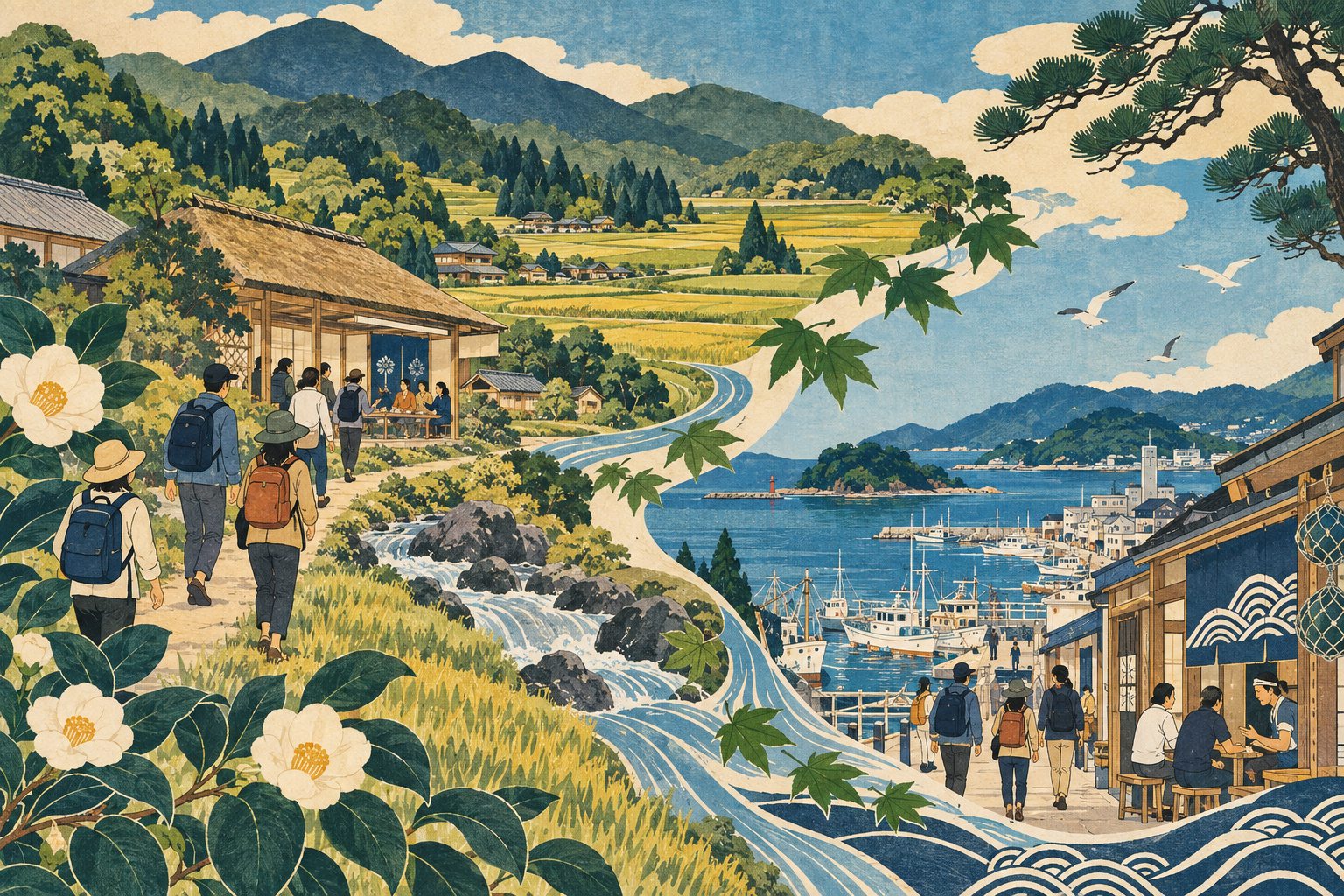
The most revealing detail in Japan’s new sustainability study tours is the application rule: come with somebody from your own community. The Environment Ministry is recruiting pairs of practitioners for visits to Kameoka in Kyoto Prefecture and Ishinomaki in Miyagi Prefecture, with preparation and follow-up designed to turn a short visit into work that continues at home.[1][3]
Announced on September 14, the programme connects two markedly different settings. Kameoka’s itinerary begins with the Hozu River and extends to art materials, organic farming and natural whetstones. Ishinomaki’s takes participants into forests and streams to consider the environmental relationships supporting coastal livelihoods. Both are scheduled training programmes; their results remain to be seen.[2]
A national idea with local responsibilities
The policy behind the visits is chiiki junkan kyōseiken, 地域循環共生圏, which links the use of local resources with environmental protection, social needs and economic activity. The ministry also describes it as local SDGs. Its concept of a self-reliant region includes cooperation with other places: a community need not produce everything within its own boundaries to strengthen its future.[4]
The approach entered Japan’s Fifth Basic Environment Plan in April 2018. The Sixth Plan, adopted in May 2024, positioned these regional initiatives as places to put improvements in well-being and quality of life into practice.[1] The analytical appeal is straightforward. A business, a river and the people caring for it can be considered together, even when administrative responsibilities fall into different departments.
That does not eliminate difficult choices. An initiative may reduce waste while requiring substantial unpaid labour. A popular workshop may attract visitors without paying for year-round maintenance. A convincing study visit should make such operating conditions visible alongside the projects themselves.
Kameoka: how concern for a river becomes a public rule
Kameoka offers a documented history of moving from an environmental goal toward everyday practice. On December 13, 2018, the city and its assembly issued a declaration aiming for zero disposable plastic waste by 2030. The city explicitly connected care for the Hozu River with the wider problem of marine plastic pollution.[5]
A plastic shopping-bag ordinance followed. Approved in March 2020, it prohibited businesses from providing the bags covered by the ordinance, whether free or for a charge, from January 1, 2021. It is not a prohibition on every plastic product. The city’s account describes approximately 50 explanatory meetings during the development of the measure, including discussion of the preparation time businesses needed.[6][7]
For a visiting community organiser, that history offers more than an example of a ban. It invites questions about how a shared concern becomes workable obligations: who talks to shops, how residents adapt, and how a municipality supports change. Article 8 of the ordinance requires the city to investigate effects and understand conditions. Making a rule and establishing whether it works are connected responsibilities.[7]
The November 9–11 course looks beyond plastic policy. The advertised activities include the art-material circulation project 巡り堂, organic farming and a sharpening experience involving natural whetstones. The programme introduces the local community-tourism organisation Fogin, established in 2020, through its representative director and course coordinator.[2]
These subjects offer different ways to investigate the same practical question: what allows a resource to remain useful? An unused material needs someone to collect it, somewhere to keep it and somebody able to use it. A skill needs people who can demonstrate it and others who want to learn. That interpretation is an analytical reading of the itinerary, not a claim that the organisers have published financial or environmental results for every stop.
Ishinomaki: a fisheries organisation looks inland
The Ishinomaki course, scheduled for November 30–December 2, is coordinated through a co-founder of the Fisherman Japan research institute. Planned activities include removing accumulated material from streams by hand, described in the Japanese programme as 沢活, and building “bionests” using thinned wood for deer-damage countermeasures and soil-making activities.[2]
The institutional history helps explain why a fisheries-related programme would take visitors into a forest. The general incorporated association Fisherman Japan was established in July 2014 and is headquartered in Ishinomaki. It identifies succession and distribution problems that predate the earthquake disaster as underlying challenges for the industry. Its work has sought to connect the development of new workers with viable livelihoods.[8]
According to its own account, the organisation expanded from workforce development and market-building into environmental initiatives. It established its Blue Fund in 2023 to support marine environmental work financially. The research institute was created to connect knowledge gained by fishing communities with scientific investigation, including questions extending from the sea into surrounding mountains and settlements.[9]
That history changes how the itinerary reads. The forest activities are part of an attempt to understand the wider setting of a coastal economy. They are not, on the evidence of a tour announcement, proof that a particular intervention increases fish catches or restores an ecosystem.
A participant should therefore be able to ask both kinds of question: what does the activity teach people about their surroundings, and what measurements would establish its environmental effects? Experience can generate useful questions and working relationships. Demonstrating an ecological outcome requires evidence beyond participation itself.
The partner who travels home with you
Applicants must be working on community development and apply with another person active in the same region. They may belong to one organisation or to different organisations. The guidelines require attendance throughout the programme, completion of assignments, willingness to apply the learning locally, participation in exchanges and cooperation with a later ministry questionnaire.[3]
The pairing requirement addresses a familiar implementation problem: the person who returns enthusiastic from a visit may not control the budget, hold the necessary relationships or have time to act alone. Two participants can compare what they saw and discuss a next step with a shared reference point. That is a plausible benefit of the design, not an outcome already demonstrated for the 2026 intake.
The training has a deliberate sequence. An online orientation introduces the framework and preparatory work. The three-day field visit moves from understanding the setting to direct experience and then to organising the information gathered. An online follow-up returns attention to participants’ own activities.[3]
This structure gives the trip a purpose beyond collecting examples. A participant might return with a clearer account of who could work together locally, what assets are being overlooked and which small experiment is feasible. Whether that happens will depend on the people, their institutions and the support available after the visit.
What another community can reasonably borrow
A river basin in Kyoto and a coastal city in Miyagi have different industries, relationships and histories. Copying a visible activity does not reproduce the conditions that sustain it. The transferable knowledge may lie in less photogenic details: permission to use a site, responsibility for equipment, a paid coordinator’s time, or an agreement about who maintains a project between events.
For that reason, useful questions extend beyond “How did you start?” Who keeps the accounts? Which tasks require specialist skills? What happens when the original organiser leaves? What is financed through sales, what through public support, and what through unpaid effort? These are questions for investigation, not documented deficiencies in either host community.
Evaluation also needs more than an attendance count. A reuse project could track material actually put back into use and the cost of handling it. An environmental activity could document conditions over time and distinguish an intervention from seasonal change. A collaboration could examine whether responsibility and workload are shared. These are suggested tests from this report, not indicators announced by the tour organisers.
The most useful return from a study tour may be a modest, testable next step. A community can begin with something it can maintain, record what happens and revise it with the people affected. That is how learning from another place can become local capacity.
Dates, eligibility and the meaning of “free”
| Stage | Kameoka | Ishinomaki |
|---|---|---|
| Joint online orientation | October 28, 18:00–20:00 | |
| Field visit | November 9–11 | November 30–December 2 |
| Meeting and finish | Kameoka Station: 11:00 first day; 17:00 final day | Ishinomaki Station: 12:00 first day; 17:00 final day |
| Online follow-up | November 25, 18:00–20:00 | December 22, 18:00–20:00 |
| Capacity | 10 pairs / 20 people | 10 pairs / 20 people |
The deadline is October 4 at 23:59 JST. Applicants choose one course. If applications exceed capacity, selection applies; results are scheduled to be emailed to each pair’s representative between October 13 and 16.[3]
There is no programme fee. The secretariat arranges the field-visit accommodation and insurance without charging participants. Travel reimbursement is subject to the guidelines, including economical routing, prior route confirmation and applicable documentation, with settlement after the trip. Meals, including those at exchange events, are generally paid by participants.[3]
Prospective applicants should consult the official programme page and application guidelines. Activities may change with local circumstances. The commitment is to preparation, fieldwork and follow-up—and ultimately to considering what the experience can contribute to the community waiting at home.[2][3]
Sources and methodology
Programme facts were checked against Japanese ministry materials and application guidelines. Local history draws on municipal and organisational primary sources. Planned activities, organisations’ own accounts and this report’s analysis are distinguished; this is not an eyewitness account or an evaluation of completed tours.
- Environment Ministry: September 14, 2026 announcement; programme purpose and policy history
- Environment Ministry: official programme page, planned activities and coordinator profiles
- Environment Ministry: 2026 application guidelines; schedule, eligibility and expenses
- Environment Ministry: 2022 Environment White Paper; the regional circulation and cooperation concept
- Kameoka City: environmental policy, December 2018 declaration and 2030 ambition
- Kameoka City: plastic shopping-bag ordinance, adoption and consultation history
- Kameoka ordinance text: definitions, business responsibilities and assessment of effects
- Fisherman Japan: organisational history, purpose and July 2014 establishment
- Fisherman Japan: research institute background and purpose, as described by the organisation