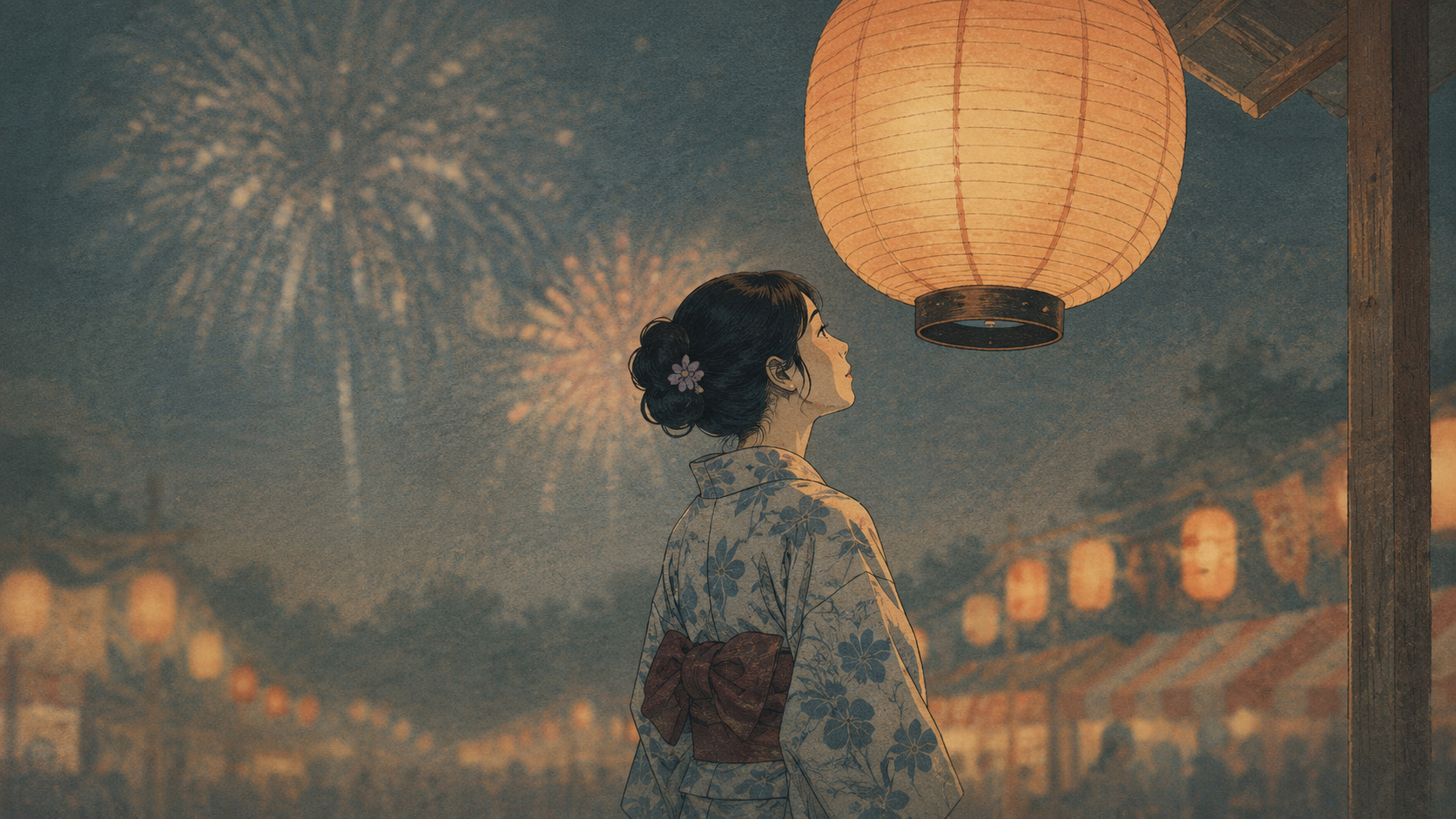
In July, Japan does not simply turn a calendar page. The country changes sound. In Kyoto, wooden float frames begin to rise. In Shonan, long paper streamers hang above a shopping street near Hiratsuka Station. In Osaka, drums and boats prepare for the river. In Tokyo, the Sumida River waits for a night of fireworks. The air is humid, the sleeves are light, the lanterns are warm, and the streets begin to remember what summer means.
July 2026 opens with one of the strongest festival calendars in Japan. Kyoto's Gion Matsuri runs from July 1 to 31, with Yamahoko float processions on July 17 and 24. The Shonan Hiratsuka Tanabata Festival runs July 3 to 5. Osaka's Tenjin Matsuri reaches its main days on July 24 and 25. Tokyo's official Sumidagawa Fireworks Festival website lists the 49th festival for 7 p.m. on July 25. In one month, four different cities light four different kinds of memory.
This is more than a travel calendar. Gion Matsuri began as a ritual against plague. Hiratsuka's Tanabata carries the story of postwar shopping-street revival. Tenjin Matsuri is Osaka's river city turned into sacred procession. Sumidagawa fireworks began as a rite of mourning and protection after famine and disease. To watch Japan's July festivals is to see how the country has transformed fear, prayer, commerce and grief into public beauty.
Gion Matsuri began with plague memory
Gion Matsuri reaches back to the year 869. Kyoto was suffering from epidemic disease, and the court sought to calm invisible forces through ritual. Spears were raised at Shinsen-en, Yasaka Shrine's deities were invoked, and a goryo-e purification rite was performed to pacify disease and vengeful spirits. Today's festival is spectacular, but beneath the brocade and music lies a memory of fear, death and communal prayer.
Yasaka Shrine explains that on the mornings of July 17 and 24, 34 lavishly decorated Yama and Hoko floats are drawn through Kyoto's streets. The procession is often described as a moving museum. The floats carry textiles, metalwork, carving, music, ropework and neighborhood pride. They are not simply vehicles. They are monumental public crafts that make memory visible.
A whole month in which the city becomes festival
The beauty of Gion Matsuri is not only the climax. It is the slow transformation. From the first July rituals through float construction, trial pulling, Yoiyama evenings, the two float processions, mikoshi movements and final rites, central Kyoto gradually enters festival time. For visitors, July 17 and 24 are the obvious dates. For the city, the process of preparation is also the festival.
Gion Matsuri survives through a delicate balance of faith, commerce and urban life. Central Kyoto is a tourist destination, a business district and a neighborhood. The Yamahoko communities preserve the festival while living inside a modern city. For Kyoto, Gion Matsuri is not only culture to be displayed. It is culture to be continued.
Hiratsuka's Tanabata made a postwar shopping street into a sky
If Gion Matsuri begins in Heian-period plague memory, the Shonan Hiratsuka Tanabata Festival belongs to a different story: postwar urban revival. In 2026 it runs from July 3 to 5 around the north side of JR Hiratsuka Station. Kanagawa's tourism site presents it as one of Shonan's signature summer events, easy to reach from the station and centered on the city's shopping streets.
Tanabata itself combines a star legend from China with older Japanese weaving rituals. Orihime and Hikoboshi, wishes written on paper strips, bamboo, stars and longing. But Hiratsuka's festival is also a modern civic creation. After the war, shopping streets needed people, brightness and confidence. Decorations became recovery. The street looked upward and remade itself under paper stars.
A shopping street decorates the sky
What makes Hiratsuka memorable is the feeling of color above your head. Giant streamers hang over the streets. When the wind moves, the paper sways and people stop to take photographs. If Gion Matsuri is a moving museum, Hiratsuka's Tanabata is a walk-through gallery of the sky.
The festival also feels distinctly Shonan. It is coastal, accessible from Tokyo, casual enough for families and day-trippers, bright enough for young visitors, and rooted enough for locals. Japan's summer festival culture includes solemn shrine rites, but it also includes shopping streets that learned how to make the city cheerful again. Hiratsuka is one of the best examples of that second tradition.
Osaka's Tenjin Matsuri is the festival of a river city
In late July, Osaka turns toward the Tenjin Matsuri. The Japan National Tourism Organization describes the festival as beginning on July 24 with rituals at the shrine and river, a lion dance, and prayers for Osaka's safety and prosperity. The center is Osaka Tenman-gu Shrine. The deity is Sugawara no Michizane, the scholar, poet and statesman later revered as Tenjin, patron of learning.
Osaka was a city of rivers. In the Edo period it was known as the nation's kitchen, a commercial hub where rice, goods, merchants and boats moved across waterways. The Tenjin Matsuri's boat procession preserves that urban memory. The land procession leads to the river, boats move through the evening, and the center of Osaka shifts toward the water. Kyoto's festival is about streets and neighborhoods. Osaka's is about water, commerce and heat.
A scholar-god lights a merchant city
Sugawara no Michizane was a Heian-period scholar and politician who was exiled to Dazaifu after court intrigue. After his death, his spirit was feared and then worshiped as Tenjin. Like Gion Matsuri, Tenjin faith carries an older layer of pacification. Many Japanese festivals place joy on top of fear and remembrance.
But Tenjin Matsuri is not dark. It is drums, boats, fire, night stalls, yukata and crowd energy. Prayer and commerce, sacred rite and entertainment, street and river all move together. That mixture is part of Osaka's cultural power.
Sumidagawa fireworks began as Edo mourning
Tokyo's July ends with one of its great lights: the Sumidagawa Fireworks Festival. The official website lists the 49th festival as scheduled for 7 p.m. on July 25, 2026. JNTO traces the tradition to the Ryogoku river-opening fireworks of 1733, launched to console the dead and pray against disease after famine and epidemic suffering.
Today the Sumida River fireworks are a modern urban spectacle, framed by Tokyo Skytree, Asakusa, bridges, apartment towers, trains, boats, police lines and smartphone cameras. But the origin was memorial. Once again, summer light is tied to the memory of death. That history is one reason Japanese fireworks can feel like more than entertainment. They have a touch of prayer.
From Edo to Tokyo, the river crowd remains
In Edo, the Ryogoku fireworks were popular entertainment, with boats, restaurants, bridges, crowds and competing pyrotechnic houses. The old cries of Tamaya and Kagiya remain in the cultural memory of Japanese fireworks. Today there are traffic controls, marine restrictions, reserved seats and social media. Yet the essential experience is still old: people gather by the river, look up, and feel the sound arrive in the chest a moment after the light.
For 2026 tourism, Sumidagawa matters because visitors increasingly seek seasonal experiences, not only monuments. A night in yukata around Asakusa, a walk toward the river, fireworks around the skyline — this is the sort of memory Tokyo can give that no shopping district alone can match.
Festivals are also a way of managing heat
Japanese summers are becoming harder. Extreme heat, sudden rain, crowding and heatstroke risk now sit beside beauty. Gion, Tanabata, Tenjin and Sumida all require care. They are crowded, humid and logistically complex. Hydration, transit planning, multilingual guidance, toilets, medical support, crowd information and weather alerts are no longer secondary details. They are part of festival survival.
That is why festivals are also modern news. Tradition does not continue by staying frozen. It continues by adjusting to climate, tourism, residents, safety, commerce and faith. Lanterns and smartphones, floats and crowdfunding, mikoshi and police plans, fireworks and boat restrictions all coexist. Old festivals are often the newest form of city management.
How travelers should read July
For travelers, July festivals are not only things to see. They are things to plan. Gion Matsuri runs all month, but Yoiyama evenings and the July 17 and 24 processions bring intense crowds. Hiratsuka's Tanabata is station-friendly, but weekend foot traffic is heavy. Tenjin Matsuri becomes difficult around riverbanks and bridges during the boat procession and fireworks. Sumidagawa is one of Tokyo's largest crowd events, and official traffic and viewing guidance is essential.
Japan.co.jp's advice is to treat these festivals as stories, not simply attractions. Gion is plague memory. Hiratsuka is postwar shopping-street revival. Tenjin is Osaka's river and merchant culture. Sumida is Edo mourning transformed into Tokyo light. Once you know those layers, a lantern or firework looks different.
Japan.co.jp's view
July may be the month when Japan looks most Japanese. But that does not mean postcard beauty alone. It means fear of disease, respect for rivers, wishes to the stars, prayers for the dead, revival of shopping streets, and the passing of neighborhood memory to the next generation. That is the depth of Japanese summer.
In 2026, Kyoto, Shonan, Osaka and Tokyo will light the month in different ways. The metalwork of a Yamahoko float, the paper streamers of Tanabata, the flames and boats of Tenjin Matsuri, and the fireworks over the Sumida River are different traditions, but they say something similar. Because summer is hot, unstable and crowded, people go outside and look up together. A festival is the moment when a city confirms that it still exists.
That makes the opening of July a worthy news story. In a cycle dominated by economics, politics and security, festivals remind us of another kind of public life. Japan is not made only of factories, markets and ministries. It is also made of neighborhoods, shopping streets, shrines, rivers, bridges, night skies and the people who gather beneath them. July teaches that lesson every year.
| Festival | 2026 highlight |
|---|---|
| Kyoto Gion Matsuri | July 1–31. Yamahoko processions on July 17 and 24. Kyoto's great plague-pacification festival turned moving museum. |
| Shonan Hiratsuka Tanabata Festival | July 3–5. Giant decorations transform the streets around JR Hiratsuka Station North Exit. |
| Osaka Tenjin Matsuri | July 24–25. Shrine rituals, land procession, boat procession and river-city energy around Osaka Tenman-gu. |
| Sumidagawa Fireworks Festival | Scheduled for 7 p.m. on July 25. Tokyo's Edo-rooted summer fireworks night along the Sumida River. |
| Travel caution | Expect heat, crowds, traffic controls and weather risk. Check official sites before going. |
Sources and references
This article draws on public information from Yasaka Shrine, Kyoto tourism authorities, Kanagawa tourism authorities, JNTO and the official Sumidagawa Fireworks Festival site. Dates, access, viewing rules and weather responses may change, so check official information before visiting.
- Yasaka Shrine: Gion Matsuri, the July 17 and 24 Yamahoko processions, 34 floats and the festival's plague-pacification roots.
- Kyoto City Official Travel Guide: Gion Matsuri history, July 1–31 festival period and paid viewing-seat information.
- Visit Kanagawa: Shonan Hiratsuka Tanabata Festival, July 3–5, 2026, with venue access near JR Hiratsuka Station North Exit.
- Japan National Tourism Organization: Tenjin Matsuri, July 24–25 rituals, boat procession and Osaka Tenman-gu setting.
- Sumidagawa Fireworks Festival official website: The 49th festival, scheduled for 7 p.m. on July 25, 2026.
- Japan National Tourism Organization: Sumidagawa Fireworks history, tracing the tradition to the 1733 Ryogoku river-opening fireworks.