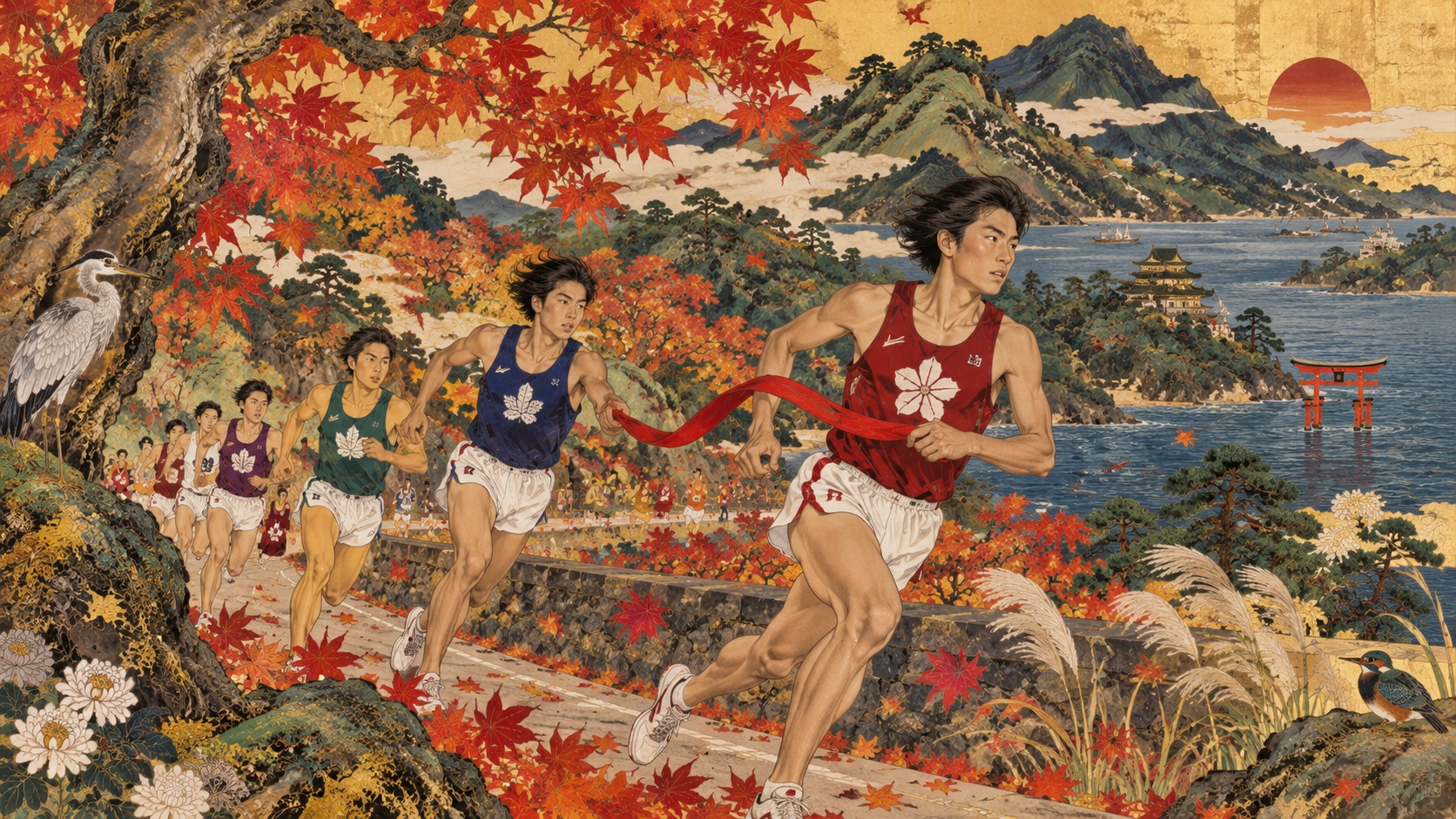
Six legs and one opening statement
At 9:10 a.m. on Monday, October 12, runners from 22 listed teams are scheduled to surge away from the main torii gate of Izumo Taisha, one of Japan’s most significant Shinto shrines. Their assignment is deceptively simple: move a sash, or tasuki, across six stages totaling 45.1 kilometers and reach Izumo Dome first. The 38th Izumo All-Japan University Ekiden is also a first major referendum on the strength of Japan’s university distance-running programs as autumn racing begins.
Why Izumo matters in Japanese sport
Ekiden is team distance running built around the transfer of a tasuki sash. It can be misunderstood abroad as an ordinary relay, but its symbolism and tactics are richer: every athlete runs alone while visibly carrying the collective responsibility of the team. Izumo is usually described as the speed race among Japan’s major university ekiden events. Unlike the long, mountainous Hakone course, its compact stages allow quick accelerations, tactical attacks and changes in position that can alter an entire race in minutes.
A field with defending champions and challengers
Kokugakuin University arrives as the winner of both the 2024 and 2025 editions. According to official historical records, its winning times were 2:09:24 and 2:09:12 respectively. Aoyama Gakuin, Komazawa, Waseda, Chuo, Juntendo and other major programs are among the registered teams. The official roster also includes regional entrants, universities from Hokkaido, and an Ivy League selection—an unusual international feature in a competition deeply rooted in Japanese university sport. The October 9 order list remained provisional at the research cutoff, so names appearing in preliminary lineups must not be treated as confirmed starters.
The map of a 45.1-kilometer battle
Stage one runs 8.0 kilometers from Izumo Taisha’s main gate to Izumo City Hall and JA Shimane; stage two travels 5.8 kilometers toward the Yume Town Hikawa area. The third is 8.5 kilometers to the JA Lapita Hirata area, the fourth 6.2 kilometers to Tobisu Community Center, and the fifth 6.4 kilometers to Shimane Winery. The final 10.2 kilometers take the anchor toward Izumo Dome. The contrast between the rapid early legs and the long concluding stage gives coaches difficult decisions about where to deploy their strongest runners and when to attack.
The tactical drama of the tasuki
The most important runner is not automatically the fastest 10,000-meter athlete on a roster. Coaches need to weigh course profile, pacing judgment, pressure, recent fitness and the ability to run alone when teams become separated. A blistering first leg can force rivals into costly early chases, but a team that spends its best resources too soon may lose positions on the anchor. The final section is long enough for a disciplined contender to close a gap, yet too short to make every deficit recoverable. That is the particular tension that makes Izumo compelling.
A race born with the Heisei era
The first event took place on October 10, 1989, under the name Heisei Memorial Izumo Kunibiki University Invitational Cross-Country Relay Festival. Its six sections totaled 42.6 kilometers and both start and finish were at Hamayama Park Stadium. The race changed names in 1990 and 1994, moved its start to Izumo Taisha’s great entrance in 1998, and shifted the finish to Izumo Dome in 2001. A 2014 route revision established the present 45.1-kilometer configuration. Those changes made a university race progressively more entwined with the streets, public spaces and identity of its host city.
The winning tradition—and its interruptions
Historical winners include Nihon, Yamanashi Gakuin, Tokai, Aoyama Gakuin, Komazawa and Kokugakuin universities. The historical tables also contain blank championship years, including the weather-cancelled 2014 event and the 2020 edition. The record time for the 45.1-kilometer configuration remains Komazawa’s 2:07:51 from the 35th event, according to the official records available for this preview. These numbers tell a history of changing champions but should not be used as perfect comparisons across weather conditions or route versions.
Why a city stages a national spectacle
Izumo City and the Japan Association of Student Athletics jointly organize the event. The route passes community centers, civic buildings, commercial sites and a winery, turning ordinary places into checkpoints in a national sporting drama. Visiting supporters may benefit local transport, accommodation and retailers. But a serious economic assessment would need actual spending and operating-cost data; a televised race alone does not demonstrate a quantified economic return. What is undeniable is the visibility that the event gives a regional city far from Japan’s largest metropolitan sporting venues.
How and when to follow the race
The official program lists a 9:10 a.m. JST start on Sports Day, October 12, with a closing and awards ceremony scheduled around 11:45 a.m. Fuji Television’s national live broadcast is scheduled from 9:00 to 11:30 a.m. Spectators should check the organizer’s traffic restrictions, designated viewing areas and parking information. The team order was updated provisionally on October 9, while confirmed starters and any operational changes should be verified against the latest official notices.
The story has not yet been decided
This feature is written for publication before the race begins. No winner, final order or stage record is asserted. The result will be settled not by a prediction or a university’s reputation, but by what the runners do after the start. Over 45.1 kilometers, each sash transfer offers a reminder of why ekiden occupies such a distinctive place in Japan: individual endurance made visible as collective ambition, in a landscape where history, regional identity and modern competition meet.