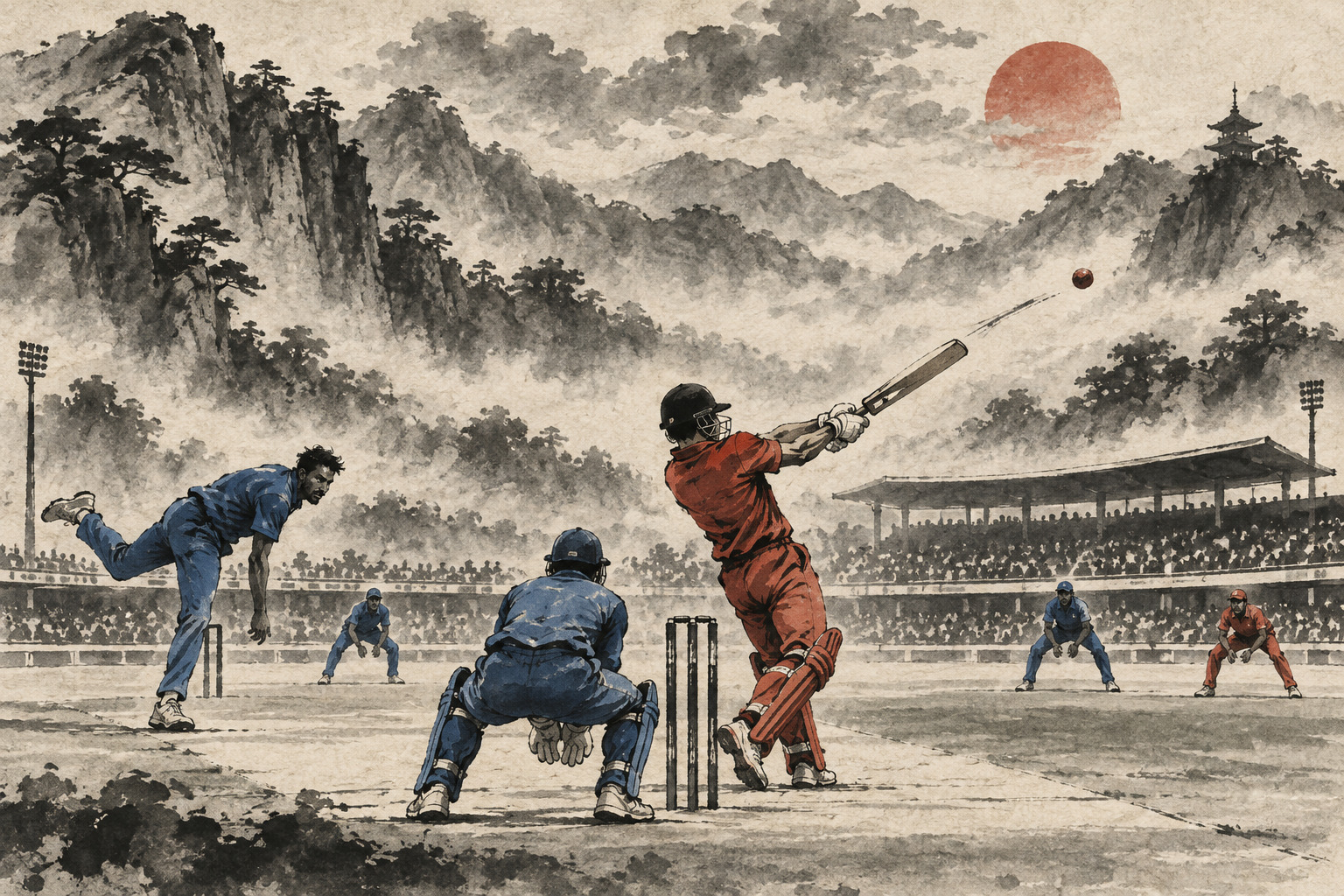
Cricket’s most powerful nation is coming to a former high-school site in inland Tochigi. On September 22, world champion and top-ranked India will face a Japanese side still climbing the international pathway. The distances in money, playing depth and experience are enormous. For one Twenty20 International in Sano, they will be measured on the same strip of grass.
Japan has selected 15 players, led by Kendel Kadowaki-Fleming, the country’s all-time leading men’s T20I run-scorer. Ibrahim Takahashi and Declan Suzuki-McComb are the other two members with more than 50 T20 internationals. Their experience matters because the event must operate on two levels at once: a diplomatic landmark and a recognized international contest against the strongest available benchmark.
The distinction in the headline matters. This is not Japan’s first T20I. It is the first international cricket match between the Japanese and Indian men’s teams. The Japan Cricket Association, the Board of Control for Cricket in India and the International Cricket Council all describe the September 22 fixture as a one-off men’s T20I.
One squad for India and the Asian Games
Japan has chosen exactly the same 15 players for the Suzuki Cup and the Asian Games men’s tournament, which begins two days later. The ICC says selectors deliberately omitted cricketers who met T20I eligibility requirements but could not satisfy Asian Games rules. Rather than assemble the strongest one-day exhibition side on paper, Japan protected continuity for the competition that follows.
Jake Kusuda-Nairn earns his first national selection after strong domestic performances. Tsuyoshi Takada returns to a squad more than a decade after appearing at the 2013 ICC East Asia-Pacific Twenty20 Championship. Charlie Hara-Hinze brings the recent experience of Japan’s 2026 Under-19 World Cup campaign, including the country’s victory over Tanzania.
Wataru Miyauchi and leg-spinner Makoto Taniyama came through Japanese schools with cricket club programs. The ICC notes that Taniyama learned by studying Shane Warne videos online and wears No. 23 in tribute to the Australian great. The squad reflects several routes into a sport without a large Japanese pipeline: school clubs, domestic competitions, bicultural families and long service in the regional international system.
| Japan squad | Role or context confirmed by official sources |
|---|---|
| Kendel Kadowaki-Fleming (captain) | Japan’s leading men’s T20I run-scorer |
| Charlie Hara-Hinze | 2026 Under-19 World Cup player |
| Benjamin Ito-Davis | Returning off-spinner |
| Wataru Miyauchi | Wicketkeeper-batter; school-club alumnus |
| Reo Sakurano-Thomas | Batter and medium-pace bowler |
| Alex Shirai-Patmore | Wicketkeeper-batter |
| Shoma Sugaya-Slater | 15-man squad |
| Declan Suzuki-McComb | More than 50 T20Is |
| Ibrahim Takahashi | More than 50 T20Is |
| Makoto Taniyama | Leg-spinner; school-club alumnus |
| Lachlan Yamamoto-Lake | 15-man squad |
| Kohei Kubota | 15-man squad |
| Tsuyoshi Takada | International experience dating to 2013 |
| Jake Kusuda-Nairn | First Japan selection |
| Alester Kadowaki-Fleming | 15-man squad |
What 120 legal balls can reveal
In T20 cricket, each side ordinarily bats for no more than 20 overs. An over contains six legal deliveries, producing a basic ceiling of 120 balls per innings. Batters score by running between the wickets, earn four when the ball reaches the boundary after touching the field, and six when it clears the boundary without bouncing. An innings ends after 20 overs or when the batting side loses ten wickets.
The short format increases volatility; it does not erase class. India defeated New Zealand in March to win the 2026 Men’s T20 World Cup, becoming the first country to retain the title and the first to win it three times. The Asian Games squad separately announced by the BCCI includes captain Shreyas Iyer, Jasprit Bumrah, Axar Patel, Sanju Samson and other established internationals. The final eleven for the Suzuki Cup had not been published by the reporting cutoff.
Japan therefore needs measurements more useful than a romantic upset narrative. Can its bowlers limit damage in the six-over Powerplay? Can its top order make sound decisions at a pace rarely reproduced in domestic cricket? Can the fielding unit prevent one error from becoming a cascade of boundaries? Against India, the spaces between international adequacy and world-champion precision will appear quickly.
One match cannot close the distance to the world’s No. 1 side. It can show, at full speed, exactly where that distance begins.
From a first win over PNG to five matches in eight days
Japan supplied evidence of its own progress in May. Facing Papua New Guinea in the East Asia-Pacific qualifier for the 2028 Men’s T20 World Cup, Japan made 121 for seven and restricted PNG to 95 for eight. Kadowaki-Fleming scored 45 from 33 balls, and the 26-run victory was Japan’s first over PNG.
The result was also a lesson in how unforgiving qualification can be. Japan and PNG finished level on points, but PNG advanced ahead of the host on net run rate. Japan remained alive in the 2028 pathway, yet a landmark win did not erase the cost of margins accumulated across the tournament.
September now compresses an extraordinary sequence. Japan is scheduled to play Hong Kong in T20Is on September 19 and 20, India on September 22, Afghanistan in its Asian Games group opener on September 24 and Nepal on September 26. That is five matches in eight days, with only one rest day between each of the final three.
The top two teams in Japan’s group advance to the quarterfinals. Afghanistan and Nepal carry far more exposure to high-level Asian cricket. Japan must balance the benefit of experiencing India’s speed against the physical cost of doing so immediately before the result that governs its Asian Games survival.
How Sano became Japan’s cricket home
The Japan Cricket Association was established in 1984 and joined the ICC in 1995. It is now an ICC Associate Member and a provisional member of the Japanese Olympic Committee. The JCA’s latest published participation figures on its institutional page—dating from 2019—count roughly 4,000 registered players and about 20,000 participants.
Sano built infrastructure around that small base. In 2016 the city formally approved the reuse of the former Tochigi Prefectural Tanuma High School site for cricket. Sano International Cricket Ground reopened in 2018 with two full grounds and natural-turf pitches. Schools added cricket to physical education and club activity, while regional clubs and international pathway events gave the site a recurring calendar.
Hosting India is the most visible test yet of that local strategy. Crowd access, transport, match presentation and basic explanation of the sport must all serve spectators who may be attending cricket for the first time. The enduring return will not be measured only by a full ground for India, but by how many viewers come back for Japan and how many children find a route onto the field.
1984 — Japan Cricket Association established.
1995 — Japan joins the ICC.
2018 — Sano International Cricket Ground reopens with two turf grounds.
May 2026 — Japan records its first men’s win over Papua New Guinea.
September 22, 2026 — Japan and India meet in men’s international cricket for the first time.
September 24, 2026 — Japan begins its home Asian Games campaign.
Diplomatic symbolism, competitive consequences
The two boards present the Suzuki Cup as the first event in SPORT-75, a bilateral initiative connected to an agreement between Prime Minister Sanae Takaichi and Indian Prime Minister Narendra Modi. Its stated purpose is to expand people-to-people contact and sports cooperation, while acknowledging India’s ambition to host the 2036 Olympic and Paralympic Games.
The event title calls it a 75th-anniversary match. Japan’s Ministry of Foreign Affairs records April 28, 1952, as the date the countries signed their peace treaty and established diplomatic relations. The calendar anniversary therefore falls in 2027. The September 2026 fixture is best understood as the opening of the commemorative program ahead of that anniversary, not the anniversary date itself.
Cricket’s return to the Olympic program at Los Angeles 2028 gives the diplomacy a practical edge. Japan is not qualified for that Olympic tournament merely because it hosts India or the Asian Games. But a visible match can strengthen the less glamorous systems—grounds, coaches, officials, youth recruitment and commercial support—that determine whether occasional attention becomes a durable national program.
For the players, symbolism ends at the boundary rope. Every run and wicket will enter an official scorecard. Japan’s first task is to keep the occasion from overrunning the contest: execute plans, withstand stretches of Indian pressure and identify which skills survive contact with the world champions. The first meeting is guaranteed to make history. What it produces after September 22 remains open.
- International Cricket Council, “Japan name squad for historic India T20I in Sano,” September 8, 2026 — 15-player squad, selection rationale, player backgrounds and September schedule.
- International Cricket Council, “India-Japan set to play historic T20I in Sano,” September 4, 2026 — first-meeting status, format and board statements.
- Japan Cricket Association, “Men’s national team named for the 2026 Asian Games,” August 6, 2026 — Japanese squad forms and Asian Games group.
- Japan Cricket Association, “Suzuki Cup: Japan v India” — official event title, time and venue.
- Japan Cricket Association, “Japan earn historic win over PNG,” May 18, 2026 — score, individual performances and qualifier outcome.
- Board of Control for Cricket in India, “India to play Japan in historic T20I in Sano,” September 4, 2026 — Indian board confirmation.
- Board of Control for Cricket in India, “Team India (Senior Men) and India A squads announced,” June 6, 2026 — India’s Asian Games squad.
- International Cricket Council, “Ponting touts India as strongest-ever T20I team,” March 16, 2026 — India’s 2026 world title and successful defense.
- Japan Cricket Association, “About the JCA” — institutional history, memberships and participation figures.
- Japan Cricket Association, “Cricket City Sano” — ground development and community program.
- Ministry of Foreign Affairs of Japan, “Japan-India Relations,” February 18, 2026 — April 28, 1952 establishment of diplomatic relations.
- International Cricket Council, “Qualification and format confirmed for cricket’s historic return at LA28,” June 29, 2026 — Olympic return and six-team T20 format.
Editorial note: Japanese player names follow the JCA’s Asian Games announcement; Romanized names follow the ICC’s Suzuki Cup squad announcement. The Indian Asian Games squad is confirmed separately, but the Suzuki Cup playing eleven was not available by the reporting cutoff and is not presented as final.