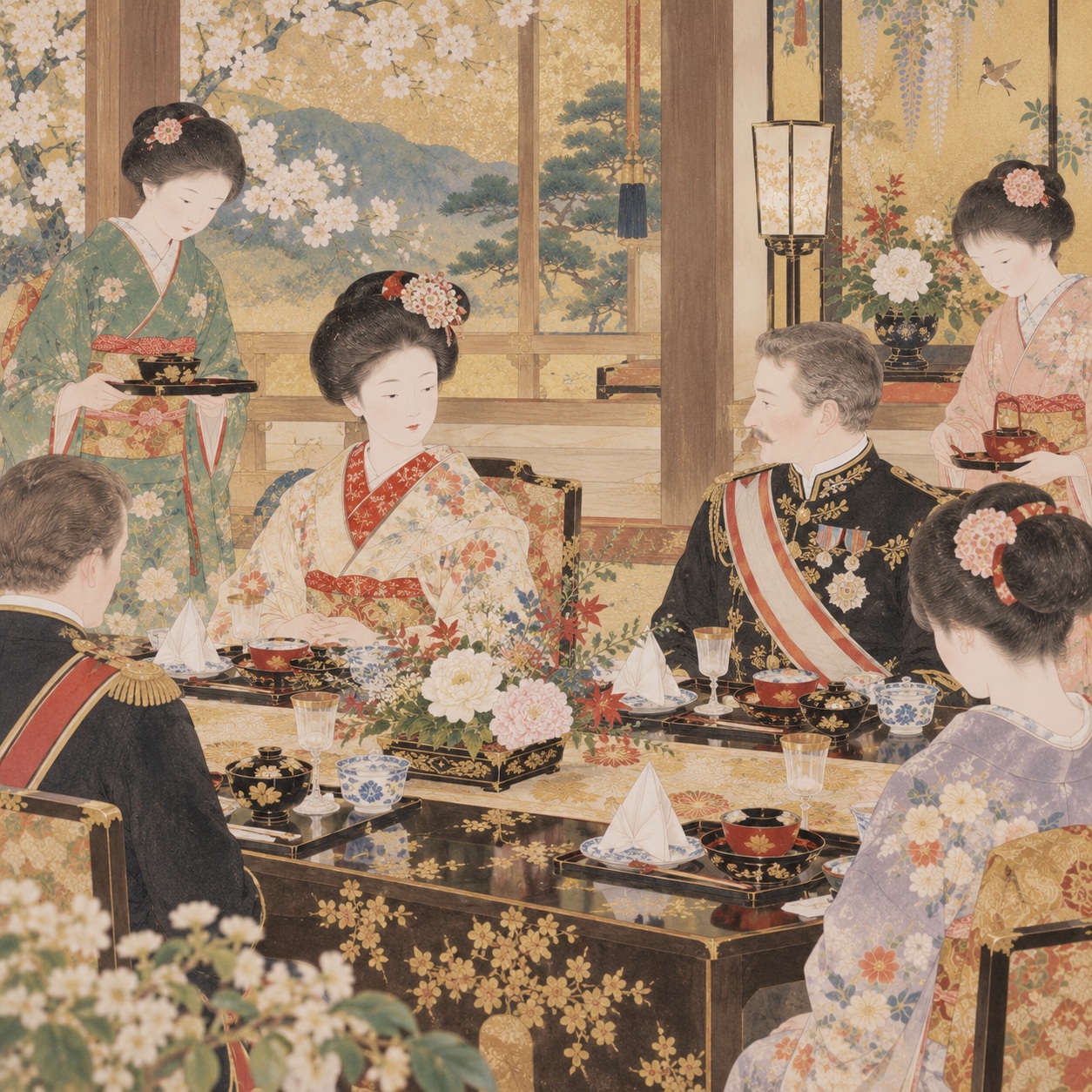
Diplomacy is conducted in treaties and joint statements, but also in seating plans, flowers, porcelain and the order in which guests enter a room. At a state banquet, the meal is only one part of a carefully constructed encounter.
A new exhibition at the Kasumi Kaikan Memorial Gakushuin Museum in Tokyo makes that invisible architecture visible. “Welcome to the Magnificent World of State Banquets”, running from September 26 through November 21, traces roughly 150 years of Imperial hospitality from the Meiji era to the present through tableware, bonbonnières, formal dress and other objects. Admission is free.[1]
A state banquet is not simply dinner
The Imperial Household Agency defines a state banquet as part of the Imperial reception of a state guest. Today, the dinner is held in the Hōmeiden of the Imperial Palace. The current palace complex was completed in 1968 and entered use in 1969.[3]
The choreography begins before anyone sits down. The Emperor and Empress receive the visiting state guest and spouse; members of the Imperial Family are introduced in the Matsu-no-Ma; guests move through a receiving line in the Ishibashi-no-Ma; only afterward does the procession enter Hōmeiden for dinner.[4]
The exhibition emphasizes the same totality. The formal French-course meal, white-tie or traditional Japanese formalwear, long dresses or irotomesode, porcelain, silver, crystal, flowers and commemorative gifts all contribute to one state occasion.[1]
For Meiji Japan, the Western banquet was an international language
The modern Japanese state banquet was not inherited unchanged from the Edo period. As the Meiji government sought diplomatic equality with Western powers, the Imperial Household and government had to learn the highly codified table culture of European diplomacy.
The stage shifted from early reception facilities such as the Enryōkan to the Rokumeikan and eventually the Meiji Palace. Imperial Household Agency materials preserve even Rokumeikan banquet menus, evidence that Western dining had become part of diplomatic practice.[7]
It is too easy to describe this simply as Western imitation. In the late nineteenth century, courtly European etiquette functioned as a practical diplomatic language. For Japan, mastering the state dinner demonstrated that the new state understood the rules by which international elites recognized one another.
Tableware became diplomatic infrastructure
Research by Gakushuin scholar Minako Nagasako has traced how the Imperial Household assembled the material system required for Western formal dining. In 1875, Western-style dinnerware for Imperial use was ordered from Britain; later, Japanese manufacturers developed the capacity to produce Western-form porcelain domestically.[6]
This was not a decorative side issue. A formal banquet requires dozens of matching plates, glasses and pieces of cutlery, replacement stock, service conventions and a sequence synchronized with the menu.
Porcelain was therefore not only art. It was infrastructure for diplomacy.
Reconstructing an Arisugawa-no-miya table
The exhibition reconstructs a formal table associated with the Arisugawa-no-miya household, which played a role in receiving foreign guests in the Meiji period. The setting combines European wares and furnishings including Haviland, Baccarat and Christofle, presenting how a princely household practiced Western-style hospitality around 150 years ago.[1][2]
The point is not simply luxury. The shape of a plate, the type of wine glass and the placement of cutlery are inseparable from the order of service. To set the table correctly meant understanding the entire structure of the meal.
The 1889 Constitution banquet and the first great bonbonnières
Another central object is the bonbonnière, the small container traditionally used for sweets and presented as a commemorative gift at Imperial celebrations.
Gakushuin research identifies the banquet associated with the promulgation of the Constitution of the Empire of Japan on February 11, 1889, as an early landmark in the Imperial use of bonbonnières. About 1,400 containers carrying the chrysanthemum crest and commemorative inscription were prepared.[5]
The object transformed an evening into something a guest could physically carry away. Design turned memory into material culture.
Westernizing while designing “Japan”
Meiji court hospitality faced an apparent contradiction. Japan needed to follow Western diplomatic conventions accurately while also presenting something recognizably Japanese.
Domestic Western-style porcelain and Imperial bonbonnières became one solution. The meal might follow French conventions, but motifs could draw on chrysanthemums, cranes and turtles, pine-bamboo-plum, flowing water and seasonal plants. Japanese craft could inhabit a Western table form.
Japan adopted an international diplomatic format and then inserted Japanese craft, symbols and seasonality into it, gradually creating a distinct style of official hospitality.
Dress is part of the diplomatic grammar
The exhibition also includes four robes décolletées worn by Princess Akiko at Imperial state banquets. The robe décolletée is the highest level of formal evening dress used for such occasions.[2]
At a state event, clothing is not only personal fashion. It communicates rank, respect for the occasion and fluency in protocol.
Japan’s continued acceptance of formal kimono such as irotomesode within the same environment is another example of the dual system: Western diplomatic form without abandoning Japanese dress.
Food can carry diplomatic meaning without making a speech
Contemporary Imperial state banquets generally use a formal French-course structure, but menus and ingredients can still communicate attention to a guest: seasonal produce, dietary and religious considerations, Japanese regional ingredients and carefully selected presentation.
Unlike a joint communiqué, food does not state policy. But it can demonstrate preparation, awareness and respect.
Earlier Gakushuin museum research notes that the Empress’s preferences can be reflected in banquet menus and floral decoration, underscoring how detailed the construction of hospitality can be.[5]
A seating plan can be an invisible diplomatic document
Who sits where also matters. A state banquet may bring together heads of state, spouses, members of the Imperial Family, government officials, diplomats and invited figures from culture and business.
The seating plan has to respect precedence while creating workable conversation. In that sense, it can serve as a snapshot of institutional rank and diplomatic relationships at a particular moment.
The table is beautiful, but its arrangement is highly structured.
Why look at 150-year-old plates now?
The exhibition is most interesting when it refuses to stop at luxury.
A wine glass can reveal import history. A dinner plate can reveal industrial policy and domestic manufacturing. A dress can reveal changing protocol. A bonbonnière can preserve the memory of a political ceremony. An entire table can show how Japan wanted foreign guests to see the country.
Diplomatic history is usually written through wars, treaties, summits and archival documents. Yet international relationships are also made in rooms where people eat together, exchange courtesies and learn how another state represents itself.
A nineteenth-century form that survives in Hōmeiden
Gakushuin Museum describes Japan’s Imperial state-banquet style as distinctive in the way a form established in the nineteenth century has been carried into the present.[1]
That does not mean a Meiji banquet and a Reiwa banquet are identical. Buildings, menus, politics and society have changed profoundly.
What persists is the concept: receive a state guest through the highest level of formal hospitality, combine a French-course dinner with carefully selected tableware and dress, and construct an environment in which the state presents itself through detail.
The exhibition’s 150 years are therefore not simply a history of magnificent meals. They are a history of how modern Japan learned to receive the world—and how it chose to make that reception look Japanese.
Sources
- Kasumi Kaikan Memorial Gakushuin Museum: “Welcome to the Magnificent World of State Banquets”
- Internet Museum: 150 years of Imperial hospitality
- Imperial Household Agency: Imperial Palace and state banquets
- Imperial Household Agency: protocol for receiving state guests before a banquet
- Gakushuin Museum Letter No.46: bonbonnières and the 1889 Constitution banquet
- Gakushuin University: Minako Nagasako research on the history of Imperial state banquets
- Imperial Household Agency: Meiji diplomatic culture and Rokumeikan banquet materials
