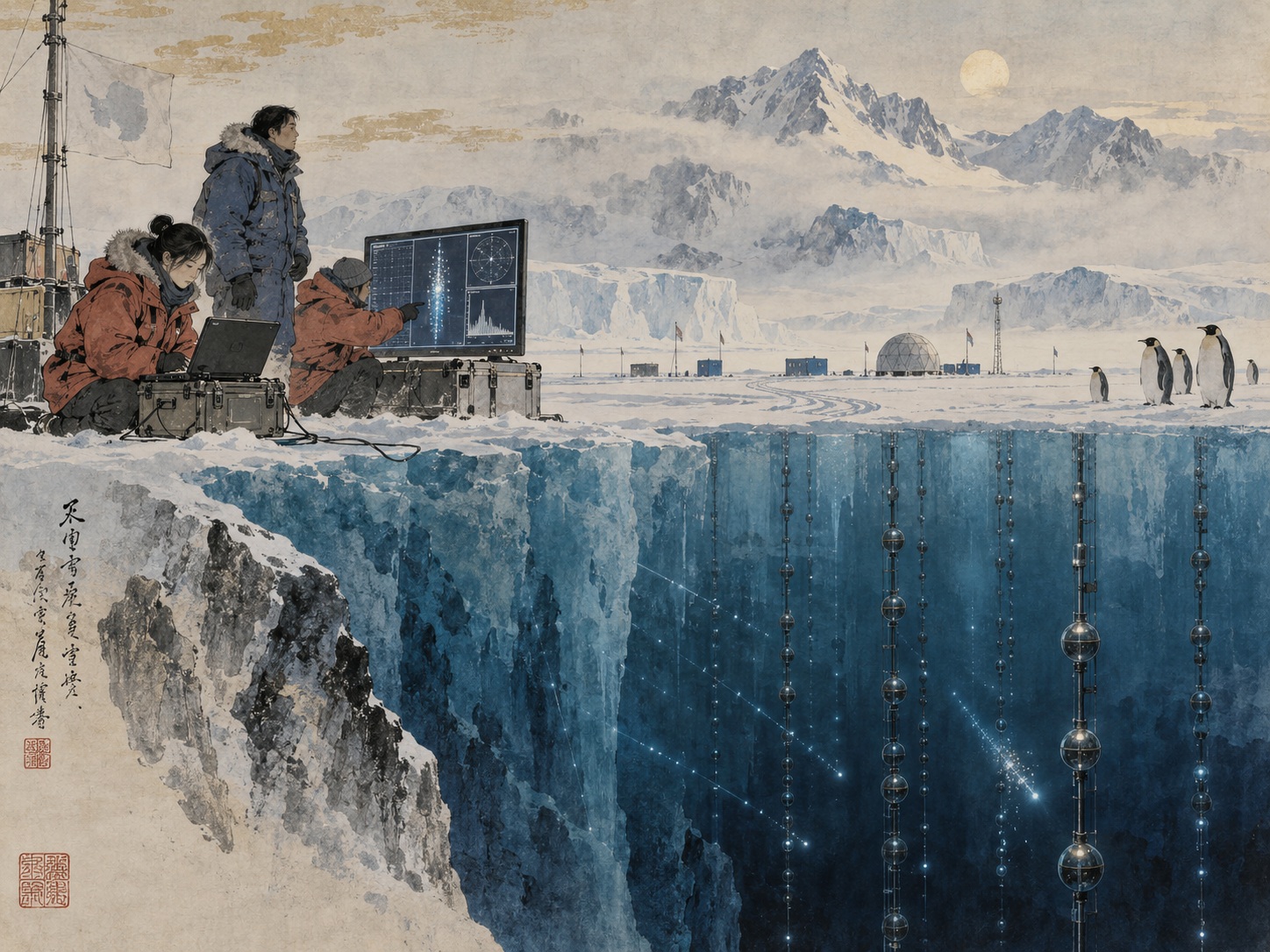
Between 1,450 and 2,450 meters beneath the South Pole, thousands of light sensors wait inside a cubic kilometer of Antarctic ice. IceCube has no mirror and no conventional lens. The ice itself is the telescope.
On October 6, Francis Halzen of the University of Wisconsin–Madison was awarded the 2026 Nobel Prize in Physics “for decisive contributions to the IceCube Neutrino Observatory and the discovery of high-energy neutrinos of astrophysical origin.” The award focuses attention on Halzen’s vision, but the observatory is the work of a collaboration of roughly 450 scientists from 58 institutions in 14 countries. Chiba University is the collaboration’s only participating Japanese institution.[1][2]
Neutrinos are messages that cross the universe almost untouched
Neutrinos carry no electric charge and interact only weakly with matter. Enormous numbers pass through the Earth — and through us — without leaving a trace. That makes them extraordinarily difficult to detect, but extraordinarily useful for astronomy.
Light and gamma rays can be absorbed by matter and radiation fields. Cosmic rays are charged and are deflected by magnetic fields. Neutrinos travel almost in straight lines from their sources, carrying information from environments that may be opaque to electromagnetic radiation. Ishihara describes them as messengers that can bring information directly from distant high-energy phenomena.[4]
IceCube sees light created inside the ice
IceCube does not photograph a neutrino directly. On rare occasions a neutrino interacts in or near the Antarctic ice and produces charged secondary particles. Those particles generate blue Cherenkov light as they move through the ice.
Digital optical modules record the arrival time and brightness of that light. By combining signals across the array, scientists reconstruct the likely direction, energy and event topology of the incoming neutrino.
Japan was there at the beginning of neutrino astronomy
IceCube’s decisive scientific breakthrough emerged from analyses of extremely high-energy events in 2012. The collaboration found PeV-scale neutrinos that could not be explained easily as products of cosmic-ray interactions in Earth’s atmosphere. The result was published in 2013 as “First Observation of PeV-Energy Neutrinos with IceCube.”[5]
Shigeru Yoshida and Aya Ishihara were part of IceCube during this formative period. In 2019 they received Japan’s Nishina Memorial Prize for the discovery of ultra-high-energy cosmic neutrinos. Chiba University identifies its team as having contributed to the 2012 discovery, the source-identification result announced in 2018 and the Glashow-resonance detection reported in 2021.[2][6]
In 2018, IceCube began to answer “where?”
Discovering an astrophysical neutrino flux did not immediately reveal its sources. A major turning point came on September 22, 2017, when IceCube detected a high-energy event known as IceCube-170922A and sent an alert to observatories around the world.
Follow-up observations found that the blazar TXS 0506+056, located in the same direction, was unusually active in gamma rays. The 2018 result became the first compelling multimessenger association between a high-energy neutrino and a specific astrophysical source.
The neutrino sky expanded
IceCube later reported strong evidence for neutrino emission from the active galaxy NGC 1068, and in 2023 announced the first observation of high-energy neutrino emission from the Milky Way. The field was moving from discovery — proving that cosmic neutrinos exist — to source populations and mechanisms.[1]
D-Egg: a detector conceived in Chiba and buried at the South Pole
Japan’s role became even more tangible with D-Egg, a new optical sensor developed at Chiba University’s International Center for Hadron Astrophysics.
The egg-shaped pressure vessel contains two photomultiplier tubes, one facing upward and one downward. The geometry broadens angular sensitivity and improves photon collection compared with older single-PMT modules. Chiba University traces the concept to 2013, when Ishihara sketched the idea during an IceCube meeting in Munich.[7]
Roughly 300 D-Egg modules were manufactured and tested largely at Chiba University’s Nishi-Chiba campus by researchers and students. The design and performance were published by the IceCube Collaboration in the Journal of Instrumentation in 2023.[8]
The first major expansion in 15 years
During the 2025–26 Antarctic summer, IceCube carried out its first major detector expansion since completion. Seven new strings were installed in the central region, carrying about 750 advanced optical sensors and calibration devices. IceCube announced completion of the Upgrade in February 2026.[9]
Chiba University says D-Egg units account for about 40% of the newly deployed detectors. Ishihara, who led the D-Egg production effort, joined the South Pole construction team and participated directly in deployment during roughly two and a half months of work.[3]
The Upgrade is not simply about collecting more photons. Its calibration devices will map how light scatters and is absorbed in the ice, sharpening reconstructions of neutrino direction and energy. The denser instrumentation also pushes IceCube toward lower energies.
At lower energies, sensitivity could improve by an order of magnitude
In August 2026, the IceCube Collaboration published projected sensitivities for the Upgrade. For short-timescale transient searches, the studies indicate roughly an order-of-magnitude improvement at lower energies compared with the existing detector.[10]
That creates opportunities for transient astronomy, neutrino oscillation studies, dark-matter searches and measurements of the Milky Way. It also strengthens multimessenger observing with X-ray, gamma-ray and gravitational-wave facilities.
Then comes IceCube-Gen2
The proposed IceCube-Gen2 would transform the scale again. IceCube’s current concept expands the optical array from about one cubic kilometer to roughly eight cubic kilometers and adds radio detection for the highest-energy neutrinos. Its goal is to collect statistically powerful samples of PeV-to-EeV neutrinos and hundreds of astrophysical neutrinos above 100 TeV.[11]
The design does not simply pack sensors more densely. At very high energies, events are so rare that the priority is instrumented volume. By roughly doubling the amount of instrumentation while spacing sensors farther apart, Gen2 aims for about eight times the volume and around an order-of-magnitude increase in high-energy neutrino detection rate.[11]
Chiba wants to help build the next “eyes” too
Chiba University has presented a Gen2 concept involving roughly 10,000 optical detectors and point-source sensitivity more than five times better than the current observatory. The experience gained with D-Egg is intended to feed directly into the next generation of detector design.[12]
That makes Japan more than a scientific user of a foreign-built observatory. The sensors were designed in Chiba, assembled and tested there, shipped to Antarctica and embedded in the ice at the geographic South Pole.
Shigeru Yoshida is already looking toward the 50-PeV universe
The scientific case for a larger detector is simple: much of the high-energy universe remains statistics-starved. In August 2026, Yoshida and Chiba colleague Maximilian Meier published work exploring active galactic nuclei identified in the distant universe, showing that ultra-high-energy cosmic rays could produce a distinctive neutrino signal near 50 PeV.[13]
At those energies, event rates are extremely low. A much larger instrument would make it easier to test whether environments around supermassive black holes accelerate the cosmic rays that ultimately generate high-energy neutrinos.
Neutrinos may meet gravitational waves
IceCube is also searching for events that produce more than one cosmic messenger. Analyses combine IceCube data with LIGO, Virgo and KAGRA gravitational-wave observations. A 2026 study concluded that improved detectors will be needed to reliably detect fainter joint emission.[14]
If a future neutron-star merger, black-hole environment or unknown transient emits both gravitational waves and high-energy neutrinos, astronomers could study the same event through disturbances in spacetime and through elementary particles.
A Nobel Prize is recognition, not completion
Halzen’s Nobel recognizes the achievement that turned neutrinos into a practical astronomical messenger. But the collaboration itself is already moving beyond that first era. The upgraded detector is expected to begin producing new science data, while Gen2 remains the proposed long-term expansion.[1]
For the Chiba team, the sequence is visible in hardware. Yoshida and Ishihara helped analyze the first astrophysical neutrino discoveries. A decade later, D-Egg modules built in Chiba now sit permanently beneath Antarctic ice.
Astronomy has expanded from visible light to radio waves, X-rays, gamma rays and gravitational waves. IceCube added neutrinos to that list. The Nobel Prize honored the generation that proved this new eye on the universe works. Japan’s IceCube researchers are now helping to build the eye that comes next.
Sources and references
- IceCube Collaboration, “Francis Halzen, IceCube principal investigator, wins 2026 Physics Nobel Prize,” October 6, 2026.
- Chiba University, “International collaboration involving ICEHAP wins Nobel recognition,” October 7, 2026.
- Chiba University ICEHAP, completion of the IceCube Upgrade and D-Egg deployment, February 13, 2026.
- Chiba University, Professor Aya Ishihara profile.
- Shigeru Yoshida publication list, including early IceCube astrophysical-neutrino papers.
- Chiba University ICEHAP, IceCube research achievements.
- Chiba University ICEHAP, D-Egg detector.
- IceCube Collaboration, “D-Egg: a Dual PMT Optical Module for IceCube,” JINST 18 (2023).
- IceCube Collaboration, completion of the IceCube Upgrade, February 2026.
- IceCube Collaboration, projected Upgrade sensitivities, August 31, 2026.
- IceCube Collaboration, IceCube-Gen2 overview.
- Chiba University ICEHAP, D-Egg and IceCube-Gen2 development.
- Chiba University ICEHAP, August 12, 2026 research update on distant AGN and ~50 PeV neutrinos.
- IceCube Collaboration, gravitational-wave and neutrino joint-source search, July 2026.
Reporting and verification cutoff: October 7, 2026. IceCube-Gen2 remains a proposed future observatory. Its final construction schedule, funding and detector configuration may change. This article distinguishes the current IceCube detector, the completed 2026 Upgrade and the proposed Gen2 expansion.