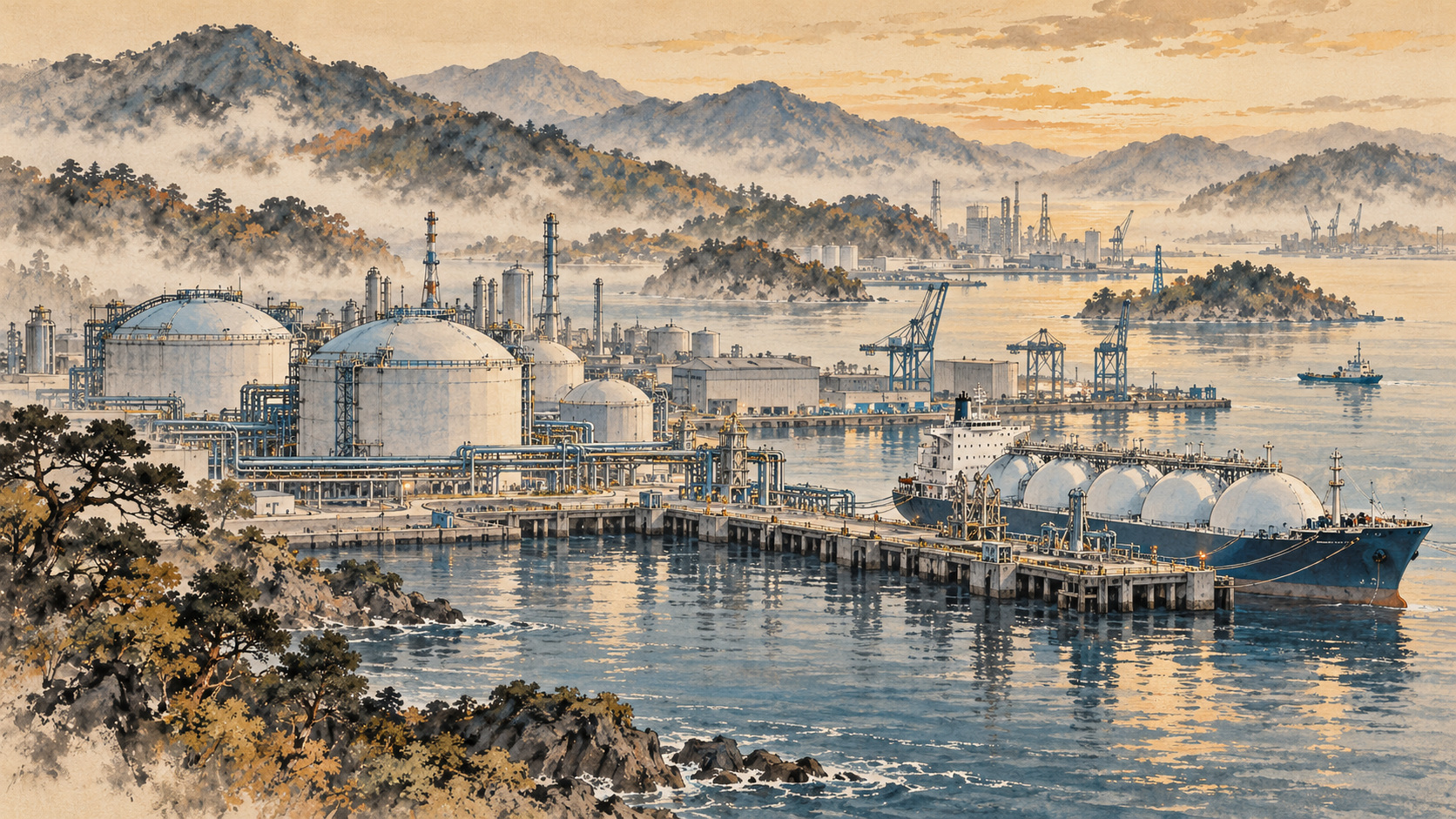
Hydrogen's problem is no longer just how to make it. It is how to deliver it, safely and predictably, to a customer prepared to pay enough for the whole system to survive.
A roadmap that begins with an uncomfortable admission
Japan's hydrogen ambitions have often been illustrated by futuristic ships, immense storage tanks and fuel-cell vehicles. The latest official roadmap starts in a less triumphant place. On October 16, 2026, the New Energy and Industrial Technology Development Organization—NEDO—published a hydrogen infrastructure technology-development roadmap acknowledging that major supply-chain investments have been delayed and that costs have not fallen fast enough.
The document points to inflation, stalled or delayed projects in regions including Australia and the Middle East, high domestic production costs and insufficient near-term demand. It says the gap between Japan's 2030 supply-cost ambition and current conditions remains large. In a field shaped by glossy promises, this is consequential: Japan is treating the economics and logistics of hydrogen as a system problem, not merely an engineering showcase.
The release does not announce a new operating commercial port or a fully financed network of hydrogen pipelines. It is a technology and deployment planning framework, organized around four areas and milestones for 2030, 2040 and 2050. Those distinctions matter to anyone assessing Japan's energy transition—or considering an investment based on it.
The price and volume targets are breathtaking
Under the hydrogen strategy revised in June 2023, Japan aims for hydrogen and related carriers, including ammonia measured on a hydrogen-equivalent basis, to reach as much as 3 million tonnes annually in 2030, roughly 12 million tonnes in 2040 and about 20 million tonnes in 2050. The associated supply-cost ambitions include ¥30 per normal cubic meter by 2030 and no more than ¥20 by 2050, expressed as CIF supply benchmarks rather than the price a factory necessarily pays at its gate.
The distinction is important. A normal cubic meter is a defined volume of gas under reference conditions, not a kilogram, and the conversion depends on the prescribed standard. The government's volumes are also not a declaration that Japan will produce that quantity of clean hydrogen domestically. They incorporate certain related carriers and different pathways for bringing molecules to users.
NEDO describes roughly 2 million tonnes of existing domestic hydrogen supply in 2024, most of it conventional gray hydrogen such as industrial byproduct hydrogen. That number cannot fairly be portrayed as evidence of an already mature, low-carbon hydrogen market. The emissions associated with production are central to the policy's climate claims.
Why moving hydrogen is difficult
Hydrogen can store energy, but it is not an energy source that emerges free of cost. Producing it from water through electrolysis requires electricity. Producing it from fossil fuels creates an emissions challenge unless the carbon is addressed. Compression, liquefaction, shipping, terminal operations, local transport and—in some applications—conversion back into electricity each add cost and energy losses. Cheap generation alone does not settle the delivered-price question.
Nor does better hardware guarantee customers. A port terminal serving few users cannot spread its fixed costs over enough sales. A steel company is unlikely to retool a major process without confidence in price and continuous supply. A truck operator cannot reasonably purchase hydrogen vehicles unless enough high-reliability refueling stations operate along relevant routes. Demand and infrastructure are interdependent, and each investor wants the other side to commit first.
Four areas that define the infrastructure challenge
The first is the large-scale supply chain: production overseas or domestically, bulk transport, reception terminals and connections to major users. NEDO considers carriers including liquid hydrogen, methylcyclohexane (MCH) and ammonia. Each approach poses distinct trade-offs in storage, energy use, handling, safety and conversion. The roadmap points to scaling equipment, improving efficiency and conducting demonstrations that can substantiate performance.
Second is the domestic distribution network. Importing molecules into a Japanese harbor is not the same as making them available to an inland factory. Trucks, trailers, coastal vessels, railways and potentially pipelines must be assessed for real locations and volumes. NEDO includes work toward a hub-and-spoke architecture, where major receiving locations supply regional users. The cheapest solution will depend on geography, demand concentration and what infrastructure already exists.
Third is refueling. Japan has promoted fuel-cell passenger cars, but the roadmap pays particular attention to heavy-duty vehicles, where frequent use on defined freight corridors could improve station utilization. A hydrogen station is a substantial asset with compression, storage and safety requirements. It is not enough to count stations without knowing their uptime, throughput, delivered fuel cost and the number of vehicles using them.
The fourth area is easy to overlook: common foundations. Materials durability, leakage detection, equipment safety, inspection data, maintenance, the scientific basis for regulation and international technical standards will determine whether facilities are insurable, financeable and interoperable. Streamlining a rule should mean using evidence to achieve safety efficiently—not waiving safety because a technology is politically favored.
A choice of carriers, not a single winning molecule
Liquefied hydrogen involves extremely cold temperatures and demanding thermal management. Ammonia can serve as a hydrogen carrier or, in some uses, as a fuel in its own right; it introduces toxicity, combustion and upstream-emissions questions. MCH uses liquid-organic-hydrogen-carrier chemistry, trading advantages in liquid handling for the energy and equipment needed to recover hydrogen at the destination.
The best option cannot be declared from a laboratory efficiency number alone. A meaningful commercial comparison needs the shipping distance, terminal scale, intended use, purity requirements, heat integration, financing and whole-system emissions. Japan's willingness to explore several technologies can be a hedge against uncertainty, but maintaining multiple paths also makes it essential to identify when a demonstration should stop receiving support.
From pioneering strategy to the harder decade
Japan formally adopted its Basic Hydrogen Strategy in December 2017, ahead of many countries' national hydrogen plans. It presented hydrogen as an integrated policy field encompassing production, transport, utilization and public safety. The strategy was revised in June 2023 with sharper industrial and supply ambitions. In 2024, legislation commonly known as the Hydrogen Society Promotion Act established a framework to help create supply chains and stimulate demand for low-carbon hydrogen and related fuels.
NEDO has been issuing fuel-cell and hydrogen technology roadmaps since 2005, adjusting priorities as engineering and industrial conditions change. Its work has encompassed electrolysis, fuel cells for passenger and heavy-duty vehicles, and stationary systems. The October 2026 document connects those technology efforts to infrastructure: the missing middle between a machine that works and a market that can actually use it.
Japan is no longer alone in this race. Europe, the United States, Australia, the Middle East and other regions have pursued their own programs, while global inflation and policy uncertainty have also led to delays and cancellations. Domestic technical leadership will translate into global commercial leadership only if Japanese equipment and services can compete on price, reliability and standards in other countries' projects.
Who should use hydrogen—and who should not?
Hydrogen's strongest potential cases are often found in activities where direct electrification is difficult: particular steelmaking and chemical processes, some high-temperature industrial applications, segments of heavy transport and energy-system functions that need long-duration or transportable fuel. Even in those sectors, the case is not automatic; the alternative might be direct electricity, another low-emissions fuel, efficiency improvements or changes to industrial processes.
For applications already served efficiently by electricity, making hydrogen from electricity and then converting it back may add unnecessary losses. A credible energy strategy asks where hydrogen delivers distinctive value rather than treating its use as an end in itself. Likewise, hydrogen cannot be assumed low-carbon simply because no carbon dioxide emerges at its point of consumption. Electricity generation, upstream fuel extraction, carbon capture, transport and the complete lifecycle require assessment.
What companies and investors should examine
The questions for an industrial customer are concrete: What is the delivered price after compression, shipping and last-mile logistics? How much of that price depends on public support? What happens if an overseas supply project slips by five years? Are purchase commitments binding, and can the factory switch fuels if demand changes? How is carbon intensity measured and independently verified?
For ports and regional governments, the critical figures include expected throughput, confirmed offtake, safety obligations, grid capacity, land requirements and what remains if a headline project is abandoned. For equipment suppliers, the question is how to make a standard, serviceable, exportable product rather than a succession of bespoke demonstrations. For taxpayers, there is a separate test: whether subsidies create lasting emissions reductions and useful industrial capability that would not otherwise exist.
A practical test for Japan's next energy chapter
The roadmap is most revealing where it admits uncertainty. Its targets describe what researchers, regulators and industrial partners should try to achieve, not what has already been delivered. Technological progress does not guarantee that a plant will be financed; financing does not guarantee a customer; and a customer's interest does not mean the final product will be affordable.
Japan's hydrogen future, if it arrives, will not be measured only by the size of tanks or the number of demonstration ceremonies. It will be judged by sustained supply contracts, dependable infrastructure, competitive delivered costs and demonstrable emissions reductions. The October 2026 NEDO roadmap is a significant document because it exposes the difficult work between the inspiring picture and the functioning economy.
Reporting note: This article is based on NEDO's October 16, 2026 infrastructure roadmap and Japanese government policy documents. Future cost, volume and deployment figures are targets or scenarios, not confirmed achievements. No original interviews with NEDO, commercial operators or municipal authorities were conducted.