The battery is the invisible leash
Small drones have already entered Japanese daily life. They inspect roofs, map rice fields, look at bridges, and give emergency crews a view from above. But when drones move from impressive demonstrations into social infrastructure, the same question returns again and again: can it fly farther, carry more, stay longer, and make one more round trip?
One answer is hydrogen. Another is larger aircraft. The practical phrase that ties them together is not “cool technology.” It is “work.” At Japan Drone 2026 and the International Advanced Air Mobility Expo, the most interesting machines were not toys. They were serious aircraft designed for ports, islands, mountains, disaster zones, power lines, farms and coastal infrastructure.
Battery-powered multicopters are excellent machines. They are relatively quiet, controllable and easy to understand. But payload punishes endurance. Wind punishes endurance. Mountains punish endurance. Islands punish range. In disaster response, nobody gets to choose the perfect weather window. The more society asks drones to do real work, the more energy becomes the central problem.
RoboDEX and the hydrogen bet
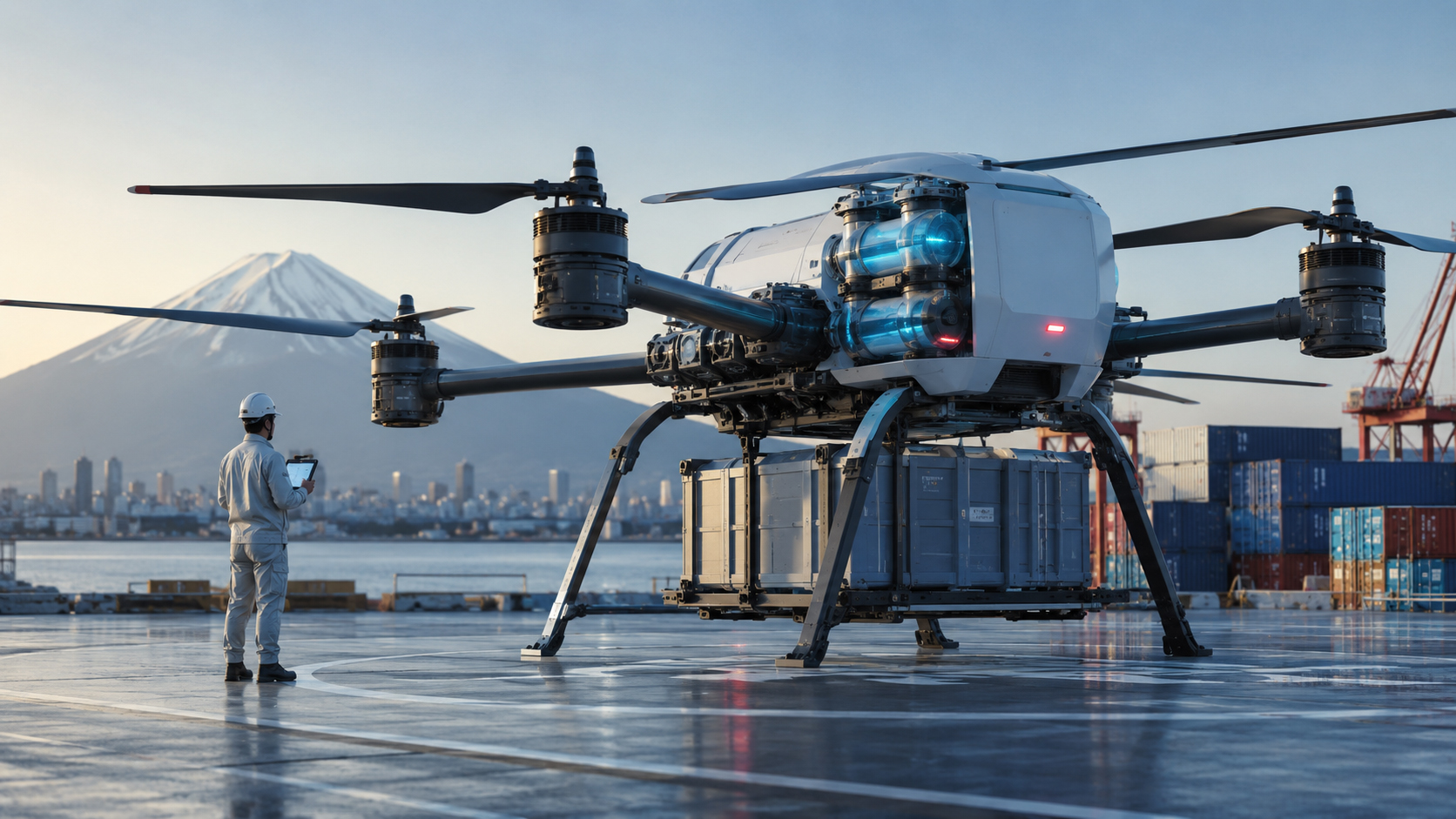
That is why RoboDEX matters. The Yokohama-based developer is working on hydrogen fuel-cell drones for industrial missions such as long-duration flight, power-line inspection and remote logistics. In Autonomy Global’s report from Japan Drone 2026, CEO Daisuke Kaio described the basic motivation plainly: batteries do not give industrial operators enough flight time to make unmanned systems genuinely useful across social and industrial sectors. Hydrogen can help.
Earlier technical reporting on the Aigis One platform described a 15 kg aircraft with a 5 kg payload and flight time of up to 120 minutes. The aircraft uses a 4.7-liter hydrogen cylinder above the fuselage, a fuel cell below it, and capacitors to provide bursts of high output for moments such as rapid ascent. That is not a slide-deck fantasy. It is the kind of machine tested, refined and argued over at places like the Fukushima Robot Test Field.
Hydrogen is not magic. It brings high-pressure cylinders, safety standards, refueling logistics, maintenance, insurance and public acceptance. Swapping a battery for a hydrogen system does not create an overnight logistics revolution. But if endurance determines whether an industrial mission is useful, hydrogen becomes difficult to ignore.
Hiroshima’s hydrogen drone port is the infrastructure story
One of the most important 2026 developments is the hydrogen drone-port project involving RoboDEX and Tokyu Land in Hiroshima Prefecture. DroneLife reported that the partners plan a permanent hydrogen drone port on the Seto Inland Sea coast to link the mainland with Osakikamijima and nearby islands. The site is to sit inside Tokyu Land’s LOGI’Q Hiroshima logistics complex, with a reported round-trip range of roughly 35 km.
The important word is “port.” Aircraft alone do not create deployment. A drone needs a place to refuel, a place to land, a payload handoff, an operator, a maintenance routine, weather rules, emergency procedures and local trust. The drone industry is not completed by the drone maker. It needs mini-airports, logistics nodes and route management.
The Seto Inland Sea is a logical place to test that idea. Ferries are essential, but island freight can be exposed to weather, schedules, transfer costs and road connections. Medicines, prescriptions, urgent parts and small parcels are often poor fits for large conventional logistics networks. If hydrogen drones are to prove themselves, the first valuable work may be small, urgent, distance-sensitive deliveries where roads and ferries make the trip slow or expensive.
Heavy lift is not vanity
Japan Drone 2026 also showed growing interest in larger VTOL platforms and heavy-lift aircraft. Reports from the show highlighted ship-launched VTOLs, gasoline-powered heavy lifters, logistics platforms entering the Japanese market and long-range electric VTOL claims. The mood was clear: bigger, longer-endurance and more mission-specific.
That is not industry vanity. It is what the jobs require. Carry supplies into mountain areas. Move medicine to an island. Fly communication equipment into a disaster zone. Follow power lines for long inspection runs. Patrol ports and offshore facilities. Treat large farm areas without stopping every few minutes. These tasks do not belong to tiny camera drones.
For Japan, the logic is especially strong. The country is long, mountainous and island-rich. Its rural population is aging. Local delivery networks are thinning. Infrastructure inspections are becoming harder to staff. A heavy-lift drone is not merely a future vehicle. It is a possible substitute for work Japan may not have enough people to do by hand.
The promise and the cold reality of hydrogen
The promise of hydrogen fuel-cell drones is easy to understand: longer flight time, faster refueling, cleaner operation and the possibility of continuous service when the fuel network is in place. For disaster response or remote logistics, that is attractive.
The hard part is also obvious. Hydrogen infrastructure is not everywhere. High-pressure storage requires serious safety engineering. Fuel-cell systems are more complex than batteries. They may be expensive to buy, maintain and insure. Local governments, fire authorities, port operators, logistics companies and residents must all believe the system is safe and useful. A good aircraft is not enough.
That is what makes the Hiroshima drone-port concept interesting. It treats the problem as infrastructure, not just aircraft performance. The winning hydrogen drone will not be the one that flies longest in an empty field. It will be the one connected to a real customer, a useful route, a refueling point, trained operators and a reason to fly every day.
Japan’s possible advantage
Japan is unlikely to dominate every category of small consumer drone. But the country may have a more natural advantage in social-infrastructure drones: safety, route design, precision components, municipal pilots, logistics integration, disaster planning, agriculture, power lines and ports. The unglamorous layers are the valuable layers.
Hydrogen and heavy-lift drones cannot be sold on spectacle alone. The business depends on the boring questions. When does wind stop the mission? Who refuels the aircraft? How do battery aircraft and hydrogen aircraft work together? How is falling-object risk explained? Who is responsible when the aircraft fails? These are precisely the kinds of detailed operational questions Japan’s industrial culture is capable of taking seriously.
That is why this is a Japan.co.jp story. The dream is not simply that a machine flies. The Japanese strength may be turning the flying machine into a procedure, a route, a maintenance checklist, an insurance file and eventually a normal service.
What to watch
| What to watch | Why it matters |
|---|---|
| Permanent hydrogen ports | The key test is whether fuel, cargo, route management and operations can become infrastructure rather than one-off demonstrations. |
| Payload and range | The business case depends on how many kilograms can move how many kilometers under real weather conditions. |
| Municipal adoption | Island, mountain and disaster missions require local government support and public trust. |
| Safety and insurance | High-pressure hydrogen, heavier aircraft and longer flights demand serious regulatory and insurance frameworks. |
| Narrow first markets | Medicine, emergency supplies, power-line inspection and island logistics may be the first practical use cases. |
Toward the flying work truck
The drone began as a flying camera. Then it became a flying sensor. What Japan now needs is a flying work truck: an aircraft that can go farther, carry something useful, enter difficult places and return. Hydrogen and heavy-lift design are ways of moving toward that machine.
But as the aircraft gets heavier, the responsibility gets heavier too. Larger drones carry larger risks. Hydrogen adds not only energy density but also the need for careful public explanation. The heroes of the next drone era may not be dramatic pilots. They may be quiet operations managers.
Japan’s hydrogen and heavy-lift drone story is still early. Hiroshima’s islands, Fukushima’s test fields, the big aircraft at Makuhari Messe and the mountain logistics experiments are still dots on the map. The question is whether those dots become lines.
If they do, the story will not end with “drones are amazing.” It will become a story about medicine for islands, supplies for mountains, inspection at sea, emergency logistics during disasters and a country trying to keep services alive as its workforce shrinks. Japan is trying to draw new routes in the sky, one battery leash at a time.
- Hydrogen fuel cells are one possible answer to the endurance limits of battery drones.
- RoboDEX and Tokyu Land’s Hiroshima drone-port project treats hydrogen drones as infrastructure, not just aircraft.
- Japan Drone 2026 showed growing interest in larger UAVs, heavy-lift platforms and longer-range missions.
- Hydrogen drones require safety rules, insurance, refueling infrastructure and municipal trust before they can scale.
- Japan’s best chance may be in practical mission design: islands, mountains, infrastructure, disaster response and logistics.
Sources and references
This article draws on Japan Drone / International Advanced Air Mobility Expo 2026 materials, Autonomy Global’s Japan Drone 2026 reporting on heavy-lift and hydrogen UAVs, DroneLife’s report on the RoboDEX / Tokyu Land hydrogen drone port in Hiroshima, and technical reporting on RoboDEX’s Aigis One fuel-cell drone. Currency display uses the Japan.co.jp market strip of 1 US dollar = ¥161.58.
- Japan Drone / International Advanced Air Mobility Expo 2026
- Autonomy Global: More Heavy-Lift UAVs at Japan Drone and AAM Expo 2026
- DroneLife: Robodex and Tokyu Land Open Japan’s First Hydrogen Drone Port in Hiroshima
- MIRU: Robodex approaching long drone flights with fuel cells
- Unmanned Systems Technology: Japan Drone 2026 event profile