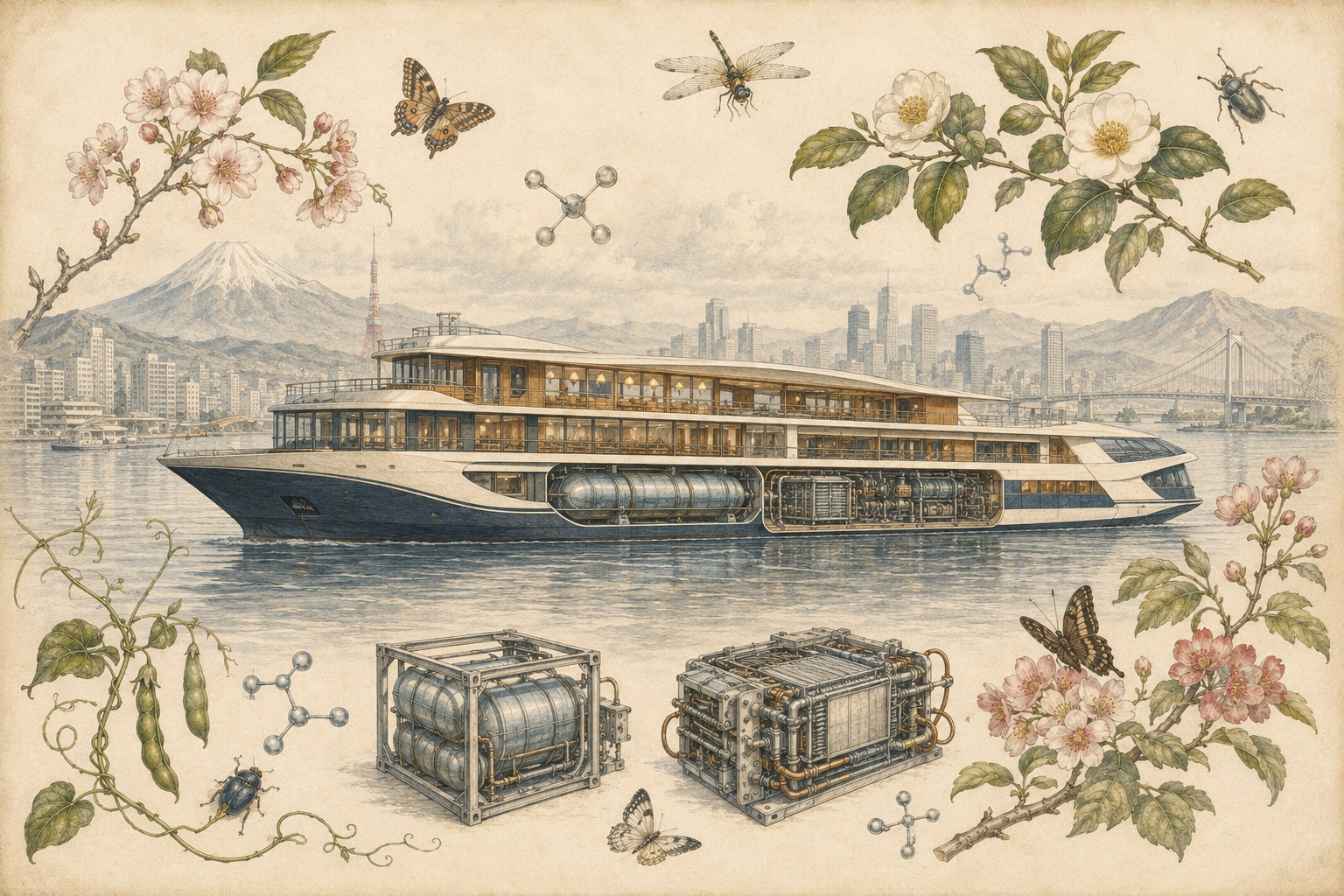
The first thing a passenger notices about hydrogen on a Tokyo Bay dinner cruise may be nothing at all. Less vibration beneath the table. Less low-frequency machinery noise under conversation. No exhaust smell drifting toward the dining space during fuel-cell operation. The vessel leaves Tennoz, moves through the harbor lights, and the machinery becomes less noticeable rather than more.
AMANE, scheduled to enter service in spring 2027, succeeds Lady Crystal, the dining ship that NYK Group’s Cruise Club Tokyo has operated around Tokyo Bay for 36 years. It will integrate a hydrogen fuel-cell system designed by Yanmar Power Solutions, Toyota Motor Corporation hydrogen storage modules and a hydrogen supply organized by ENEOS primarily through stations in the Tokyo area.
Compared with the giant decarbonization projects of international shipping, the vessel is small: about 48 meters and 480 gross tons. It is not a car carrier crossing the Pacific or a bulk ship consuming tonnes of fuel each day.
That small scale is part of the logic. Passenger vessels expose technology directly to customers. A dining ship returns repeatedly to the same home port, follows relatively predictable routes and can concentrate refueling infrastructure in one place. It is an unusually controlled environment for testing not merely whether hydrogen can power a ship, but whether hydrogen can support a daily commercial service.
From 36 years of Lady Crystal to AMANE
AMANE is not creating a dining-cruise business from nothing. Lady Crystal has carried passengers around Tokyo Bay from Tennoz for 36 years under Cruise Club Tokyo, an NYK Group company.
NYK itself dates to 1885 and has a long passenger-shipping history extending through prewar liners, Hikawa Maru, the return to luxury cruising with Crystal Harmony in 1990 and the Asuka cruise brand.
AMANE compresses that passenger-ship heritage into a small Tokyo Bay service. NYK’s July 2026 announcement says the vessel will continue the tradition of French cuisine associated with NYK passenger ships. Lady Crystal executive chef Kenji Hayama will create course menus using carefully selected seasonal ingredients from around Japan. Private-room guests are planned to receive dedicated butler service.
That matters because this is not supposed to be an environmental-technology exhibition with a restaurant attached. Hydrogen has to fit inside a product built around food, service, interior design, views and hospitality. The ship must be desirable even to a guest who does not care what powers it.
A fuel cell is not a hydrogen-burning engine
A hydrogen fuel cell does not work like an internal-combustion engine burning hydrogen. In a PEM fuel cell, hydrogen is separated electrochemically; electrons travel through an external circuit to produce electrical power while hydrogen ions pass through a membrane and ultimately combine with oxygen to form water.
The electricity can drive propulsion motors. Batteries can also be used in marine fuel-cell architectures to handle short-term power changes while allowing the fuel cell to operate in a more stable range.
The joint AMANE announcement says the hydrogen fuel-cell system produces electricity without GHG or NOx emissions during operation. Yanmar’s commercial maritime fuel-cell systems also emphasize zero CO₂, NOx, SOx and particulate emissions from the fuel-cell power source, together with reduced vibration, noise and exhaust odor.
That does not justify describing the entire vessel as guaranteed zero-emission during every phase of every voyage. The partners have not disclosed AMANE’s total fuel-cell capacity, battery capacity, auxiliary generation or operating modes.
The precise statement is that the hydrogen fuel-cell system itself provides zero-emission electrical generation at the point of operation. Vessel-wide and lifecycle emissions require additional information.
On a restaurant ship, quietness becomes an energy-performance metric
A cargo ship is measured largely by how efficiently it moves freight. A dining vessel sells time onboard.
Modern diesel engines can be isolated with mounts, insulation and exhaust design, but combustion and reciprocating machinery create vibration, noise and odor that engineers have to manage. Those mitigation systems also consume space and weight.
Fuel-cell electric propulsion can reduce mechanical vibration and noise. Electric motors are particularly smooth at lower operating speeds.
A useful precedent is MOL Group’s HANARIA, although it is a different vessel with a different power system. MOL has described zero-emission operation on fuel cells and batteries as so quiet that passengers can hear waves against the hull.
For a Tokyo Bay dinner cruise, that passenger benefit can become part of the economics of decarbonization. A fuel-cell system is not only an emissions-control device; it may also improve the product being sold.
The first hard problem for a hydrogen ship is often the fueling point
No ship moves without fuel. One of the biggest barriers to hydrogen shipping is simply the scarcity of convenient hydrogen supply.
A large oceangoing vessel would require dedicated bunkering infrastructure capable of transferring very large quantities. A small passenger ship still needs carefully controlled hydrogen transfer, secure tanks, connections, leak checking, ignition control and emergency procedures.
AMANE connects this maritime problem to existing urban hydrogen infrastructure. ENEOS will produce hydrogen at refueling stations, primarily in Tokyo, and supply it to the Toyota storage modules used in the vessel’s fuel system.
ENEOS reported that it operated 31 of Japan’s roughly 155 hydrogen stations as of September 30, 2025. The company is therefore bringing automotive hydrogen-production, filling and safety experience into a marine application.
This is an important form of infrastructure reuse. Japan does not have to build a massive dedicated port hydrogen-production plant merely to put the first small dining vessels into regular operation.
Toyota’s hydrogen-storage experience moves from road to sea
The hydrogen storage modules will come from Toyota, which has accumulated high-pressure hydrogen-storage experience through vehicles such as the Mirai.
On a ship, tank technology is only part of the problem. Engineers have to decide where tanks can be placed, how they are protected in collision scenarios, where leaked hydrogen can vent, how fire zones are separated, how pipes connect and how inspection or replacement occurs.
NYK says it worked with Yanmar and Toyota to conduct comprehensive safety and reliability verification under MLIT’s safety guidelines for hydrogen fuel-cell ships.
Automotive manufacturing can bring cost and reliability advantages, but a marine environment introduces salt, motion, confined spaces and long operating periods. Maritime integration is therefore more than putting a car tank inside a vessel.
In 2015, MLIT was already drawing a small restaurant ship
One of the most revealing documents in AMANE’s history is an MLIT maritime-policy presentation from 2015. Its future applications for hydrogen fuel-cell vessels included water taxis and a small restaurant ship, with the Tokyo 2020 Olympic period in view.
The stated advantages look remarkably familiar: no CO₂, NOx or SOx in fuel-cell use, together with less vibration and noise.
The unresolved challenges also look familiar: fuel-cell degradation in salty air, continuous high-load operation, ship motion and load fluctuations, leak prevention and detection, ignition prevention and emergency preparedness. MLIT also identified cost and hydrogen availability/infrastructure as remaining barriers.
The vision of an ordinary Tokyo hydrogen restaurant ship did not arrive by 2020. The Olympic Games themselves were postponed to 2021 by the pandemic, but the technology and regulatory work also needed more time.
That delay is useful history. Maritime commercialization is slower than a concept drawing. It requires a safety framework, operating evidence, commercial hardware, trained crews and actual fuel logistics.
The 2018 safety guidelines turned hydrogen ships from exceptions into design objects
A major commercialization barrier was not simply that hydrogen was “dangerous.” It was that regulators and designers needed a common definition of what a safe hydrogen ship should look like.
MLIT began technical work and vessel testing in FY2015 and issued its hydrogen fuel-cell ship safety guidelines in March 2018. In August 2021 the guidelines were revised to incorporate emerging IMO fuel-cell safety work, improve design flexibility and better accommodate larger vessels.
In March 2026—only months before the AMANE fuel-cell announcement—MLIT issued a second revision reflecting newer knowledge and international developments.
The guidelines cover the ship structure, fuel cells, hydrogen fuel piping, control and monitoring, electrical systems, ventilation, fire safety, leaks and emergency isolation.
Standards matter commercially because shipowners, shipyards, class societies, insurers and ports can design around shared rules instead of treating every fuel-cell vessel as a one-off exemption.
Yanmar: a diesel pioneer building a system without combustion
Yanmar’s history makes the transition particularly striking. Founded in 1912, the company says it became the first to commercialize a practical compact diesel engine in 1933. Much of its engineering identity was built around making combustion engines durable and efficient.
Now Yanmar is commercializing a marine power source that removes combustion from the primary fuel-cell conversion process.
The company has worked on maritime fuel cells since government-backed research beginning in the mid-2010s. It began commercialization of its maritime hydrogen fuel-cell system in 2023 and in January 2024 received Japan’s first ClassNK Approval in Principle for a complete maritime hydrogen fuel-cell system.
Yanmar’s marine architecture is modular, allowing multiple units to be connected in parallel and the number of fuel-cell modules to vary with vessel power requirements. The company has announced 300 kW-class and later GH320FC product platforms.
AMANE’s exact model, number of units and total installed fuel-cell output have not been disclosed. It would therefore be wrong to copy a catalog rating directly onto the new ship. What is known is that Yanmar calls AMANE its fifth system implementation.
HANARIA already took the technology into commercial passenger service
The critical predecessor is MOL Group’s HANARIA. Named and launched in 2023, it entered commercial service from Kitakyushu in April 2024.
HANARIA is a hybrid passenger ship with hydrogen fuel cells, lithium-ion batteries and a biodiesel generator. Yanmar supplied its first commercial maritime hydrogen fuel-cell installation: two 240 kW GH240FC units.
The vessel can operate in a zero-emission mode using fuel cells and batteries and in hybrid configurations using biodiesel generation. It was named Ship of the Year 2024.
HANARIA’s importance for AMANE is not that the second ship will copy the first vessel’s specification. It is that Yanmar and the Japanese maritime system already have experience with paying passengers, salt air, real maintenance intervals, real fueling schedules, crew procedures and everyday operation.
AMANE is Yanmar’s fifth implementation. That is the commercial transition worth watching: from “the first vessel” toward a repeatable product installed on different ships for different customers.
A dining ship is also a floating hotel
Propulsion is only one part of a passenger ship’s electrical load. A restaurant vessel needs galley equipment, refrigeration, lighting, air conditioning, pumps, navigation electronics, audio systems and guest services. It consumes electricity before departure and after arrival.
Fuel-cell system design therefore cannot be reduced to the power needed to turn the propeller. Engineers need an hourly load profile covering galley preparation, boarding, cruising, dinner service, HVAC peaks and cleaning.
In many marine fuel-cell systems, batteries can smooth short load spikes while fuel cells provide steadier generation; shore power can also play a role where infrastructure exists.
AMANE’s detailed battery, shore-power and backup-generation architecture has not been made public. Those are general system-design principles, not undisclosed AMANE specifications.
Tokyo Bay is a good “test tank” for hydrogen shipping
An oceangoing container ship can spend weeks away from its home country and has to find fuel at foreign ports. It is one of the hardest places to introduce a fuel with limited infrastructure.
A Tokyo Bay dining ship is almost the opposite. The operating area is constrained. The vessel returns to Tennoz. Voyage time and hydrogen demand can be forecast. Maintenance and fueling can be concentrated at a home base.
In the early infrastructure phase, that “return-to-base” operation is enormously valuable. It is the same reason scheduled buses and depot-based trucks are often stronger early fuel-cell candidates than private cars.
Tokyo also has an existing ENEOS hydrogen-station network. The vessel does not need the national marine hydrogen economy to exist before the first commercial route begins.
Small vessel, fixed water, fixed base, existing supply: the conditions simplify the first stage of deployment.
Portable hydrogen modules can change what bunkering looks like
MLIT’s compressed-hydrogen bunkering guidance includes approaches using portable hydrogen-gas tank systems that can be moved to and secured on a vessel, in addition to more conventional fixed transfer arrangements.
The AMANE release’s use of Toyota “hydrogen storage modules” fits naturally within a modular logistics philosophy. ENEOS produces hydrogen at stations and supplies the modules.
The June release does not disclose the actual bunkering operation for AMANE. It does not say whether modules will routinely be exchanged, filled while fixed onboard or handled through another specific procedure. Refueling frequency and exact location are also not disclosed.
The broader point is that small ships may not need the same bunker infrastructure as future large hydrogen vessels. Modular storage can provide another path into the market.
Zero emissions onboard is not the same as low-carbon hydrogen upstream
A hydrogen fuel cell produces no carbon dioxide at the point of electrochemical conversion. Lifecycle emissions depend on how the hydrogen was made.
ENEOS has experience producing renewable hydrogen by electrolysis at hydrogen stations, but Japan’s broader hydrogen supply uses multiple pathways.
The June AMANE announcement says ENEOS will produce hydrogen primarily at Tokyo-area refueling stations and supply it to the vessel’s storage modules. It does not disclose the electricity mix or lifecycle carbon intensity of the specific hydrogen to be used by the ship.
It would therefore be premature to call AMANE a lifecycle zero-carbon vessel merely because it uses hydrogen.
The accurate distinction is simple: zero-emission fuel-cell operation onboard; lifecycle climate performance dependent on hydrogen production and the rest of the energy system.
- Fuel-cell operating share: What portion of each voyage is actually powered by the fuel-cell system?
- Hydrogen consumption: How many kilograms per cruise, day and year?
- Refueling turnaround: Can hydrogen be replenished without disrupting the passenger schedule?
- Noise and vibration: What measurable comfort improvement does the new power system deliver?
- Equipment utilization: How many hours per year does the expensive fuel-cell asset operate?
- Hydrogen carbon intensity: What is the verified lifecycle footprint of ENEOS-supplied hydrogen?
- Operating cost: What is the incremental cost per voyage including fuel, maintenance and equipment?
Before hydrogen ships become large, small ships can make them normal
Decarbonizing global shipping will eventually require changes to large cargo vessels. IMO’s 2023 GHG Strategy aims for international shipping to reach net-zero greenhouse-gas emissions by or around 2050.
A 48-meter dining ship is not a direct technical template for a trans-Pacific container ship. Fuel quantity, range, redundancy and economics differ profoundly. Ammonia, methanol, biofuels, batteries, hydrogen engines and other options will all compete across different vessel types.
AMANE’s contribution is more foundational: operating culture. Design approval, crew training, hydrogen delivery, leak response, maintenance, spare parts, port coordination and passenger communication have to become routine before hydrogen systems can scale confidently.
Learn the expensive mistakes on a smaller commercial vessel. Standardize the hardware and rules. Build the workforce. Then attempt larger applications.
Missing Tokyo 2020 may have been the more honest commercialization path
Had MLIT’s 2015 vision produced a hydrogen restaurant ship by the Tokyo 2020 period, it would have made a spectacular technology showcase.
Instead, the safety guideline arrived in 2018 and was revised in 2021 and 2026. Yanmar’s commercial marine system emerged in 2023. HANARIA entered passenger service in 2024. AMANE is scheduled for 2027.
Technology commercialization does not always respect event calendars.
An Olympic one-off can be engineered at extraordinary cost. An industry needs something different: a guideline that shipyards understand, systems that suppliers sell more than once, operational experience from another vessel, an energy company willing to supply fuel and a shipbuilder able to construct the project as normal business.
That slower sequence may be a better foundation for a market.
AMANE has to be a Tokyo restaurant first and a hydrogen demonstration second
Technology coverage naturally emphasizes tanks, fuel cells and gas detectors. AMANE’s customers will not board for those things.
NYK’s service design emphasizes cuisine, hospitality, Japanese ingredients, interior experience and Tokyo Bay. The vessel’s name—AMANE, written 海音—evokes the sound of the sea.
That brand concept happens to align with a practical advantage of fuel-cell electric propulsion: less machinery noise and vibration.
When environmental technology and customer experience point in the same direction, some of the premium cost can potentially create service value rather than remain an invisible compliance expense.
Even if fuel cells cost more, a vessel may obtain several forms of value at once: lower onboard emissions, quieter operation, innovation branding, passenger comfort and learning for future ships.
What would success look like in 2027?
A successful launch ceremony proves only that the equipment can operate. Commercial success begins the following morning.
Does hydrogen refueling ever cancel a cruise? Does fuel-cell maintenance fit the schedule? How quickly does salt exposure degrade components? Can the system handle summer air-conditioning load and winter conditions? Do passengers notice the quieter ride? Can the service survive hydrogen cost?
And perhaps the most important question: does there become a sixth, seventh and eighth vessel?
One special ship is a demonstration. Repeat orders for water buses, sightseeing vessels, port craft and ferries constitute a market.
Yanmar already describes AMANE as its fifth implementation. The technology has moved beyond vessel number one. Regular, uneventful operation on Tokyo Bay could become the strongest sales brochure for the next customer.
Hydrogen succeeds most completely when nobody talks about hydrogen
For a guest eating dinner on Tokyo Bay, the ideal hydrogen system does not demand attention every minute.
The ship leaves on time. Food arrives hot. Air conditioning works. The floor vibrates less. Conversation is easy. The vessel returns safely.
Behind the scenes, engineers monitor hydrogen pressure, fuel-cell temperature, insulation, ventilation, gas concentration, battery state of charge and load response. Passengers do not need to know.
That is what infrastructure maturity looks like.
Lady Crystal spent 36 years selling Tokyo Bay, food and time together. AMANE inherits that ordinary commercial mission.
If a passenger in 2027 says, “I rode a hydrogen ship,” while a passenger in 2037 simply says, “It was a quiet dinner cruise,” hydrogen will not have disappeared.
It will have succeeded by becoming normal.
1885 NYK is established and begins building what becomes one of Japan’s defining maritime businesses.
1933 Yanmar commercializes a practical compact diesel engine, beginning a long marine-engine lineage.
Around 1990 Lady Crystal begins Tokyo Bay dining-cruise service, ultimately serving guests for 36 years.
2015 MLIT policy work identifies water taxis and small restaurant ships as early targets for hydrogen fuel cells, with the Tokyo 2020 period in view.
2017 Japan advances real-vessel fuel-cell testing to generate evidence for safety requirements.
March 2018 MLIT issues its hydrogen fuel-cell ship safety guidelines.
August 2021 The guidelines are revised to incorporate emerging IMO work and better accommodate larger vessels.
2023 Yanmar commercializes its maritime hydrogen fuel-cell system and makes its first delivery to HANARIA: two 240 kW systems.
January 2024 Yanmar receives Japan’s first ClassNK AiP for a complete maritime hydrogen fuel-cell system.
April 2024 HANARIA enters commercial passenger service in Kitakyushu.
September 2024 NYK announces a new restaurant ship to succeed Lady Crystal in 2027.
March 2026 MLIT issues the second revision of its hydrogen fuel-cell ship safety guidelines.
June 15, 2026 NYK, Yanmar Power Solutions and ENEOS announce adoption of the hydrogen fuel-cell system for the new dining ship.
July 6, 2026 NYK names the vessel AMANE (海音) and states a spring 2027, around-May service target.
2027 AMANE is scheduled to enter Tokyo Bay commercial operation from Tennoz, testing whether hydrogen can become ordinary passenger-service infrastructure rather than a special demonstration.
Reporting notes and principal sources
This article uses public information checked through August 9, 2026, 12:50 a.m. JST. AMANE’s exact fuel-cell model, installed output, hydrogen quantity, range between refueling events, battery capacity, auxiliary-generation architecture and detailed bunkering method have not been publicly disclosed and are not inferred. “Zero emissions during operation” refers to the hydrogen fuel-cell power system itself and is not a claim of zero lifecycle emissions from hydrogen production.
- NYK / Yanmar Power Solutions / ENEOS: Hydrogen Fuel Cell System to Be Adopted for New Dining Cruise Ship, June 15, 2026
- NYK: New Cruise Ship AMANE (海音), Set to Enter Service in Spring 2027, July 6, 2026
- AMANE official site: Lady Crystal’s 36-year legacy, vessel name, service concept and specifications
- NYK: New Restaurant Ship Symbolizing ESG Management to Enter Service in 2027, September 30, 2024
- Yanmar: Maritime Hydrogen Fuel Cell System selected for AMANE, fifth implementation
- Yanmar: first delivery of maritime hydrogen fuel-cell system to HANARIA, 240 kW × 2
- Yanmar: Japan’s first ClassNK AiP for a maritime hydrogen fuel-cell system
- MOL: Japan’s first hydrogen and biofuel hybrid passenger ship HANARIA
- MOL: HANARIA commercial operation, quietness and zero-emission mode
- MLIT: Safety Guidelines for Hydrogen Fuel Cell Ships, issued 2018 and revised 2021 and 2026
- MLIT: 2015 maritime hydrogen policy presentation identifying water taxis and small restaurant ships
- MLIT: Compressed Hydrogen Fuel Bunkering Operation Guidelines
- ENEOS: hydrogen-station network, including 31 operated stations as of September 30, 2025
- NYK Group History
- IMO: 2023 IMO Strategy on Reduction of GHG Emissions from Ships