- The hardest part of aging at home is not always the stairs
- Eight projects, and a revealing range of ambitions
- A closed school becomes a possible home
- What an adaptable apartment block can accomplish
- Kyoto asks whether an available apartment is truly available
- The geography of care runs from Yokohama to rural Kagawa
- The demographic pressure is already here
- Nine million empty homes—and a shortage of usable ones
- From postwar shortages to a different housing crisis
- A 2025 legal change addresses the invisible barrier to renting
- What would count as success?
- A century-long life needs a neighborhood that can adapt
The hardest part of aging at home is not always the stairs
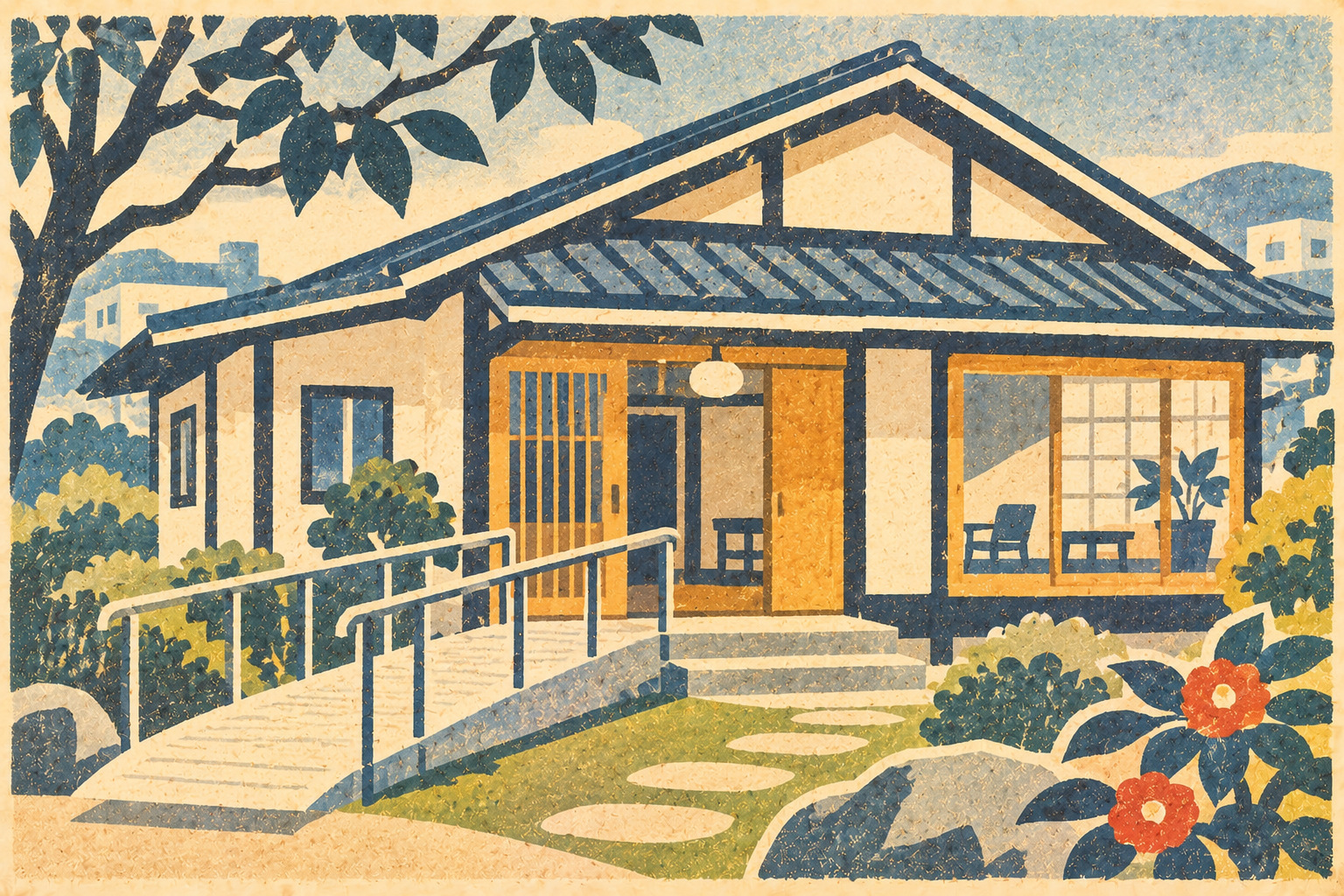
A doorstep can be flattened, a bathroom fitted with grab bars, and a hallway widened. Yet an older tenant may still face a more formidable obstacle: a landlord unwilling to sign a lease, a clinic too far away, or nobody to call when the electricity fails and the person living alone needs help. Housing can be physically accessible and socially impossible to inhabit. Japan is beginning to treat those problems as parts of the same design challenge.
On November 6, 2026, the Ministry of Land, Infrastructure, Transport and Tourism (MLIT) chose eight proposals for its Model Project for Living Environments Supporting a 100-Year Life. The choices range from a disused school in Tochigi Prefecture to adaptable shared accommodation in Kitakyushu and a municipal-housing initiative in Kyoto. Four proposals belong to the program’s issue-focused category; four are at the project-development stage. These are selections for support—not eight finished residential developments.
Eight projects, and a revealing range of ambitions
The four issue-focused proposals are: a combined housing and welfare-workforce model in Yokkaichi, Mie, led by Genkijirushi Co.; the conversion of a former school into a shared living environment in Nasushiobara, Tochigi, led by Nasu Machizukuri; a flexible shared-housing scheme in an existing housing estate in Kitakyushu, Fukuoka, from ZEN; and the use of existing Kyoto municipal housing to serve people who face barriers to securing accommodation, led by Rutreffle.
The other four are development-stage proposals: renewal of housing linked to a public rental arrangement in Yokohama by Seikatsu Club Kanagawa; a three-generation mutual-support living environment in Mitoyo, Kagawa, from Yaoyorozu; outreach to help disaster survivors rebuild housing, with Yatsushiro in Kumamoto identified as a potential location, from One Family Sendai; and a young-people’s community hub in Tanabe, Wakayama, from Izumi. The ministry did not publish these as completed projects, established service outcomes, or fully costed construction contracts.
A closed school becomes a possible home
Japan has spent generations building schools, public apartments and community facilities for a population that was growing and moving toward cities. As demographics shift, some of those buildings have lost their original purpose. In Nasushiobara, the new selection proposes reusing a school that once served education and community gathering as the basis for a different kind of shared living.
The ambition is easy to see: reuse land and structures rather than start with an entirely new development, and retain an institution’s role as a community anchor. The engineering is harder. An old school may need substantial work to meet residential fire-safety, accessibility, privacy, heating and seismic requirements. The announcement gives the project’s theme and lead applicant, not a verified construction budget, final occupancy plan or certificate of readiness.
What an adaptable apartment block can accomplish
In Kitakyushu, ZEN proposes to upcycle existing estate housing into flexible shared accommodation. Adaptability matters because living arrangements rarely stay fixed for decades. A tenant may be healthy and mobile at 55, need modest assistance at 75, or require a very different level of care at 90. Household sizes change; paid carers and visiting relatives may need space; one resident may prefer privacy while another benefits from collective support.
The project raises architectural questions that can travel far beyond Japan. Can rooms be reconfigured without expensive structural work? Can common spaces reduce loneliness without sacrificing residents’ autonomy? Does reusing existing apartments lower life-cycle costs? None of those outcomes is yet demonstrated by the selection itself. A prototype can be important without being mistaken for a proven product.
Kyoto asks whether an available apartment is truly available
The Kyoto proposal focuses on using existing municipally owned housing to support households described in Japanese policy as jutaku kakuho yohairyosha—people requiring special consideration in securing housing. The category includes older adults, people with disabilities, low-income households and others likely to face barriers in the rental market.
A vacant unit is not necessarily a viable home. Tenancy rules, guarantees, daily-life support and access to medical or welfare services can determine whether someone can move in and stay. The project’s essential innovation may therefore be organizational rather than architectural: connecting the housing operator with a network that can respond before a manageable difficulty becomes an eviction or emergency. Whether that happens in practice remains a question for later evaluation.
The geography of care runs from Yokohama to rural Kagawa
Other selections address the community beyond the front door. In Yokohama, a consumer cooperative is exploring housing renewal at the point when leased public rental units are returned. In the Nio area of Mitoyo, Kagawa, another proposal imagines an environment in which three generations can look out for each other, linked to wider neighborhood revitalization.
The selection list also includes outreach for disaster survivors who need help rebuilding residential stability, with Yatsushiro named as a candidate site, and a young people’s base in Kumano’s Tanabe area. These are not exclusively elder-care projects. They recognize that a community in which older people can remain is also a community in which younger people, caregivers and displaced households need somewhere to live. No single age group can sustain the local support network alone.
The demographic pressure is already here
Japan’s 2026 White Paper on the Ageing Society records 36.22 million people aged 65 or older as of October 1, 2025—29.4% of the population. The 75-plus population, at 21.27 million, already exceeds the 65-to-74 group. These figures point to growing needs for mobility, support services and homes that can accommodate changing abilities.
But chronological age does not define an individual’s housing requirements. Many older people are independent; younger people can need accessible homes, financial assistance or supportive services. The “100-year life” framing is most useful when it shifts planners away from designing housing for a narrow age category and toward creating places where needs can change without forcing people out of their communities.
Nine million empty homes—and a shortage of usable ones
Japan has a paradox. The 2023 Housing and Land Survey counted approximately 9.002 million vacant dwellings, or 13.8% of the housing stock, the highest rate recorded. That count includes units available for rental or sale as well as second homes and other vacant housing; it does not mean nine million immediately habitable, accessible apartments exist in places people want to live.
Buildings may be in the wrong location, too costly to renovate, difficult to reach without a car, or legally and physically unsuitable for a new use. In a market where stock and demand do not automatically align, adaptive reuse needs a plan for accessibility, financing, transportation and operations. The new school, estate and municipal-housing proposals are attempts to address pieces of that mismatch, not evidence the entire vacancy problem has been solved.
From postwar shortages to a different housing crisis
Japan’s modern housing policy emerged from the enormous shortage of homes after World War II. The Housing Loan Corporation, public housing system and Japan Housing Corporation helped finance and construct large numbers of dwellings during the rapid growth of the 1950s and 1960s. Providing units was the overriding problem; mass housing estates became symbols of an expanding urban middle class.
As the population aged and household composition changed, the policy question shifted from how many units could be built toward what residents could actually do with them. The 2006 Basic Act for Housing reoriented policy around the stability and quality of residential life. A new national Basic Plan for Housing was adopted by Cabinet decision on March 27, 2026. The November model selections sit within this longer transition from volume to resilience, quality and social support.
A 2025 legal change addresses the invisible barrier to renting
A revision to Japan’s Housing Safety Net Act took effect on October 1, 2025. It strengthens the framework for people who encounter difficulty finding private rental housing, including older renters and people with disabilities. Government explanations describe landlords’ concerns about arrears, unattended death and the handling of belongings after a tenant dies. The reforms include an accredited category of supported housing offering monitoring and other ongoing help.
This matters because physical design is only one layer of accessibility. Someone who can navigate an apartment without assistance still needs the right to rent it and a practical path to get help when circumstances change. Housing-support organizations, welfare agencies, landlords and municipalities must cooperate. The November projects may provide valuable examples of that integration, but the announcement alone cannot establish how well any particular partnership will function.
What would count as success?
A serious evaluation of these eight selections should begin with questions the announcement cannot yet answer. Who is eligible to move in? What will residents actually pay? How expensive will renovations be? Who provides care and monitoring? How will operators remain solvent after initial public support? Can people stay in their homes as their needs change, or will they face another forced move?
The program’s published rules require selected projects to begin within the fiscal year and foresee follow-up surveys after completion. That is an appropriate starting point for accountability, but it is not a substitute for measured results. Residents’ experiences, financial sustainability, numbers served and adaptations made over time will show whether the concepts can be replicated elsewhere. A selected model is a hypothesis with institutional backing, not an established best practice.
A century-long life needs a neighborhood that can adapt
The most important design element in an age-friendly home may be something the architect cannot draw on the floor plan: a trusted person who answers the telephone. A broad doorway matters. So do rent, a bus stop, reliable heat, accessible health care and a place to meet neighbors. Housing is where those systems become personal.
Japan’s eight new experiments suggest that a long-lived society cannot solve its problems merely by building more specialized elder-care facilities. Existing schools, public apartments, cooperatives and ordinary neighborhoods all have roles to play. In November 2026, the country is not unveiling eight completed answers. It is testing eight ways to ask a better question: how can a home keep working as a person—and the community around them—changes?
Sources and reporting method
Japanese-language government primary sources were checked for project names, dates, housing terminology and historical statistics.
- MLIT, Eight housing models selected (Nov. 6, 2026)
- 100-Year Living Environment Model Program, FY2026 application guidance
- Cabinet Office, 2026 White Paper on the Ageing Society
- Statistics Bureau, 2023 Housing and Land Survey, definitive results
- MLIT, National Basic Plan for Housing, adopted Mar. 27, 2026
- MLIT, revised Housing Safety Net Act (effective Oct. 2025)
- MHLW, Supported Housing certification and information system
- MLIT, First-round 2026 housing model selection (Sept. 11)