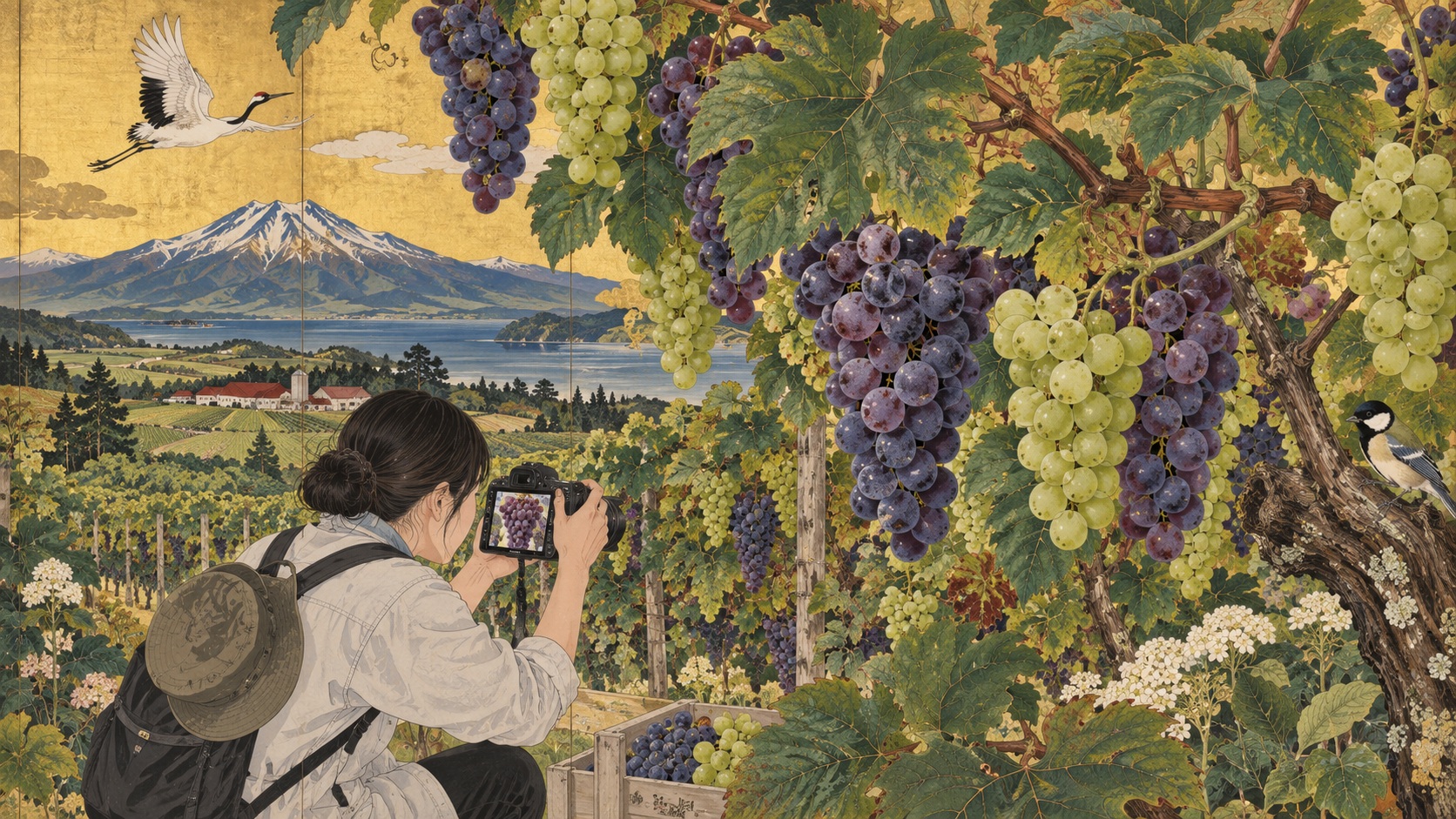
The grape berry that appeared to shrink
A camera looking into a vineyard can be misleading. A grape berry hidden behind its neighbors may appear smaller from one photograph to the next even as the fruit continues to grow. That seemingly mundane problem sits at the heart of a new Japanese study: using computer vision without mistaking changes in visibility for changes in biology.
On October 8, 2026, Hokkaido University announced a model developed by researchers including Professor Yoichiro Hoshino, postdoctoral researcher Li Jixiao and Professor Teruo Sone. The team studied Kerner and Zweigelt wine grapes at the university's Yoichi orchard in Hokkaido. The underlying paper had appeared online on July 15 in The Horticulture Journal. That distinction matters: October's news is the university's announcement of published research, not a claim of a just-completed harvest or a commercial deployment. [1] [2]
Computer vision meets a stubborn biological fact
The researchers photographed clusters in the field and used YOLOv8, an object-detection model, to identify individual berries in the images. From those observations they calculated changes in apparent berry diameter. But the resulting growth curves sometimes dipped for reasons unrelated to genuine growth: berries overlapped, disappeared from view or entered the detected population at different moments.
Their answer was not simply to ask the neural network to try harder. They introduced a “forcibly smoothed,” or F-smoothed, algorithm incorporating a physiological premise: during the early growth phase, berry diameter should not decline. The resulting approach is described in the paper as biology-informed smoothing. It is a revealing example of hybrid scientific reasoning: machine vision provides large quantities of observations, while domain knowledge identifies results that make little biological sense. [2]
Two surges of growth, not one straight line
After the correction, both grape varieties exhibited the characteristic double-sigmoid pattern associated with grape-berry growth. In the university's account, two periods of rapid expansion occurred principally in July and August. Such curves are valuable partly because they help researchers plan when to collect samples for chemical and quality measurements.
That does not mean the system can already predict the ideal picking day for every vineyard. Berry diameter is one component of fruit development. The choice of harvest date also depends on sugar, acidity, disease pressure, the desired wine style and weather. The study establishes a method for tracking relative berry growth; its use for harvest decisions is a prospective application. [1]
Why the experiment belongs in Yoichi
The field site is not an incidental detail. Yoichi, on Hokkaido's western side, is an important wine-grape growing area, and the university operates an orchard there. Research conducted outdoors in an actual vineyard must confront uneven light, weather, changing foliage and crowded fruit clusters—the very conditions under which a grower might want useful measurements.
Kerner and Zweigelt also make a specific, bounded experimental pair rather than a stand-in for every grape in Japan. Their development can provide useful knowledge for the northern growing environment, but it would be premature to assume that the same correction performs equally well across all cultivars, climates or camera setups. The next scientifically meaningful tests involve repeatability across years, sites and varieties.
From a grower’s eye to a digital time series
Vineyard observation predates electronics by centuries. Growers judge vigor, fruit set, ripening and weather through regular visits and accumulated experience. Modern fruit physiology added measurement and formal growth curves. Photography brought a non-destructive means of recording visible changes. Computer vision now makes it possible to examine many observations systematically rather than manually measuring each berry.
The Hokkaido work illustrates both the strength and weakness of that progression. Automated detection can increase the amount of usable information, but a photograph remains a projection of a three-dimensional, changing bunch. The algorithm has to account for what the camera cannot reliably see. Otherwise, greater measurement frequency merely produces a more elaborate record of error.
A national push for smart farming
The research also falls within a wider, though not necessarily directly funded, Japanese effort to make agriculture more productive as its workforce changes. Japan's Smart Agriculture Technology Utilization Promotion Act took effect on October 1, 2024. The Agriculture Ministry describes schemes supporting changes in farm production methods and technology development and dissemination. There is no basis in the cited material to claim this particular study was approved under that law. [4]
For growers and technology companies, the most commercially significant question is not whether an AI model detects grapes on a photograph. It is whether reliable measurements improve decisions enough to justify cameras, data handling, training and maintenance. A useful product must also tolerate rain, changing light and the irregularities of real vines. The university announcement does not establish a commercial price or return on investment.
What the results do—and do not—prove
The announced achievement is a non-destructive method for monitoring relative berry growth in two cultivars at the Yoichi field site, yielding biologically plausible curves. The university says this provides a foundation for better sampling plans and may eventually aid cultivation management and harvest timing. It does not publish evidence that the system predicts finished wine quality, reliably selects picking dates, or has been deployed commercially across Japan.
Those boundaries are not a reason to dismiss the science. They identify the next tests required to move from a promising research technique to a dependable vineyard tool: external validation, errors quantified against manual measurements, performance under difficult weather, and the relationship between growth trajectories and outcomes growers actually value.
The most interesting lesson is not about AI replacing farmers
The enduring appeal of the project lies in its reversal of a familiar automation story. When the data seemed to suggest that fruit was shrinking, the answer came from understanding the plant, not unquestioningly accepting the model. The system became more credible when a simple biological constraint corrected a sophisticated visual analysis.
The July paper and October university announcement place Yoichi at an intersection of agricultural tradition and new measurement technology. Whether the method ultimately becomes routine vineyard equipment remains open. For now, it shows how closely the future of agricultural AI may depend on knowledge that growers and plant scientists have spent generations developing.
Sources and further reading
- Hokkaido University research announcement, October 8, 2026
- Original paper in The Horticulture Journal, published online July 15, 2026
- Hokkaido University Field Science Center
- Japan Ministry of Agriculture, smart farming legislation
Sources reviewed October 10, 2026. University announcement: October 8; paper published online July 15. Commercial performance and harvest-date accuracy remain unverified.