In the global fusion race, one word dominates: tokamak. ITER in France is a tokamak. Japan's JT-60SA is a tokamak. Many of the best-funded private fusion companies are building tokamaks or close relatives—machines that use a large electric current in the plasma, together with external magnets, to make the twisted magnetic field needed for confinement.
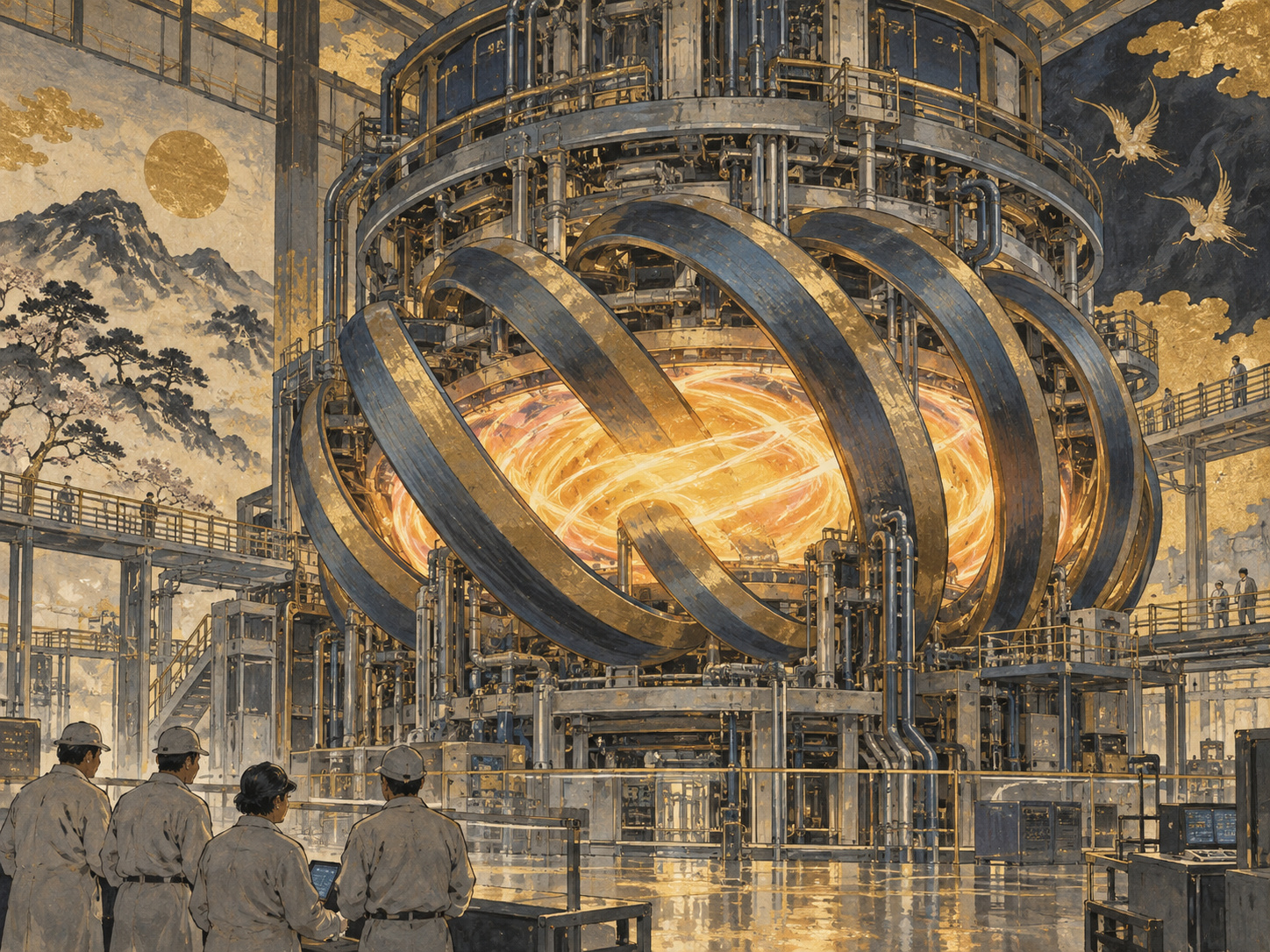
In Toki, Gifu Prefecture, Japan is advancing a different lineage. Helical Fusion, a startup spun out of the National Institute for Fusion Science, is building an integrated engineering demonstrator called Helix HARUKA on the NIFS campus. Reuters reported on September 29 that the first construction stage is largely complete and that preliminary power-on tests are planned for 2027.
The helical route avoids relying on a large plasma current
The central physics problem in magnetic fusion is confining plasma hotter than 100 million degrees without allowing it to touch the chamber wall.
A tokamak uses external coils plus a large current flowing through the plasma to create the required twisted magnetic field. A helical device—part of the broader stellarator family—creates the three-dimensional twist with external coils alone.
That distinction matters. Tokamaks must manage plasma current as a central operating variable and protect against disruptions in which that current can collapse rapidly. Helical systems do not require a large toroidal plasma current, giving them an inherent attraction for steady-state operation and reducing one class of disruption risk.
The price is engineering complexity. External coils must create a precise three-dimensional field, so their shapes are harder to manufacture, support, cool and maintain.
Japan made helical fusion a world-class research program with LHD
Japan's heliotron and helical research goes back decades. In the 1980s, the country moved toward a large shared-university experiment. The National Institute for Fusion Science was established in 1989 and construction of the Large Helical Device began.
LHD was completed in 1997 and produced first plasma on March 31, 1998. With enormous superconducting helical coils, it became one of the world's leading stellarator-class machines.
In 2017, deuterium experiments reached an ion temperature of 120 million degrees Celsius. LHD also sustained plasma for 3,268 seconds—54 minutes and 28 seconds—demonstrating one of the central promises of current-free helical confinement: long-duration operation.
The experimental program ended on December 25, 2025 after more than 27 years and over 200,000 plasma discharges.
Between a plasma experiment and a power station lies an engineering valley
A research device can be scientifically successful without being remotely ready to sell electricity.
Plasma experiments focus on temperature, density, confinement, stability and transport. A power plant must solve all of those problems while also keeping magnets alive for years, removing heat, absorbing fusion neutrons, breeding and recovering tritium, replacing damaged components and achieving economically useful availability.
Helical Fusion's business is an attempt to cross that valley from plasma science to integrated reactor engineering.
Helical Fusion spun out of NIFS in 2021
Helical Fusion Co., Ltd. was established on October 22, 2021 using a framework for commercializing research results from NIFS.
Co-founder and CEO Takaya Taguchi came from finance, power-plant export finance, M&A and new-business development. CTO Junichi Miyazawa was a NIFS professor and worked across plasma experiments, high-temperature superconductors, blanket systems and divertor technologies.
The combination is revealing. Commercial fusion does not require only plasma physicists. It needs reactor design, manufacturing, finance, construction, regulation, operations and an industrial supply chain capable of producing unusually difficult hardware repeatedly.
A 2025 high-temperature-superconducting coil test cleared one hurdle
One of the defining engineering problems of a helical reactor is the magnet: a large, precisely shaped superconducting coil that must carry enormous current while surviving equally enormous electromagnetic forces.
In 2025 Helical Fusion announced a successful test of a coil using REBCO high-temperature-superconducting material. The company said it reproduced a fusion-relevant magnetic environment and maintained stable current under superconducting conditions.
REBCO—rare-earth barium copper oxide—is part of a class of superconductors that can operate at higher temperature and magnetic field than many traditional superconducting materials. That makes it attractive for compact, high-field fusion magnets.
“High temperature,” however, does not mean room temperature. The magnet still requires cryogenic cooling, and a commercial machine must solve joints, structural support, quench protection and lifetime reliability.
What HARUKA is supposed to integrate
Helical Fusion lists a helical-coil major radius of about one meter or more for HARUKA and a target magnetic field of about 2 tesla. The design uses REBCO magnets and electron cyclotron resonance heating, with pellet injection and gas puffing for fuel supply.
The second major system is the blanket/divertor complex.
In deuterium-tritium fusion, the reaction releases a high-energy neutron. A power-plant blanket must absorb that neutron energy as heat and use interactions with lithium to breed new tritium fuel.
Helical Fusion is developing a liquid-metal blanket concept. Liquid systems could create different maintenance and fuel-recovery options from solid breeder blankets, but they also introduce demanding questions around corrosion, magnetohydrodynamic flow, materials compatibility and tritium control.
The divertor is the exhaust system for a burning plasma
Keeping plasma confined is only part of reactor operation. Helium “ash,” impurities and excess heat must be removed from the plasma edge.
The divertor performs that job. In a power reactor it is exposed to extreme heat loads, making materials lifetime and maintainability critical.
Because a helical device has a three-dimensional magnetic geometry, its exhaust design differs from the simpler axisymmetric picture often associated with a tokamak. HARUKA's emphasis on integrated blanket/divertor engineering shows that Helical Fusion is trying to test power-plant hardware, not only plasma confinement.
What a 2027 power-on test can actually prove
Reuters reported that construction of the first spiral coil at the NIFS site is largely complete and that Helical Fusion intends to begin preliminary power-on testing in 2027.
The first questions are electrical and mechanical: can the magnet, power system, cryogenics, structures and control systems operate at their designed conditions?
If that phase succeeds, the company plans to add a second coil and other major components, including a liquid-metal wall blanket, before power-on testing of the completed integrated facility around 2030.
The phrase “power-on” is easy to misunderstand in fusion coverage. It means supplying power to operate the equipment. It does not mean HARUKA will be generating net electricity for the grid.
HARUKA tests the hardware; KANATA is meant to test the plant
| Attribute | Helix HARUKA | Helix KANATA |
|---|---|---|
| Role | Integrated/final demonstration device | First power-generating unit |
| Purpose | Integrate HTS magnets and blanket/divertor systems | Demonstrate steady-state, net-electric operation and maintainability |
| Coil major radius | ~1 m or more | ~10 m or more |
| Magnetic field | ~2 T | ~7 T |
| Continuous-operation target | 1+ year | 1+ year |
| Availability target | Above 80% | Above 80% |
| Net electricity | Not the net-power demonstration plant | Targeted in the 2030s |
Net electricity is the boundary that matters
Fusion news often uses the word “breakeven” for very different milestones: more fusion energy than laser energy delivered to a target, more fusion heating than external plasma heating, or more electrical power out of an entire plant than the facility consumes.
For a commercial station, the last definition is what matters.
A plant must power magnet cooling, plasma heating, vacuum pumps, fuel processing, controls, heat-transfer equipment and all the other “house loads” and still deliver useful electricity to the grid.
Helical Fusion's stated goal of net power with KANATA is therefore a plant-level engineering goal. HARUKA sits one stage earlier: demonstrate that the hardware can be integrated and operated for long periods.
Steady-state operation is the helical system's strongest commercial argument
A power plant has little value if it operates only for seconds or minutes. It must run for long stretches between maintenance outages.
Helical machines are attractive because the confining magnetic field can be produced entirely by external coils and held continuously. LHD demonstrated that physics advantage with its 3,268-second plasma.
But a one-year reactor campaign is not simply a 54-minute plasma multiplied by thousands. Plasma-facing materials, blankets, cooling, vacuum, fuel cycles and components all have to survive together.
That is why HARUKA's one-year-plus operating target is as much a materials-and-maintenance challenge as a plasma challenge.
Japan's government is deliberately backing more than one fusion architecture
Japan adopted its Fusion Energy Innovation Strategy in 2023 and revised it in 2025. In 2026 the government further defined a commercialization pathway.
The Seventh Strategic Energy Plan explicitly supports accelerated demonstration using multiple concepts, including tokamak, helical and laser fusion, while drawing on capabilities developed through ITER and JT-60SA.
A 2026 METI roadmap places Helical Fusion alongside private projects using tokamak and laser approaches. The policy logic is portfolio-based: fusion remains uncertain enough that choosing a single technical winner today would create its own strategic risk.
Why tokamaks became the mainstream
Tokamaks have dominated magnetic-confinement fusion research since the late 1960s because their axisymmetric geometry can achieve very strong plasma performance and because decades of global research have built an enormous knowledge base around them.
ITER is the largest expression of that path. Japan's JT-60SA follows it. Private companies such as Commonwealth Fusion Systems are also using tokamak architectures.
Stellarators and helical devices exchange one problem for another. They can avoid reliance on a large plasma current, but their magnets and three-dimensional fields are much harder to design and manufacture.
Advances in computational optimization, precision manufacturing and high-temperature superconductors have changed that tradeoff. Germany's Wendelstein 7-X and Japan's LHD also supplied decades of experimental evidence on what these geometries can do.
HARUKA cannot succeed merely by making plasma
Even if the 2027 energization goes exactly to plan, the difficult questions continue.
Can the HTS coils maintain field under long-duration electromagnetic and thermal loads? Can liquid metal coexist with structural materials? Can tritium be bred and recovered safely? Can the divertor survive heat flux? Can components be replaced remotely and economically?
And eventually: can the entire plant be permitted, built quickly enough, financed and operated at a cost that competes with alternatives?
Taguchi told Reuters that commercial operation still faces not only technical challenges but also cost, safety and construction-speed hurdles.
Fusion does not mean “no radioactive waste”
Fusion differs fundamentally from today's fission reactors. There is no fission chain reaction, and shutting off fuel and plasma conditions stops the fusion reaction. The accident physics and waste profile are different.
But deuterium-tritium fusion produces large numbers of 14.1 MeV neutrons. Those neutrons activate structural materials. Tritium is itself radioactive and requires controlled handling.
Commercial fusion therefore does not eliminate radioactive materials. The engineering objective is to reduce long-lived waste, choose low-activation materials and make components replaceable and manageable over the plant lifetime.
The fuel cycle is also a reactor technology
Deuterium is abundant in water. Tritium is not naturally available in the quantities a global fusion industry would consume.
A D-T power plant must use fusion neutrons to breed tritium from lithium inside its blanket, extract that tritium, limit losses and return it to the plasma.
A reactor that produces excellent plasma but cannot close its tritium fuel cycle is not a self-sustaining commercial power source.
Helical Fusion's early focus on blanket technology reflects that reality.
1980s: Japanese heliotron research matures and the LHD concept takes shape.
1989: NIFS is established and the LHD project advances.
1998: LHD produces first plasma.
2017: LHD deuterium experiments reach 120-million-degree ion temperatures.
2021: Helical Fusion is founded as an NIFS spin-out.
2025: HTS magnet milestone; HARUKA enters construction. LHD experimentation ends in December.
2026: First-stage HARUKA construction advances on the NIFS site.
2027: Preliminary HARUKA power-on testing planned.
Around 2030: Target for power-on testing of the completed integrated HARUKA facility.
2030s: Helix KANATA targets steady-state, net-electric generation.
2040s: Company aims toward commercial plant operation.
From a national laboratory machine to electricity someone can buy
Japan is not starting from zero in helical fusion. LHD spent 27 years building knowledge in superconducting coils, long-duration plasma, high-temperature confinement and three-dimensional magnetic geometry.
But a power plant is judged by different metrics from a research institute: annual availability, construction time, maintenance days, component cost and net megawatts delivered to customers.
HARUKA is meant to move the scorecard in that direction.
If it works, the global fusion race retains a distinct Japanese path rooted in decades of helical research. If it does not, the failure will still identify which engineering constraint—magnets, blankets, maintenance, materials or economics—blocks that route.
The 2027 power-on test will not create a miniature sun that begins selling electricity.
But nearly three decades after LHD's first plasma, Japan's helical program is preparing for a different kind of experiment: whether knowledge from a national laboratory can be turned into hardware capable of becoming a power business.
Sources & Reporting Notes
- Helical Fusion: Helix Program — Primary description of Helix HARUKA and Helix KANATA, including REBCO magnets, liquid-metal blanket, target field, long-duration operation and availability.
- Helical Fusion: About Us — Company history: 2021 NIFS spin-out, 2025 move into HARUKA manufacturing and construction, and Helix Program milestones.
- Helical Fusion: Team — Primary source for co-founder and CEO Takaya Taguchi, CTO Junichi Miyazawa and other leadership.
- Helical Fusion: HARUKA construction-site announcement — Primary source on construction at NIFS and the transition from LHD-derived research to integrated hardware.
- Helical Fusion: HTS magnet milestone — Primary company account of the 2025 high-temperature-superconducting magnet test.
- National Institute for Fusion Science: History — Official chronology of NIFS and the Large Helical Device.
- NIFS: Completion of the LHD Experiment — Primary source confirming the end of the LHD experiment in Dec. 2025 after more than 27 years and over 200,000 plasma discharges.
- NIFS: Large Helical Device Project — Official explanation of the heliotron/helical configuration and its steady-state advantage.
- NIFS: LHD and Wendelstein 7-X explanation — Primary background on stellarator/helical versus tokamak confinement and LHD's 120-million-degree result.
- Cabinet Office: Fusion Energy Innovation Strategy — Japanese national fusion strategy, including the 2025 revision and 2026 commercialization pathway.
- METI Strategic Energy Plan — Government policy supporting multiple fusion concepts including tokamak, helical and laser approaches.
- METI fusion roadmap — Government roadmap showing Helical Fusion among private-sector power-demonstration projects.
- Reuters, Sept. 29, 2026 — Reports preliminary HARUKA power-on tests planned for 2027, full integrated power-on testing around 2030 and longer-term KANATA plans.
This article is based on material public through September 30, 2026. HARUKA's planned 2027 preliminary power-on testing is described as equipment energization and first-stage hardware testing, not a demonstration of net electricity generation. The around-2030 integrated HARUKA test, 2030s KANATA net-power target and 2040s commercial-operation ambition are company plans, not guaranteed outcomes; they depend on technical performance, regulation, capital and construction. Company claims of world-first status for parts of the 2025 HTS test are attributed to Helical Fusion rather than presented as independently certified records.
Image rights: © 2026 Japan.co.jp. AI-assisted scientific editorial illustration. Permission is required for reuse. Contact.