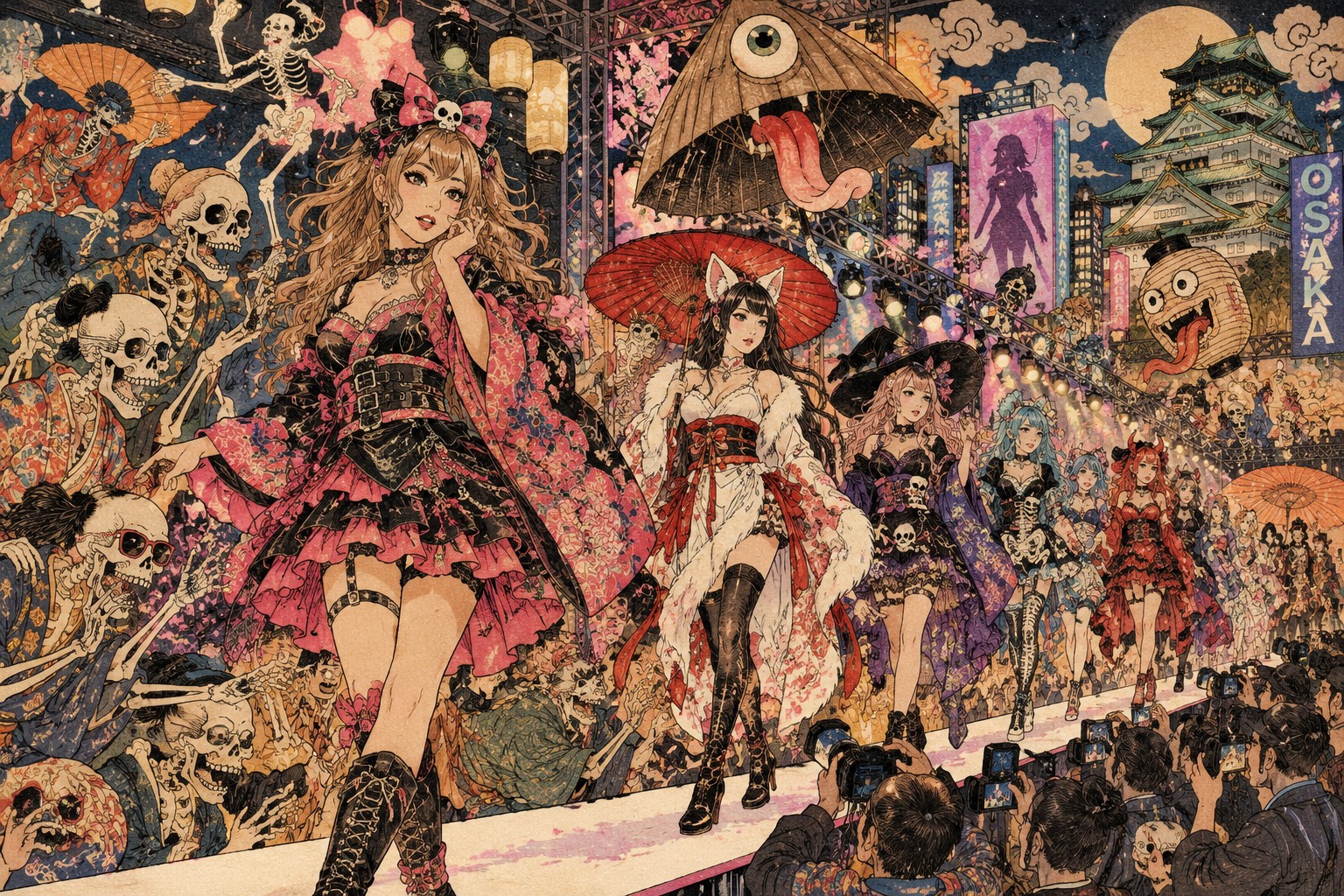
What began as a way to stand out on Shibuya’s streets is now marketed as an outfit made to be seen everywhere.
The costume is the medium; visibility is the product
A leopard-print cat, a red-and-black China-inspired outfit and a turquoise diner uniform have little in common as historical costumes. Yet on October 27, Japanese fashion retailer Tika presented all three as part of a seven-design “gyaru cosplay” collection. Its campaign offers a useful window onto a larger transformation: a street-fashion language once shaped by teenagers and shop staff in Shibuya can now be packaged by an online merchant for a Halloween photograph, a dance event or a coordinated outing with friends. The collection is real; whether it becomes a commercial hit is not established.
What the October 27 announcement actually says
DRESS DESIGN WORKS describes Tika as a retailer of nightlife dresses, costumes, yukata and other fashion products. The company announced seven new designs and named two models: Mirai Yokota, written 横田未来 and read Yokota Mirai, and Aisa, whose full name the release gives as 細川愛沙 (Hosokawa Aisa). Those are company-supplied identifications. Descriptions of the models’ exceptional popularity are promotional claims, not independent audience measurements. The announcement supplies no sales totals, sell-through rates or verified consumer-response figures.
Seven costumes, seven different cultural references
The prominent designs are a leopard cat, a contemporary Chinese-inspired dress and a retro American diner look. The rest include a glossy maid-bunny outfit, a soft bunny style, a pastel sailor uniform and a Thai-inspired costume. That range is revealing. “Gyaru” here does not specify a single historical uniform; it provides an attitude of exaggeration, photogenic styling and confident display. Some costumes borrow imagery from cultures outside Japan, raising a separate question of how designers distinguish affectionate inspiration from caricature. The company’s promotional copy does not resolve that question.
Before cosplay retail: the teenage makers of Shibuya fashion
SHIBUYA109 opened in 1979, but it was not born as the sanctuary of the gyaru movement. Shibuya cultural histories describe a crucial pivot in the mid-1990s, when shops catering to younger women gained commercial momentum. The building, its staff and the surrounding streets became a feedback loop: visitors copied sales clerks, clerks watched street trends, magazines photographed both, and shoppers altered the looks again. The result was an industry in which consumers helped create the product’s cultural meaning rather than merely accepting a designer’s instructions.
How the word “gyaru” became a cultural identity
Gyaru derives from the English “gal,” but the Japanese term took on a distinct social meaning. Scholarship from Hitotsubashi University traces the stronger association of gyaru and gyaruo with conspicuous youth cultures in Shibuya from the late 1990s into the 2000s. Its varied forms included kogal schoolgirl styles, striking makeup, dyed hair and subcultures such as ganguro and yamanba. Those labels are not interchangeable, and members did not all dress alike. Outsider portrayals often treated the culture as a spectacle; its practitioners also used fashion to claim belonging, play and autonomy.
Magazines, charismatic clerks and the pre-social-media influencer
The mechanics of influence existed long before the smartphone. Retail historians describe charismatic shop staff at SHIBUYA109 and publications such as egg creating an ecosystem of imitation and experimentation. Photographs of ordinary young people could make a look desirable. The contemporary version compresses the cycle: a retailer releases model imagery, creators circulate their own variations and shoppers can buy directly from a link. Tika’s hiring of named models illustrates the method, but the company has not provided independently audited data connecting this campaign to orders.
A business with more than one seasonal occasion in mind
Tika’s press release explicitly pitches its costumes for photo shoots, events, themed outings, clubs and coordinated “twin looks,” not solely for Halloween evening. That is a marketing positioning, not proof of substantial off-season sales. Nonetheless, it captures a potential shift in how costumes are valued: visibility in pictures, consistency within a group and the ability to re-use a look in a different setting can be part of a purchase decision. For a retailer, those use cases might reduce dependence on a single weekend—if customers actually adopt them.
The uncomfortable numbers behind Halloween spending
Japan’s Halloween market was not unequivocally booming in the most recent independently sourced figures available for this story. In an October 2025 survey of 5,000 people, research company Intage found that 24.1% planned Halloween-related activities, 4.2 percentage points below the previous year. Among those with plans, average intended spending rose from ¥6,565 to ¥7,192. Intage estimated a ¥167.3 billion market, 93% of the prior year’s level. These are survey-based 2025 estimates, not confirmed 2026 costume sales. Rising expenditure among participants did not mean overall participation was rising.
What an apparel analyst would still need to know
Seven advertised products do not establish a trend in revenue. Unit prices, returns, inventory costs, gross margins, conversion rates and repeat purchases would help explain whether the capsule collection makes economic sense. So would evidence that customers use costumes in other months. The launch supplies neither a multi-year comparison nor a customer cohort study. It is therefore defensible to report a retailer’s strategic pitch toward event use, but not to declare that Japanese costume retail has already escaped Halloween seasonality.
From Osaka to Shibuya: the geography of a portable aesthetic
The October release identifies the operator as DRESS DESIGN WORKS and gives an Osaka city location in its opening description while listing a Tokyo address in its company-profile section. The precise legal functions of those locations were not resolved from this single release. What is clear is that gyaru imagery, often narrated through Shibuya, has become a commercially portable vocabulary for companies and consumers beyond the neighborhood. The city remains central to the history even when production, fulfillment, marketing and consumption happen elsewhere.
Expression, agency and the pressure to be photogenic
The history of gyaru is not merely a catalogue of short skirts, hair color or makeup. It includes young women setting their own standards and testing social expectations. Commercial packaging can preserve that sense of fun, but it can also narrow it into a requirement to look attractive on camera. The phrase “photogenic” may describe a consumer desire and a commercial pressure at once. A more complete report would speak to wearers, designers and former gyaru participants about what they see as continuity or distortion.
The story after October 31
When the decorations come down, the deeper experiment continues. Can a visual vocabulary born in the streets, stores and magazines of 1990s Tokyo support today’s network of online retailers, event-goers and short-form creators? Tika’s seven designs are a small but telling case, not a verdict. Their importance lies in the tension between a subculture that once made its own meaning and an industry that now markets that meaning as a ready-to-wear experience. The next evidence must come from the customers, not the campaign photograph.
Sources and verification
Based on the October 27 corporate release, historical reporting, sociology research and the 2025 consumer survey. No original interviews or independently verified 2026 sell-through figures.