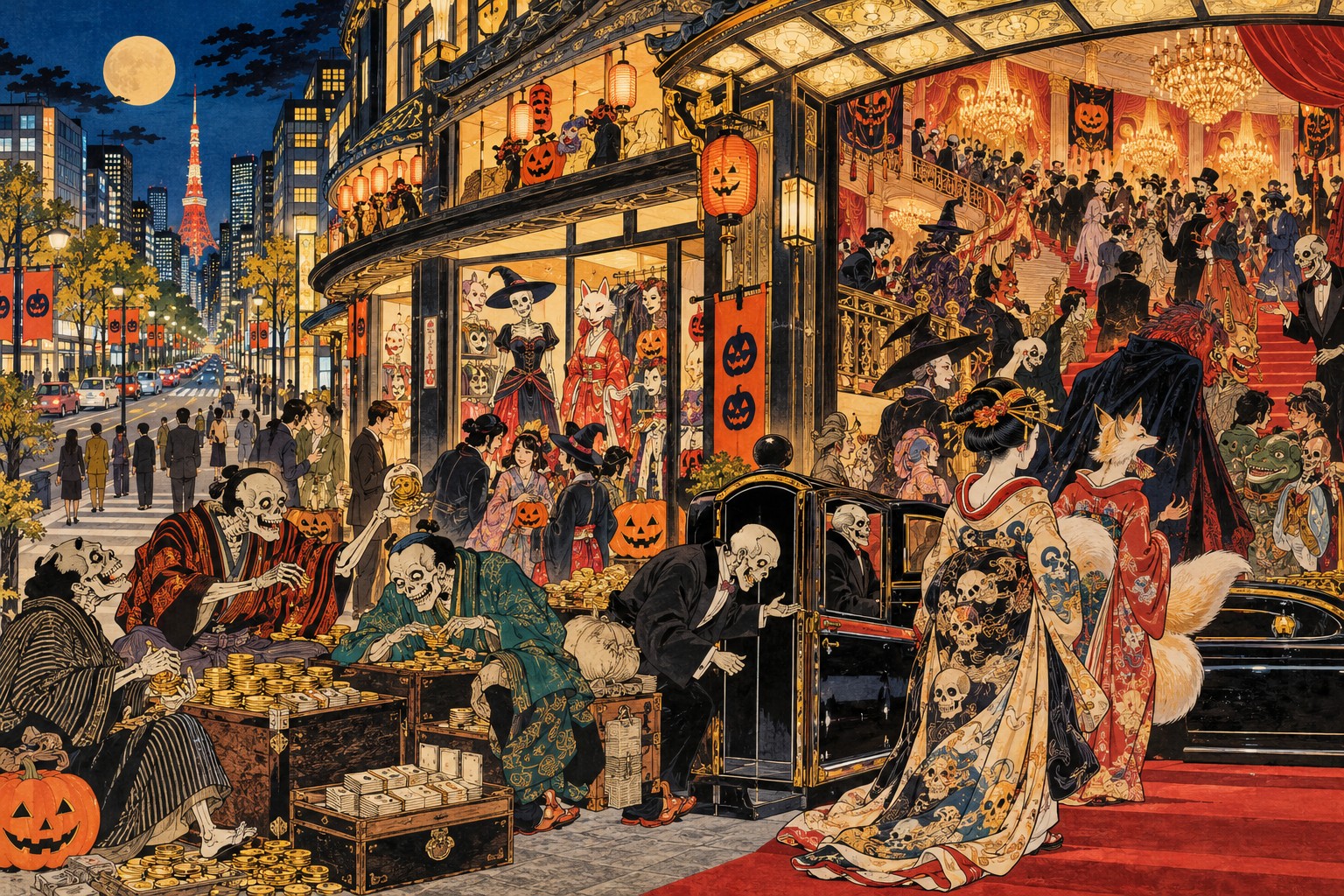
To measure the value of a celebration, count more than ticket receipts: count safety and the cost to the city.
The party has not vanished. Its venue is changing.
Halloween falls on a Saturday in 2026, and Japan offers a striking contradiction. City authorities in Tokyo are tightening the rules for public streets, yet commercial parties, ticketed cosplay gatherings and extended theme-park seasons continue. It is tempting to declare that Japanese Halloween has “moved indoors.” The evidence supports a more interesting conclusion: informal street celebration now competes with increasingly structured experiences, some in buildings and some outdoors, where tickets, registration, security and published conduct rules define what participation means.
A market that can shrink while participants spend more
In October 2025, research firm Intage surveyed 5,000 people aged 15–79 nationwide. It found 24.1% had Halloween plans, down approximately 4.2 percentage points from a year earlier. Among those with plans, the average budget rose from ¥6,565 to ¥7,192. Its estimated Halloween market fell to ¥167.3 billion, or 93% of the prior year. This is not the tidy story of unstoppable growth. Fewer people were planning to take part, while some of those who were participating expected to spend more. Inflation matters: larger nominal budgets do not necessarily mean more costumes bought, more tickets sold or better margins.
A tempting 2026 forecast — and its limitations
On October 26, the Japan Happy Halloween Association published its own scenario of approximately ¥153 billion in Halloween-related spending for 2026. Crucially, the association builds from its own 2025 baseline of ¥130 billion, not Intage’s ¥167.3 billion estimate. It explicitly says its increase is a provisional scenario, not a bottom-up tally of industry revenue, and acknowledges that the two organizations’ methodologies are not directly comparable. Its projected 17.7% growth is therefore not a verified national growth rate. We do not present it as one. There is, as yet, no independently reconciled October 2026 market total.
Shibuya’s rule is about drinking, not costumes
Shibuya adopted its local public-safety ordinance in 2019. An amendment effective October 2024 made drinking in designated public places near Shibuya Station illegal from 6 p.m. to 5 a.m. year-round, not just at Halloween. The ward’s September 30, 2026 press conference introduced the message “GOODBYE BAD HALLOWEEN,” asking visitors to avoid street drinking, smoking, littering and obstruction and instead enjoy properly managed events. Shibuya also announced road restrictions beginning at approximately 4 p.m. on October 30 and 31 and lasting into the following mornings. None of these facts establishes a blanket prohibition on dressing up.
Shinjuku draws a narrower, time-limited line
Shinjuku Ward says it will restrict street drinking from 5 p.m. on October 31 to 5 a.m. on November 1 in parts of Shinjuku 3-chome and Kabukicho 1-chome. It will request voluntary restraint in alcohol sales from relevant shops and deploy staff and crowd-control guards. The message to revelers is straightforward: if you drink, do so inside an establishment according to its rules. This is principally a public-safety measure. No publicly verified figures show how many customers it sends to bars and restaurants, or whether those businesses gain overall.
Ikebukuro puts a price on an organized cosplay experience
A more explicit commercial model is visible at the Ikebukuro Halloween Cosplay Festival, scheduled for October 30–November 1. The Saturday and Sunday program runs from 10 a.m. to 6 p.m.; an adults-only Friday evening event is held at Sunshine City. The organizer lists a general advance cosplay ticket of ¥2,980 per day, rising to ¥3,480 for same-day purchase, with premium tickets priced at ¥3,980 in advance and ¥4,480 on the day. A children’s ticket costs ¥500, with a free provision for eligible local elementary pupils. There are separate photographer tickets. These charges apply to defined forms of event participation, not simply to walking through Ikebukuro. That distinction is essential.
Tickets do not automatically translate into profit
The economics of registration-based festivals are more complicated than multiplying a headline ticket price by a crowd estimate. Attendance includes ticket buyers, casual spectators, staff and people participating across multiple days. Revenue may involve sponsorship and sales concessions; costs include security, changing facilities, staging, insurance and cleaning. No reliable organizer profit figure is available in the official materials reviewed. The important observable change is that organizers now specify services and participation rights for which people may pay, in contrast with an unstructured crowd occupying public space.
Osaka sells a season, not just an October evening
Universal Studios Japan’s official Halloween Horror Nights schedule runs from September 11 through November 8, 2026, and marks the program’s fifteenth year. Attractions include street performers, themed horror experiences and a separately ticketed adults-only experience called Zanzō (残像). In commercial terms, this is a multi-week reason to travel and spend time in Osaka, rather than a one-night celebration. But published program pages do not reveal Halloween-specific operating profit or incremental visitor expenditure. A list of attractions is evidence of an offering, not proof of commercial success.
How an imported festival found Japanese forms
Halloween’s roots are intertwined with European customs and the Christian calendar; contemporary costumes, trick-or-treating and mass-market imagery spread internationally in large part through North American popular culture. Japan did not acquire it in one moment. Seasonal retail displays, amusement parks, language schools, children’s parties and Japan’s own sophisticated cosplay culture each helped give it a different meaning. Nor should Halloween simply be equated with Obon or classical yokai traditions. What matters is the country’s capacity to adapt a global cultural product to local institutions, fan communities and consumer habits.
The hidden bill for a public celebration
Street parties can generate value for restaurants, transport firms and retailers while shifting costs to municipal workers, nearby residents and businesses disrupted by congestion. Trash collection, crowd safety, road access and the rights of residents rarely appear in market-size estimates. The coexistence of tighter street rules and more ticketed events is suggestive, but it is not causal proof that spending has migrated from sidewalks to clubs. Establishing that would require comparable attendance, sales, policing and cleanup data across years and districts.
Beyond the famous Tokyo crossing
The busiest Tokyo streets dominate foreign coverage, but Halloween also exists as neighborhood events, children’s programming, museum exhibitions, shopping-district activities and smaller gatherings across Japan. Their objectives differ. Some aim to sell tickets, others strengthen a community or provide family-friendly entertainment. Judging all of them solely by national consumer spending would miss social value and would overstate the dominance of metropolitan nightlife.
A better question for Halloween 2026
Japan’s Halloween is neither simply banned nor demonstrably booming. The verified story is about governance and format: year-round alcohol restrictions in Shibuya, a specific Halloween window in Shinjuku, paid participation choices in Ikebukuro and weeks of branded experiences in Osaka. Whether national spending grows, which businesses capture it and what the public pays for safety remain open questions. The next phase of reporting should follow comparable sales figures, travel activity and municipal costs. On Halloween night, the real transformation may be less about how frightening the costumes are than about who organizes the celebration, who pays and who gets to enjoy the city.
Sources and verification
Official announcements and survey material available through October 28, 2026. Actual October 31 receipts, attendance and on-the-ground conditions remain unverified. No organizer interviews are claimed.
- Shibuya Ward: ordinance and year-round restriction
- Shibuya Ward: September 2026 Halloween measures
- Shibuya Ward: October 2026 traffic restrictions
- Shinjuku Ward: 2026 Halloween restrictions
- Ikebukuro Halloween 2026: official event outline
- Ikebukuro Halloween 2026: official ticket prices
- USJ: Halloween Horror Nights 2026
- Intage: 2025 Halloween consumer survey
- Japan Happy Halloween Association: 2026 scenario