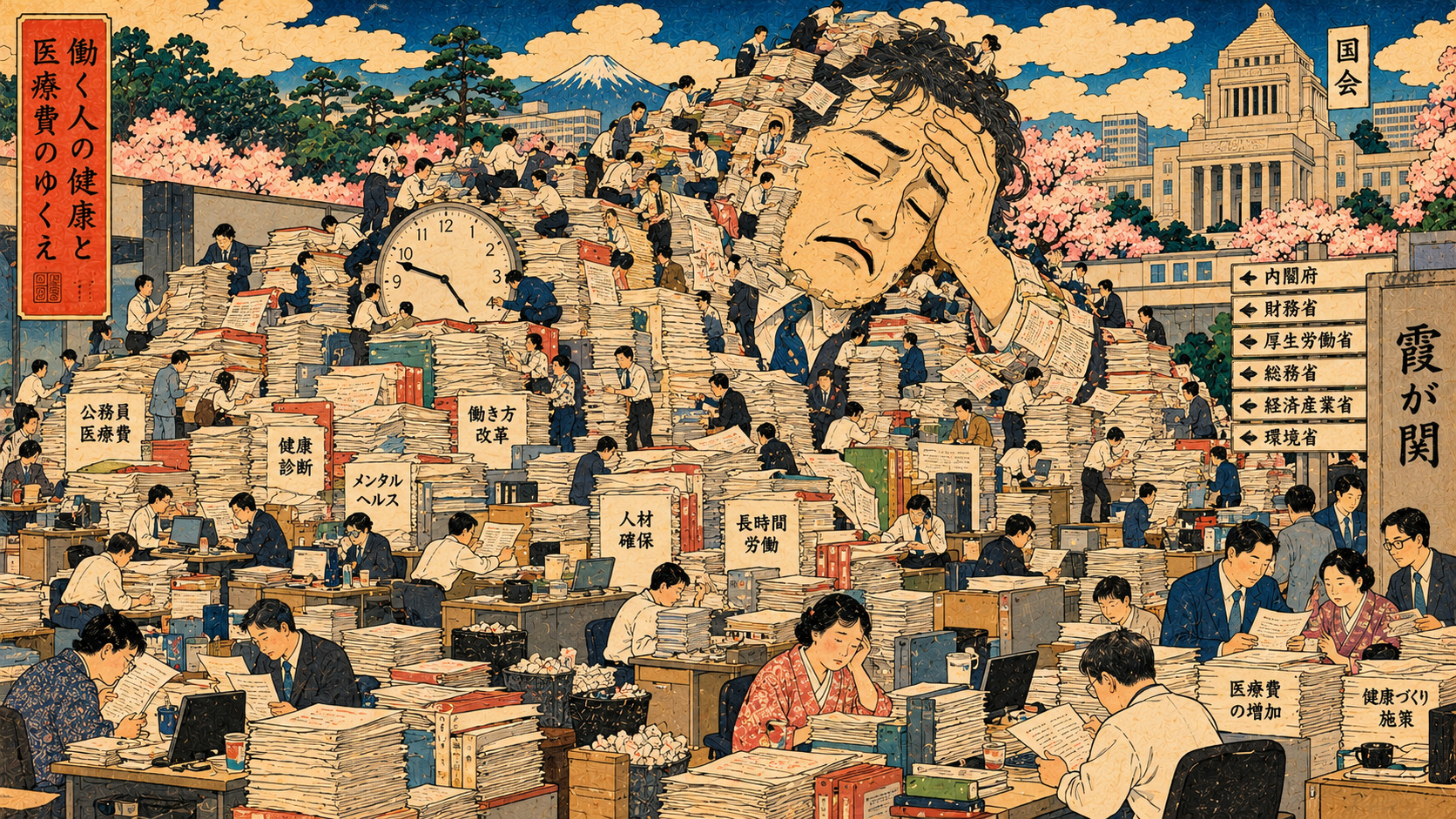
The spending gap is documented. The causes of that gap remain an open question.
The numbers behind the desks
Japan’s central bureaucracy is frequently described in terms of budgets, laws and late-night paperwork. A new occupational-health study asks a different question: do medical spending patterns differ between the ministries that keep the machinery of government running? The answer is striking. After adjusting for age and sex, estimated monthly outpatient costs ranged from ¥2,374 per employee at the Ministry of Foreign Affairs to ¥5,125 at the Ministry of Health, Labour and Welfare—a 2.16-fold gap. The finding is a comparison of groups, not a diagnosis of individual civil servants or a league table of ministry performance.
A study spanning eight years, published this October
The research was published online October 11, 2026, in the Scandinavian Journal of Work, Environment & Health and featured in a Kyoto University release on October 23. Lead author Koryu Sato of Keio University worked with Hirotaka Kato of Yokohama City University, Kyoto University’s Kosuke Inoue and Naoki Kondo, and Harvard’s Ichiro Kawachi. Combining administrative health data and parliamentary workload indicators, the paper examines an occupational-health issue that often escapes national policy debates.
What exactly was counted?
The team studied headquarters employees aged 18–50 in ten Japanese ministries over 2016–2023. Its dataset contained 6,454 outpatient insurance claims adjudicated in April of each year. The authors estimated sex- and age-standardized monthly costs per covered employee using statistical weighting. These were outpatient expenditures, not lifetime illness burdens, hospital bills, annual medical totals or out-of-pocket payments by individual workers. The April-only claims window is a real constraint: it matters when generalizing to other seasons, ministries or personnel.
The Health Ministry at the high end
Japan’s health ministry registered the highest adjusted estimate, ¥5,125, compared with the foreign ministry’s ¥2,374. A decomposition by diagnostic category indicated that mental and behavioral disorders were the largest above-average component at the Ministry of Health, Labour and Welfare. That does not mean most ministry staff have such conditions, nor does it establish that their jobs caused them. Differences in care-seeking, organizational composition and unobserved circumstances may also affect the figures.
What did parliamentary workload have to do with it?
To approximate parliamentary demand, researchers took the annual deliberation time of standing Diet committees covering a ministry’s policy area and divided it by the number of insured headquarters employees. After accounting for calendar-year effects, they found that a 1% higher previous-year deliberation-time measure was associated with a 0.25% higher adjusted outpatient cost, with a 95% confidence interval of 0.04–0.46%. The association was driven more by claims per person than by the price of each claim. The number is not a measurement of how much overtime any individual employee worked.
Correlation is not an occupational diagnosis
This is an ecological study: its key comparisons operate at the ministry level. It cannot tell us whether one worker prepared an extra Diet response, lost sleep and consequently visited a doctor. Inferring individual causation from an aggregate association would be an ecological fallacy. Parliamentary sitting time is an imperfect stand-in for ministerial preparation; other characteristics may contribute to both healthcare use and workload. Higher spending can also reflect access to appropriate care, not only a higher disease burden.
The invisible labor of parliamentary accountability
Questions posed in Japan’s National Diet can trigger rounds of fact-checking, departmental coordination and drafting of ministerial responses. Those tasks are important to legislative scrutiny. The challenge is how to preserve accountability without requiring unsustainable schedules from the civil servants who support it. Parliamentary deliberation length alone does not reveal when a question was communicated, how much time officials had to prepare, or how fairly work was distributed.
How Japan reached this point
Japan’s national civil servants work under a public-service personnel framework distinct from the Labour Standards Act rules applied to much of the private sector. The National Personnel Authority maintains overtime limits, ordinarily 45 hours per month and 360 annually, with different provisions for departments whose workloads are largely driven by outside demands. Following reforms implemented from 2019, the authority continued monitoring overtime and surveying ministries about Diet-response duties. Cabinet Personnel Bureau records likewise identify earlier notice of questions and better communication during response drafting as issues for reform.
The wrong target would be lower healthcare use at any cost
An agency that discouraged needed doctor visits might lower its outpatient spending while making employee health worse. A credible public-sector response would instead examine workloads, staffing, rest periods, mental-health support, and timely access to care alongside expenditure trends. This paper points toward better measurement; it does not prescribe a single intervention or prove that shifting a specific committee schedule would reduce medical bills.
The next questions are testable
Future research could link appropriately protected records of actual hours worked, assignment patterns, timing of parliamentary questions, sick leave and healthcare use. Independent review of changes in workload management could then reveal whether reforms improve employees’ health and the quality of public service. For now, the new figures put an often-unseen public workforce into focus—and underscore how carefully data about health and government need to be interpreted.
Sources and verification
Cross-checked against the journal article, university releases and Japanese government documents. No original interviews were conducted.