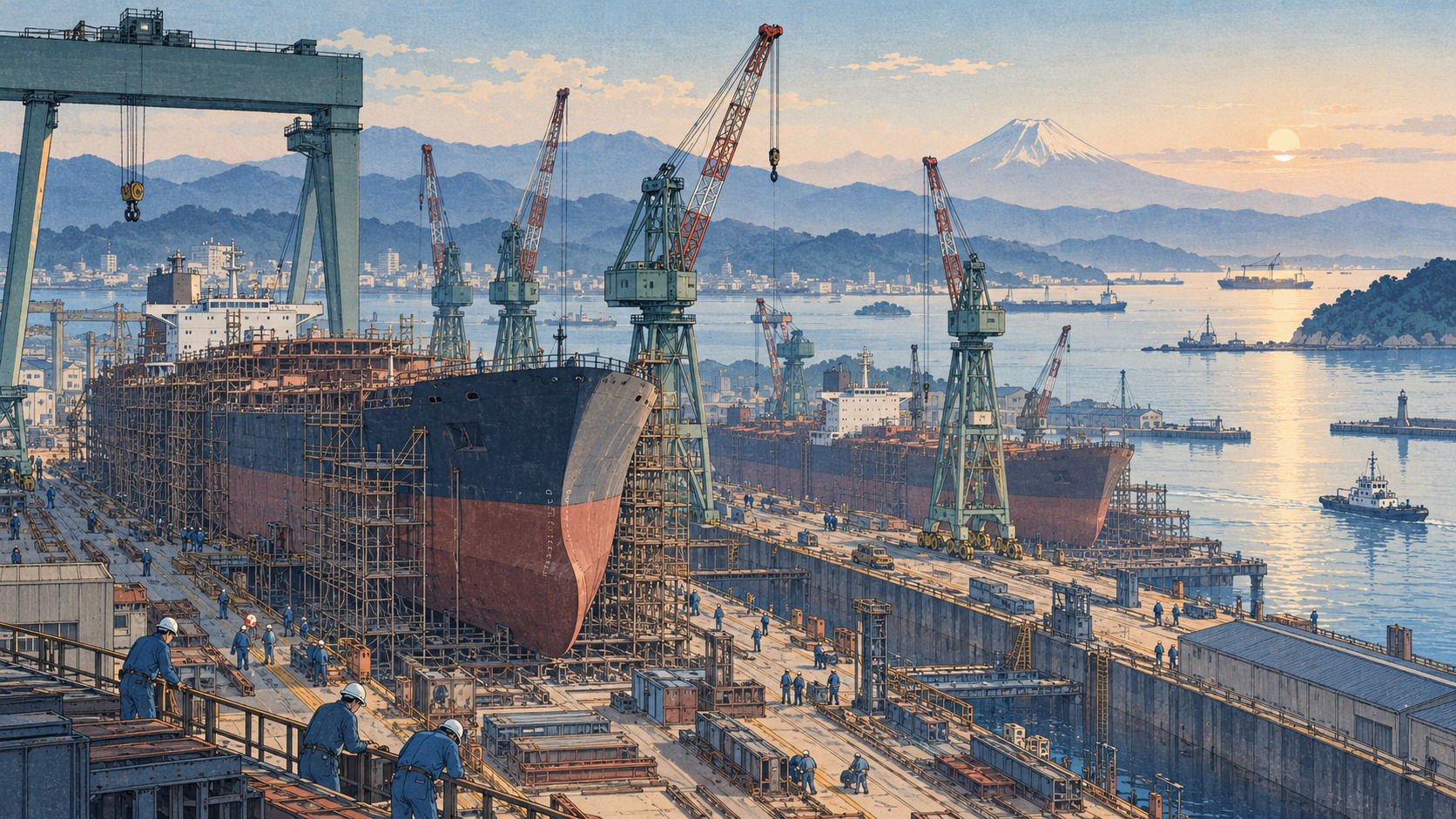
The OECD has not enacted new shipbuilding rules. It has reopened the question of how fair competition can be defined—and enforced.
An agreement to begin negotiating—not a new treaty
A meeting in Paris has reopened one of the toughest questions in industrial trade: how should governments prevent subsidies and other support from distorting the price of ships? At the 143rd OECD Shipbuilding Committee meeting on October 22–23, participants agreed to begin examining whether new international disciplines could be drawn up as part of the committee’s 2027–2030 work programme. Japan’s Ministry of Land, Infrastructure, Transport and Tourism announced the outcome on October 30. No new binding shipbuilding agreement has been enacted, and no sanctions regime was adopted.
Japan chaired the discussion
The hybrid meeting was chaired by Hideaki Saito, an adviser to Japan’s transport ministry who took the chair in August 2026. Attendees included representatives from Japan, South Korea, the United Kingdom, France, Italy, Norway and Türkiye, among others. Japan’s delegation included the ministry’s Maritime Bureau and the Shipbuilders’ Association of Japan. The ministry’s communiqué does not identify a deadline for a completed treaty, disclose draft legal provisions or say that every attending country has endorsed Japan’s proposed approach.
The steel-price signal
The figures that made the competition issue unusually concrete came from an OECD Secretariat analysis relayed by the ministry. Average steel prices in China in 2025 were reportedly around 50 percent of those in Japan. For 2024, the ratio of subsidies to assets received by an average Chinese steel enterprise was reportedly 15 times the corresponding ratio at steel companies in other countries. These comparisons concern upstream steel producers, not a verified subsidy paid to each shipyard. Nor does a raw-material price gap, by itself, explain differences in finished-vessel prices: productivity, labour, exchange rates, financing, vessel specifications and yard utilisation matter too.
Why the steel connection matters
Steel is a fundamental input for hull construction. If a shipyard can reliably procure it at substantially different prices, that may change the economics of bidding for a bulk carrier, tanker or container vessel. A modern ship, however, is also a bundle of engines, control systems, electronics, engineering know-how, labour and capital. Competition policy aimed only at a single input risks missing the other forces that determine final prices.
The delicate question of countries outside the arrangement
Japan proposed continued monitoring of Chinese steel pricing and state support in cooperation with the OECD Steel Committee, a proposal the ministry says participants accepted. It also argued that any future discipline must consider measures concerning countries that do not participate; otherwise firms in non-participating economies could obtain an advantage over those subject to the rules. What those measures would be—and whether they could be negotiated or implemented—is unresolved. The announcement should not be read as Chinese acceptance of a proposed regime.
Six decades of unfinished business
The OECD’s shipbuilding work dates to the 1960s. Its working party was established in 1966 to address the peculiar economics of an industry characterised by enormous fixed costs, long investment cycles and global buyers. Ships may be designed, financed, constructed, registered and operated in different jurisdictions. That international structure makes ordinary domestic competition remedies difficult to apply and helps explain why policymakers have kept returning to the question of an international level playing field.
The 1994 deal that never took effect
In December 1994, governments concluded an agreement intended to bring normal competitive conditions to commercial shipbuilding and repair. It was meant to curb government support and injurious pricing. But the agreement never entered into force because ratification was incomplete, notably in the United States. Further negotiations on a multilateral shipbuilding agreement later faltered and ended in 2010, according to OECD institutional material. The new 2026 discussion has to confront the same enduring obstacle: an agreement can be carefully drafted and still be ineffective if major competitors do not participate.
A separate, more advanced result: green-ship finance
The Paris meeting also reported a different outcome that is further along procedurally. Experts reached final agreement on proposed revisions to the official export-credit rules for ships, which Japan had advanced to encourage greener international shipping. The ministry expects those amendments to take effect in early 2027 once national administrative steps are completed. These export-credit provisions are distinct from the prospective new competition disciplines. The exact financing terms and final effective date require the published amended text and formal implementation notices.
What is at stake for industry
Japan’s new four-year programme also covers resilience of steel and marine-equipment supply chains, forecasts of newbuilding demand, analysis of new technologies and continued monitoring of prices and construction costs. The stakes extend from shipyard owners and steel suppliers to shipping lines ordering vessels and lenders funding them. Greater transparency could improve the basis for investment decisions; poorly designed provisions might instead add cost or fail to capture hidden support. Neither outcome is assured.
Japan, Korea and China: competition and interdependence
South Korea participated in the October meeting, reflecting the role of major Asian shipbuilders in the debate. Participation is not equivalent to agreement with every Japanese proposal. China is central to global shipbuilding, yet the October statement does not establish that Beijing joined or accepted a future set of rules. Any durable framework will have to reckon with both large-scale competition and the extensive international connections among steelmaking, equipment suppliers, shipping customers and financiers.
Five questions for the next negotiating round
What qualifies as prohibited state assistance? How would investigators compare prices across ship types and national cost structures? What happens when a major producing economy remains outside? Who verifies claims and settles disputes? And can rules supporting cleaner ships coexist with neutral competition? The October meeting places these questions back on the agenda. Whether the result becomes an enforceable agreement—or another episode in a long history of frustrated negotiations—remains to be seen.
Sources and verification
Based on the Japanese ministry’s October 30 statement and OECD institutional records. Discussions, expert agreement and entry into force are treated as separate stages.
- MLIT: Results of the 143rd OECD Shipbuilding Committee, October 30, 2026
- OECD Shipbuilding Committee: mandate and history
- MLIT historical background on OECD shipbuilding negotiations
- OECD: Sector Understanding on Export Credits for Ships
- 1994 shipbuilding agreement: archived OECD overview in USTR exhibits