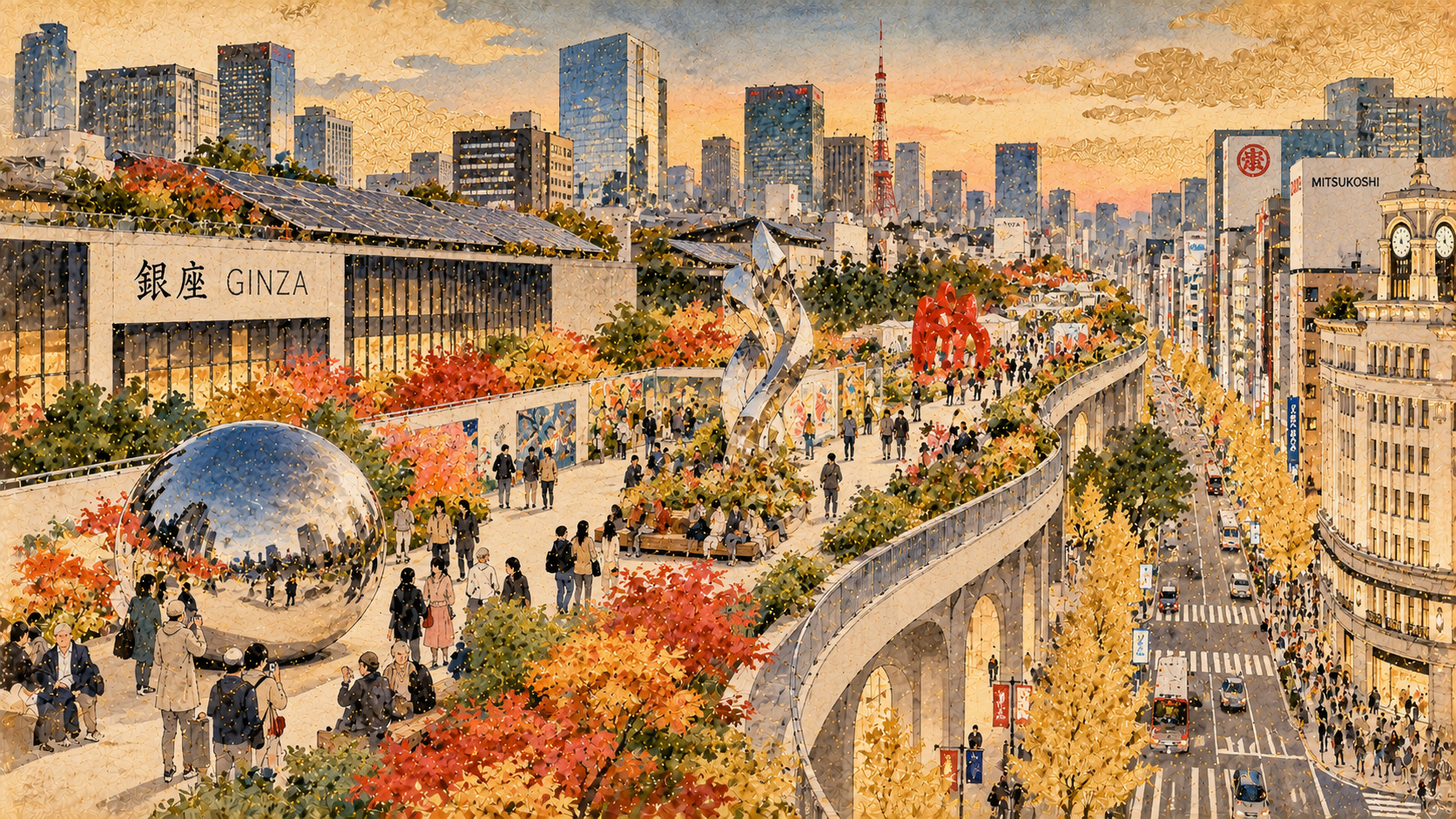
For decades, Tokyo devoted this elevated strip of Ginza to movement. This November it will ask people to stop, look at the night sky—and imagine what the city could become without cars.
Tokyo has an unusual new exhibition space: a former expressway
Near Ginza's glittering shops, a road that once carried cars across the centre of Tokyo is preparing for another purpose. From November 21 to 29, 2026, the former Tokyo Expressway, widely known as the KK Line, will host Roof Park Art Fes 2026, nine nights of installations and site-specific performance organised by the Tokyo Metropolitan Government and Tokyo Expressway Co.
At the time of writing on October 19, the festival is still a month away. Tokyo has announced the programme and begun ticket sales; there are no completed festival performances to review or crowds to count. The story is instead about a city testing a remarkable idea: whether the infrastructure of the motor age can be remade into a public place defined by art, walking and memory.
The programme belongs to the larger Tokyo Sky Corridor redevelopment. This is not a brand-new platform built for the festival. It is the former roadway itself, high above central Tokyo, its retained structure serving as the setting for an exhibition that would be difficult to stage anywhere else.
Light, the ghost of a river and an enormous artwork
Japanese visual artist YOSHIROTTEN is responsible for the main installation, developed around the theme INVISIBLE - A signal of River -. Tokyo's announcement describes projected historic images and an ambitious work approximately 40 metres long, intended to make hidden layers of the site perceptible against the lights of the modern city. The installation will operate from 5 p.m. to 8:30 p.m. daily, with last admission at 8 p.m.; its access point is the Nishi-Ginza entrance.
Over the final weekend, November 28–29, Setouchi Circus Factory will present SHIODOME SPACE-KK-RAFT, a newly created contemporary circus work drawing on the vanished Shiodome River and the timber that once moved through this part of the capital. Organisers describe a moving performance in which performers and audience travel through the elevated space together. Doors are scheduled for 6:30 p.m., with the roughly 50-minute show beginning at 7 p.m. near the Shimbashi entrance.
The main-installation tickets are ¥800 for adults of high-school age and above on weekdays from November 24–27, and ¥1,000 on weekends and holidays. A ticket including the special performance costs ¥1,500. Pair tickets and a wheelchair-user pair-ticket option are also advertised. Sales began October 16. Visitors should confirm availability and practical access instructions through the official festival website, rather than assume every part of the old road is freely open to the public.
Why did Tokyo build a road above Ginza in the first place?
To understand the conversion, go back to the postwar city. As Japan rebuilt and motor traffic expanded, central Tokyo needed routes that could carry vehicles through some of the most valuable and intensely developed land in the country. The company operating the KK Line employed a distinctive structure: a roadway running above commercial facilities, putting vertical space to work rather than assembling an ordinary ground-level road corridor.
Its segments entered service beginning in 1959, with full operation from 1966. The route ran for roughly two kilometres across the Kyobashi, Ginza and Shimbashi area, eventually forming part of the central urban expressway network. Its design embodied a particular vision of metropolitan modernity: the city as a machine that must keep people and goods moving.
But infrastructure ages not only physically; it ages politically and functionally. The reorganisation of Tokyo's central expressway system, including the project to put the Nihonbashi section of the Metropolitan Expressway underground, reduced the need for the KK Line in its old role. On April 5, 2025, at 8 p.m., most of the road ceased operating as an expressway. The Higashi-Ginza exit was excluded from the closure and remains managed for road traffic. It would therefore be wrong to imply that every associated road connection disappeared overnight.
Not quite a park—yet
Tokyo Expressway Co. calls the transformation the Roof Park Project. The metaphor is deliberate: the former road sits like a roof above commercial space and could become a park-like connector between districts. Its stated aspiration is a greener, pedestrian-centred public space. For international readers, the concept invites comparisons with elevated-infrastructure conversions in other world cities, though Tokyo's unusually close relationship between the road and underlying commercial premises gives it a distinct set of constraints.
Crucially, November's art event is not the opening of a completed permanent park. The company describes completion of the entire redeveloped route as a long-term objective spanning the 2030s to 2040s, with some sections potentially opening earlier. What visitors will see this November is a temporary programme at a site still undergoing a far longer transformation.
The programme has precedents. Tokyo adopted a reuse policy in April 2025 and organised Roof Park Fes & Walk events allowing people to experience the road on foot. Another walking event followed in spring 2026. Those experiments asked what it felt like to occupy the former road without vehicles. The new festival asks a more ambitious question: what cultural life might such a space sustain?
The hidden Tokyo beneath the bright one
The choice of river imagery is central to the event's identity. Much of central Tokyo was shaped by the movement of goods along waterways, some later altered, filled or concealed as streets and buildings changed. The Shiodome River is part of this layered geography. Contemporary Ginza is easy to recognise through its shops and lights. The practical networks of earlier centuries are less immediately visible.
Art can offer an encounter with these histories without pretending to be an archive. A projected photograph, a figure moving through a performance, or a beam of light against concrete may connect the visitor emotionally to a place whose former functions are no longer apparent. Yet evocative interpretation should remain distinct from documentary evidence. The precise provenance of any historical imagery and the final form of the artworks will warrant attention once the exhibition opens.
What makes a successful public space?
The promise of an elevated green corridor is powerful, particularly in a dense city where ground-level space is scarce. But the engineering and social responsibilities are substantial. Maintaining a reused structure, managing crowds and evacuation, providing weather protection, ensuring step-free access and connecting the route with surrounding neighbourhoods are different problems from staging a short festival.
There is also a question of who benefits. Ginza is already a magnet for visitors and investment. A project that adds another celebrated destination could generate considerable cultural prestige without necessarily creating a place that nearby workers, older residents, children or people with disabilities can use in daily life. Free opportunities to sit, reliable access and transparent management rules may ultimately be more revealing measures of public value than the attendance at a single ticketed event.
Tokyo Governor Yuriko Koike told reporters on October 16 that the administration wants the KK Line to become an internationally recognised walkable visitor destination. She placed the art festival within ARTE TOKYO, a new programme of urban cultural events. The ambition is clear; how effectively it will translate into an inclusive, sustainable everyday space remains unproven.
A nine-day glimpse of a longer future
Tokyo's transformation presents an intriguing reversal of the postwar city. In one generation, engineering made it possible to drive above Ginza; in another, the same elevated space may become a place to wander, meet and look at art. The move is neither a repudiation of all roads nor proof that the redevelopment has already succeeded. It is an experiment in changing what a piece of infrastructure is for.
After the installations have been dismantled, the real test will continue. Will the designs respect the unusual structure and its history? Will the resulting space remain genuinely open to different kinds of people? And can a corridor once valued primarily for the speed of its traffic become meaningful because visitors are free to slow down? That is the future this November's art festival invites Tokyo to imagine.
Sources and References
- Tokyo Metropolitan Government, October 16 festival announcement
- Tokyo governor, October 16 news conference
- Tokyo Expressway Co., road closure
- Tokyo Expressway Co., company history
- Tokyo Expressway Co., long-term transformation
- Tokyo Metropolitan Government, 2025 redevelopment policy
- Organizer release and ticket details
- Official festival website
- Bijutsu Techo, contemporary arts coverage