Who is teaching whom?
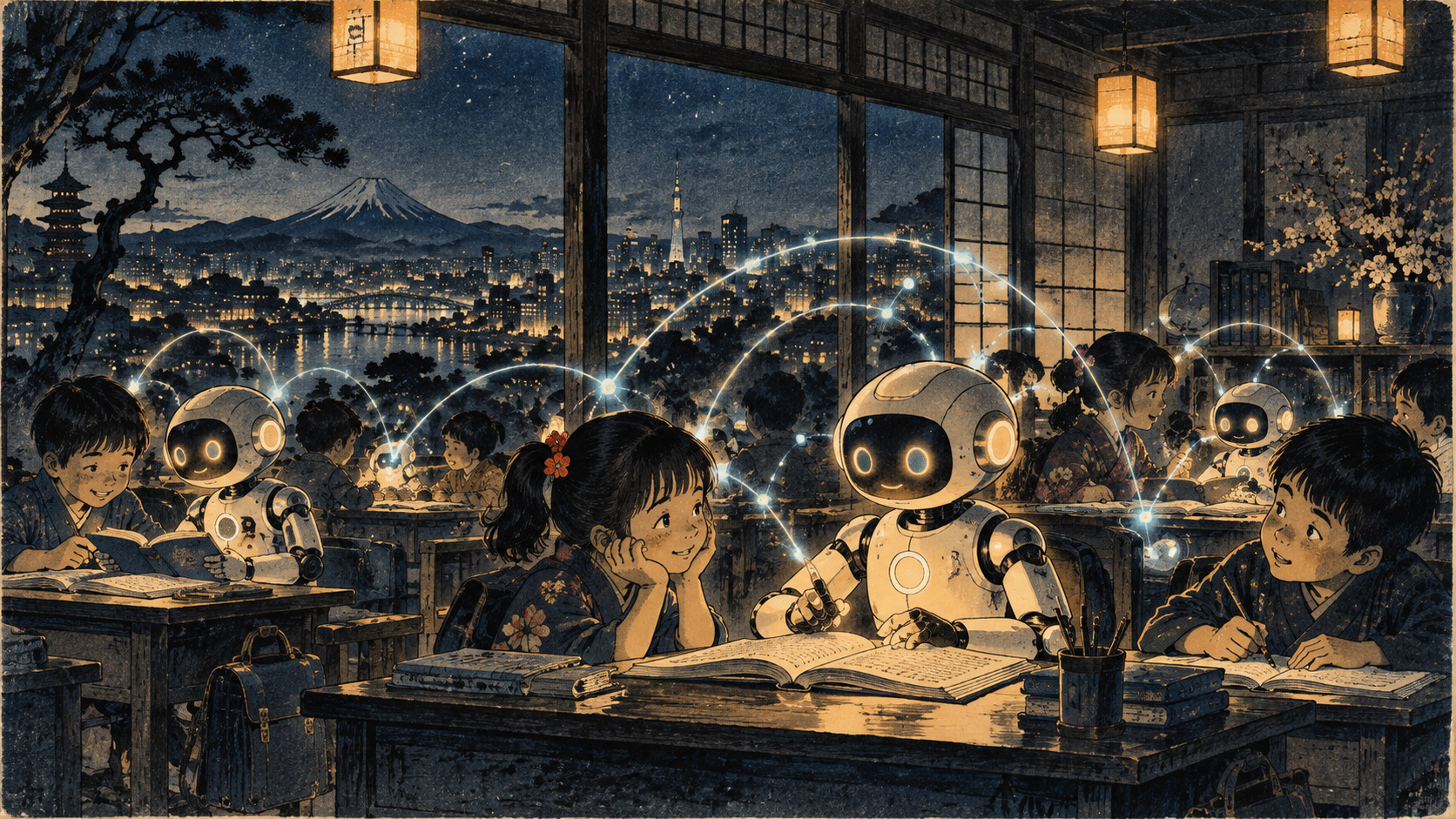
When a generative-AI robot enters a classroom, the obvious question is what it will teach children. The more interesting question is what children will teach the robot—and what that interaction will reveal about children themselves. Turn-taking, patience, repair after misunderstanding, kindness toward a struggling partner, the instinct to dominate, the willingness to help: these are not simply curriculum topics. They are lived behaviors. A growing body of 2026 research, including work from Japan, suggests that child–AI and child–robot interaction should be understood not only as educational technology, but as a field where sociality, empathy and moral judgment become visible.
What a generative-AI Pepper showed in a Japanese special-support school
One of the most concrete Japanese studies this year examined the introduction of a generative-AI-equipped humanoid Pepper robot in a special-support school. The study, published in the Japanese Society for Educational Technology’s research reports, found that students generally evaluated learning with the robot positively. Teachers who had prior experience using robots showed significantly stronger observational evaluations of interaction. Yet the study also reported avoidance reactions among some pupils, underscoring that the technology does not affect all children in the same way. This may be the study’s most important lesson: a classroom robot is not a uniform intervention. It can invite engagement, but it can also expose discomfort, overload or mismatch.
Generative AI changes the role of the robot
Earlier educational robots often operated through tightly scripted interaction. A generative-AI robot is different because it can respond more openly, producing language in real time and creating the impression of a partner rather than a device. That changes the educational stakes. The question is no longer only whether the robot can deliver content, but how children manage ambiguity, misunderstanding and social expectation with an artificial conversational counterpart. Research published this year on children’s communication repairs with AI versus human partners found that children experienced more communication breakdowns with AI, yet made fewer repair attempts than they did with people. In other words, children do not simply treat AI as another child or another teacher. They adapt differently.
Can a robot become a moral other?
A Japanese master’s thesis summary on children’s moral interaction with robots frames the deeper issue well. Do children treat robots as entities worthy of moral consideration? If a child insults a robot, strikes it, ignores it or comforts it, what is actually being learned? These questions matter even if the robot has no inner life in any human sense. The educational significance lies in how children classify the robot: as object, tool, toy, social partner or something in between. A robot can become a boundary object for moral thinking. It does not hand children a finished answer about humanity. It prompts children to expose their own working definitions of what deserves care, apology or restraint.
Children may teach robots by modeling behavior, not lecturing values
If children teach robots what it means to be human, they are unlikely to do so through explicit philosophical lessons. They do it through behavior. They interrupt or wait. They rephrase when misunderstood or give up. They show delight, irritation, protectiveness, curiosity or cruelty. A robot receives these patterns as interactional data, but children also receive feedback from the robot’s responses. The result is reciprocal shaping. The child adapts to the machine, and the machine is designed to adapt to the child. That is why the story is not really about a robot becoming human. It is about the social processes through which children externalize their own assumptions about personhood and relationship.
Japan is moving carefully, not blindly, into classroom AI
Japan’s education world in 2026 is not treating generative AI as a solved problem. Public seminars, practical reports and school-based experiments show strong interest, but also caution. A Japanese study on students’ attitudes toward generative AI found that developmental stage and frequency of use influenced motivation, understanding and recognition of appropriate use cases. That means “children” cannot be treated as a single category. Elementary-school pupils, secondary students and special-support learners encounter AI differently. The policy temptation is to discuss generative AI as a universal solution. The research reality is messier and more useful: implementation depends on age, setting, support structure and the aims of the lesson.
Robots can also become sources of comfort
Another line of research, involving Doshisha University scholar Masaharu Kato and colleagues, explored whether robots can function as a safe haven during mother–child separation. The results suggested that living with a robot for seven days could reduce stress for children and mothers under certain conditions. That work is not a classroom study, but it matters for education because it broadens the meaning of a robot in a child’s life. A robot may be experienced not just as a tutor or entertainment system, but as a relational presence. If so, discussions of classroom robots cannot be limited to achievement metrics. Emotional attachment, reliance and comfort all become part of the ethical landscape.
The longer cultural backdrop in Japan
This conversation has particular force in Japan because robots have long occupied a friendlier imaginative space than they do in some other societies. Figures such as Astro Boy and Doraemon helped normalize the idea that machines might be companions, helpers or even moral interlocutors. Pepper’s public debut in the 2010s arrived in a culture already primed to personify machines. Generative AI intensifies that legacy. Once a robot can sustain open-ended conversation, the issues are no longer just design and charm. They include authority, dependence, truthfulness, privacy and the child’s sense of who—or what—is entitled to social response.
The evidence is promising but still limited
The most responsible conclusion is therefore a modest one. The studies now available are important, but many are small, context-specific or early-stage. The Pepper study in special-support education is valuable, yet it does not establish long-term learning gains across all schools. Research on child–AI communication or robot bonding clarifies mechanisms, but does not settle how such systems should be deployed at scale. The headline question—can children teach a robot what it means to be human?—works best as a disciplined provocation, not as a marketing promise. It points us toward the social and ethical core of the issue, while reminding us how much remains uncertain.
In the end, adults may be the ones on trial
Watch children with a conversational robot long enough and the final subject of scrutiny may not be the children at all. It may be the adults who designed, purchased, deployed and normalized the system. Who decides when the robot belongs in the classroom? What counts as success? Who safeguards children from overdependence, confusion or bad information? What happens when a child recoils rather than engages? Children may indeed teach robots fragments of human behavior. But the broader test is whether adults can build environments that respect children’s developmental needs while resisting technological hype. The robot may be the newest figure in the room. The moral responsibility, however, is still entirely human.
Sources and supporting documents
- 日本教育工学会研究報告集「生成AI搭載人型ロボットの特別支援学校導入における教育効果と課題」
- 日本教育工学会研究報告集「児童生徒の発達段階と活用頻度が生成AI活用に関する意識に及ぼす影響」
- 人間科学研究「子どもとロボットのモラルインタラクション」修士論文要旨
- ACM Transactions on Human-Robot Interaction: Child–Robot Bonding as a Safe Haven
- International Journal of Human-Computer Studies: Children’s communication repairs with AI versus human partners
- Learning and Instruction: We are stronger together: The impact of dialogic reading with robots on children's mathematical language and numeracy skills
- 東京学芸大学附属学校情報教育部 2026年度公開セミナー「生成AIを活用した授業実践研究」案内