- A rematch with a memory that has not faded
- Exactly what was announced on November 4
- Brazil: the win, the loss, and the unfinished argument
- Paraguay: a different kind of examination
- A post-World Cup team already facing its next transition
- The defence and the case for structural flexibility
- The midfield puzzle: hold the centre or invite the counterattack?
- A first call-up for Shio Fukuda, with careful expectations
- What supporters should watch during the two matches
- Singapore is part of the story
- The measure of a team after its World Cup disappointment
A rematch with a memory that has not faded
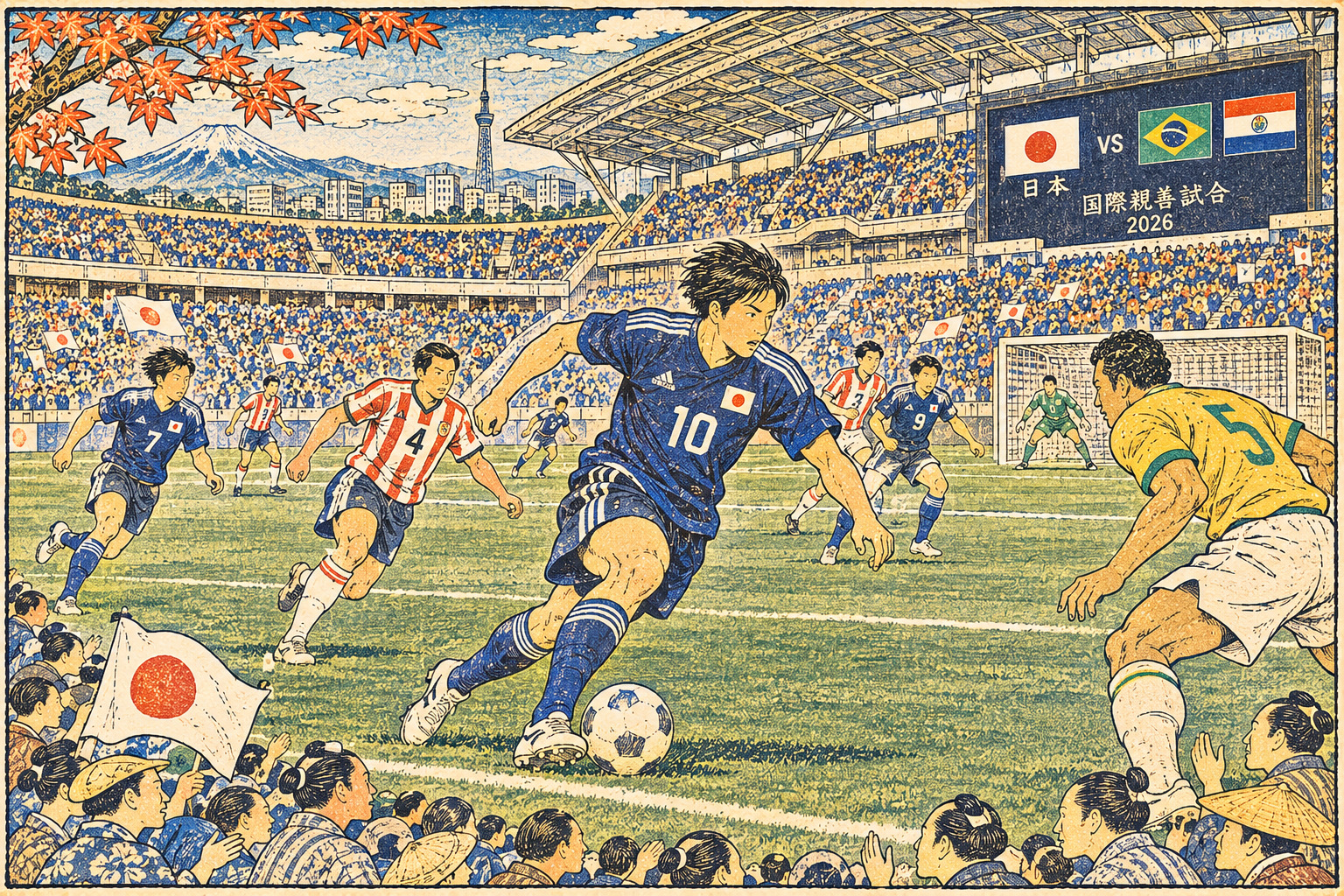
In Houston in June, Japan went into halftime ahead of Brazil at the World Cup. By the final whistle, the five-time champions had overturned that lead. The 2–1 defeat ended Japan’s tournament in the round of 32 and turned a promising first half into an uncomfortable question: can this national team control an elite opponent for the full ninety minutes? Barely five months later, the two countries will meet again, this time in Singapore.
The Japan Football Association announced its squad on November 4 for the Mizuho Blue Challenge, the Kallang Football Series Singapore. Japan play Brazil on November 14 and Paraguay on November 17. Both games will be held at Singapore National Stadium, and both come after a year of results that made Japanese football harder to dismiss but also exposed how slim the margins remain at the highest level.
This is more than another ceremonial set of friendlies. It is an opportunity to evaluate the team’s defensive choices, distribution of creative responsibility and emerging players at an unusual moment: a transition has already been planned for the head coach, and Japan’s next competitive landmark is the 2027 AFC Asian Cup.
Exactly what was announced on November 4
The official JFA roster lists three goalkeepers, eight defenders and seventeen midfielders/forwards, for a total of 28 players. Hajime Moriyasu is head coach; the staff includes Hiroshi Nanami, Shunsuke Nakamura, Makoto Hasebe and several other coaches and analysts. Forward Shio Fukuda, listed with Karlsruhe SC, carries the asterisk denoting his first senior Japan selection. That marking matters: other young players may be developing rapidly, but the JFA did not designate every young selection as a debutant.
The first match kicks off on Saturday, November 14, at 6:15 p.m. Singapore time, equivalent to 7:15 p.m. in Japan. The Paraguay fixture begins Tuesday, November 17, at 9:10 p.m. Singapore time, or 10:10 p.m. in Japan. JFA schedules training from November 10 and warns that sessions may change with weather and player condition. No starting lineup, final match result or subsequent replacement call-up was established in the November 4 announcement.
Among the named players are goalkeeper Zion Suzuki, defenders Ko Itakura and Hiroki Ito, midfield creators Daichi Kamada, Takefusa Kubo and Takumi Minamino, and wide attackers Ritsu Doan, Junya Ito and Keito Nakamura. Forward options include Koki Ogawa, Daizen Maeda, Shio Fukuda and Keisuke Goto. The club affiliations printed in the November 4 JFA release represent that official roster snapshot, not guarantees of their employment status at publication.
Brazil: the win, the loss, and the unfinished argument
For much of Japan’s international history, Brazil seemed a measure of distance rather than a plausible scalp. In October 2025, Japan finally won a senior meeting, overturning a deficit to beat Brazil 3–2 in Tokyo with second-half goals from Minamino, Nakamura and Ayase Ueda. The JFA called it Japan’s first victory over Brazil in fourteen meetings. The result was meaningful precisely because the earlier record was so lopsided.
The June 29, 2026 World Cup meeting in Houston reversed the direction of the story. Kaishu Sano put Japan ahead in the 29th minute; Casemiro equalized after halftime, and Gabriel Martinelli struck in stoppage time to make it Brazil 2, Japan 1. It was a knockout match, with consequences that a friendly does not carry. Japan had shown it could score and compete; it had not protected its advantage.
The Singapore match cannot undo that elimination, and its players may differ from the Houston starting elevens. Still, the rematch creates a useful tactical test: can Japan sustain concentration after the break, defend changes of tempo and find attacking outlets when the opponent increases pressure? Those questions are more illuminating than attaching the word revenge to an exhibition.
Paraguay: a different kind of examination
Paraguay brings a distinct football history into the same week. Japan supporters still remember the 2010 World Cup round-of-16 match in Pretoria, which ended 0–0 after extra time before Paraguay advanced 5–3 on penalties. The game became one of the defining frustrations of Japan’s early knockout-stage era, just as its disciplined defensive performance demonstrated how seriously it could contest a place among the final eight.
The historical connection is not a prediction of a similar match in 2026. Different coaches and generations make the comparison limited. What remains useful is the contrast between two South American tests: Brazil has traditionally posed questions about attacking invention and individual superiority, while Paraguay can challenge Japan’s ability to create chances, maintain defensive balance and remain patient when a match becomes compressed.
JFA opponent information lists Paraguay at 34th in the July 20, 2026 FIFA ranking and Brazil at fifth; these are explicitly dated figures, not live November rankings. Performance analysis must use the actual current opponents, selection availability and match conditions rather than a reputation built from past tournaments.
A post-World Cup team already facing its next transition
In July 2026 the JFA made an unusually clear succession announcement. Moriyasu, who guided Japan through the 2026 World Cup, would remain in charge until the conclusion of the AFC Asian Cup Saudi Arabia 2027. Tsuyoshi Oiwa, then responsible for the under-21 side, was designated to take the senior role afterward while continuing preparations toward the 2028 Los Angeles Olympics.
That decision alters the meaning of a November camp. Moriyasu is neither beginning an indefinite new cycle nor immediately handing over the squad. He must prepare a team to compete for an Asian title, test potential contributors and maintain continuity while the future leadership arrangements are already public. The presence of established performers and first-time invitees therefore deserves to be considered against a defined competitive horizon.
It would be unjustified to portray any player as definitely selected for the Asian Cup, or to declare a formation that the coach has not announced. But the circumstances make squad building itself news: the staff can evaluate who understands the systems already in place, who can change a match from the bench and who might carry responsibilities into the subsequent era.
The defence and the case for structural flexibility
October’s 2–1 Kirin Cup victory over New Zealand provided recent evidence that Japan has multiple defensive starting structures. According to the JFA match report, Japan moved from a three-centre-back approach in the preceding matches to a four-back 4–2–3–1, placing Shuto Nakano, Ayumu Seko, Hiroki Ito and Junnosuke Suzuki across the back line, with Sano and Kamada in central midfield.
That adjustment illustrates a choice, not a permanent conversion. Three centre-backs can provide different cover and release wing-backs higher up the field; a back four can alter the relationships between wide defenders, midfield pivot and pressing structure. Against Brazil the issue is not simply how many defenders appear on the starting diagram, but how the nearest players respond when Japan loses the ball.
The November roster includes Itakura, Tsuyoshi Watanabe, Koki Machida, Ito, Seko, Nakano, Yukinari Sugawara and Junnosuke Suzuki as defenders. Those names give the staff alternatives in distribution, aerial defending and flank coverage. Who is fit to start, and which balance is chosen, remain unanswered until the matchday selection.
The midfield puzzle: hold the centre or invite the counterattack?
Japan has technical midfielders capable of delivering passes into difficult spaces, yet the Brazil result showed why possession and territorial control are not sufficient by themselves. When attackers occupy advanced positions, the midfield must still protect the space behind them. When a high press fails, the team needs a way to slow an opponent’s transition before it reaches the back line.
The JFA names Kamada, Ao Tanaka, Kaishu Sano and Kodai Sano among the versatile central options, alongside players normally used higher or wider. Takefusa Kubo, Takumi Minamino and Ritsu Doan can contribute creativity, but where they receive the ball matters as much as their reputations. A front line with several technically gifted players can become disconnected if the build-up fails to deliver the ball in useful conditions.
The New Zealand game offers a relevant precedent: Moriyasu placed Sano and Kamada together in the centre as part of the 4–2–3–1. Against Brazil and Paraguay, an important indicator will be whether Japan can secure second balls, keep passing access through the middle and regain a compact defensive shape after failed attacks.
A first call-up for Shio Fukuda, with careful expectations
At the bottom of the November 4 JFA list, next to the name Shio Fukuda, is a small asterisk. It identifies his first selection to the senior national team. The forward is listed with Karlsruhe SC in Germany, and his inclusion is one of the genuinely new elements of this squad announcement. It brings another option into a group that already contains experienced attackers and other developing forwards.
A first call-up should not be confused with a first cap, a promise of minutes or proof that a player has won a permanent place. The November camp may provide evidence from training before it yields minutes on the field. Even if Fukuda does not play, coaches can assess his movement, reaction to pressure, combinations with teammates and understanding of tactical instructions.
Keisuke Goto, Kuryu Matsuki and Kōdai Sano are also noteworthy younger names. But a mature evaluation of youth development asks what role each player can plausibly fulfill, not merely how many newcomers appear in a headline. The transition from promising club footballer to international contributor is often defined by decision-making speed under pressure.
What supporters should watch during the two matches
Against Brazil, the most useful observations will involve phases rather than an imagined ideal lineup: can Japan escape a press from deep areas, defend rapid changes of direction, and sustain its structure once substitutes alter the match? Watch the space outside its central defenders and the reaction when a high full-back or wing-back is caught ahead of play.
Against Paraguay, a separate test could involve attacking patience, set pieces and the ability to turn possession into high-quality opportunities. Merely keeping the ball can conceal a lack of penetration. The coach may distribute minutes differently across the two fixtures, so comparisons of player impact should acknowledge time played and match state.
Neither result alone will establish who is ready for 2027. Fitness, club workload, the quality of opposition personnel and the experimental purpose of the fixtures all influence the meaning of friendlies. But specific tactical behaviors—defensive distances, combinations under pressure and the ability to respond to setbacks—can still reveal progress.
Singapore is part of the story
The Kallang Group and Dentsu Sports International announced this four-nation event in September. The schedule comprises Singapore against Paraguay on November 13, Japan against Brazil on November 14, and a November 17 double-header featuring Singapore–Brazil before Japan–Paraguay. Japan are not playing the host team in these two listed fixtures.
The staging matters commercially and culturally. Bringing Brazil, Japan and Paraguay into a shared program gives Singapore supporters access to major national teams while extending Japan’s international football footprint in Southeast Asia. The format also means travel, recovery between matches and unfamiliar venue conditions are part of the competitive setting.
For a bilingual publication, the appeal extends beyond Japan. Local Singapore fans, Japanese residents overseas and supporters of the South American teams all have different reasons to follow the games. Practical kickoff information should therefore include both Singapore and Japan times, and readers should be directed to the official organizer for possible schedule changes.
The measure of a team after its World Cup disappointment
Japan’s last year cannot be reduced to the final score in Houston. The October 2025 victory over Brazil showed an ability to turn a match against an elite opponent. The World Cup defeat showed how unforgiving a small lapse can be. October’s Kirin Cup title, secured by a 2–1 win over New Zealand with goals from Ayase Ueda and Doan, demonstrated that the staff could also adjust structure and still win.
November’s selection places those experiences alongside a deliberate leadership transition and the continuing development of younger players. It is a moment to ask what the team has learned, not to treat a friendly result as a referendum on an entire football generation.
The story to follow is whether Japan can turn promising passages into a durable ninety-minute performance against strong and contrasting opponents. Singapore offers a stage on which that process becomes visible. The answer will come from the matches, not from the roster announcement alone.
Sources and reporting method
This report cross-checks Japan Football Association announcements, match reports, historic results and the event organizer. Tactical considerations are editorial analysis, not attributed quotations from the head coach.
- JFA: November 4 squad and schedule
- JFA: Brazil–Japan, 2026 World Cup round of 32
- JFA: Japan’s historic 3–2 victory over Brazil in 2025
- JFA: Moriyasu tenure and Oiwa succession, July 2026
- JFA: October 2026 New Zealand match tactical report
- JFA: historical 2010 World Cup loss to Paraguay
- JFA: official opponent records and statistics
- The Kallang: official Singapore tournament announcement
- JFA: September–November 2026 results and schedule