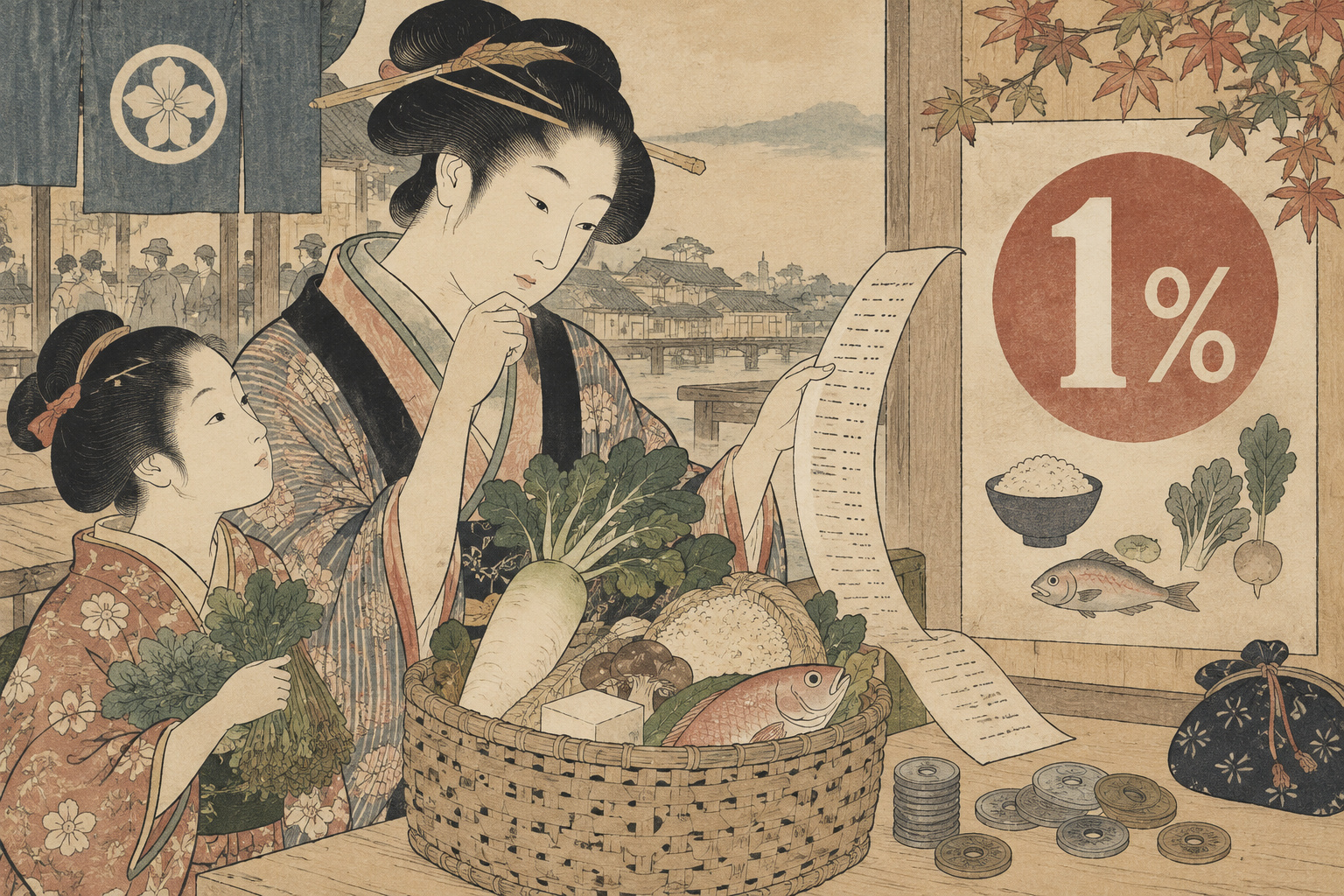
A ¥10,000 basket of qualifying food before tax costs ¥10,800 under Japan’s current 8% reduced consumption-tax rate. If the rate falls to 1% and the tax change is fully passed through, the same basket costs ¥10,100. The household sees ¥700 disappear from the bill.
The government sees the other side of that receipt. On September 15, Japan approved an outline for a two-year cut in the consumption tax on qualifying food, starting April 1, 2027, together with a new income-linked support payment for workers. The payment is to operate within an amount corresponding to one percentage point of food consumption tax, while a fuller income-linked benefit and refundable tax-credit architecture is planned for fiscal 2029. [2]
The 1% rate is not yet law. The National Tax Agency opened a special information site on September 15, but explicitly says its material describes what would apply only if a bill is submitted to the Diet, debated, passed and enacted. [1]
The political attraction is obvious: a tax cut reaches shoppers automatically and appears directly on a receipt. The fiscal problem is just as visible. Nomura Research Institute economist Takahide Kiuchi estimates that cutting the food rate from 8% to 1% would reduce annual tax revenue by about ¥4.4 trillion. Daiwa Institute of Research has modeled the early income-linked payment using a ¥0.6 trillion funding assumption. Those figures put the policy’s full-year scale around ¥5 trillion, before its final design is known. [7][8]
That is why the headline question should be stated carefully. ¥5 trillion is best understood as an annual, full-scale fiscal challenge, not an official two-year total. Eligibility, payment timing, the partial first fiscal year and the final bill can all change the arithmetic.
What actually goes to 1%?
Japan is often described as having a 10% consumption tax, but the system already has two rates. Since October 2019, most goods and services have been taxed at 10%, while food and beverages excluding alcohol and restaurant dining, plus certain subscription newspapers, have received an 8% reduced rate. The Finance Ministry identifies the current 8% as 6.24% national consumption tax and 1.76% local consumption tax. [4]
The new outline targets food and beverages covered by the reduced-rate regime. Alcohol and restaurant meals remain outside that food-rate cut. That makes the distinction between takeaway and eating on premises more economically important, not less.
¥10,000 before tax becomes ¥10,800 at 8% and ¥10,100 at 1%. That is ¥700 less, or about 6.48% below the current tax-inclusive price. It is a tax arithmetic example, not a promise that shelf prices will fall by exactly that amount: firms can change pre-tax prices as input, labor, rent and logistics costs move.
That distinction is crucial. A seven-percentage-point tax cut is not the same thing as a guaranteed 7% fall in the sticker price. The final consumer benefit depends on how much of the tax change is transmitted through prices.
How a zero-rate promise became a 1% bridge
The 2026 debate began with a more dramatic idea: temporarily zero-rating food. As policymakers moved from campaign language toward implementation, the practical burden on registers, billing systems and corporate software became harder to ignore. NRI’s account of the spring debate says the 1% option gained ground partly because a non-zero rate could be easier to accommodate in existing systems than zero. [7]
By September, the design had become a bridge rather than a destination. The September 15 outline couples a two-year 1% food rate with the new worker burden-reduction payment and then points toward a more fully developed income-linked benefit in fiscal 2029. [2]
That architecture tries to combine two very different policy tools. A tax cut is broad and automatic. An income-linked payment can be better targeted but requires eligibility rules, data and administration. The government is effectively using the first to buy time for the second.
Opening the ¥5 trillion box
Japan’s fiscal 2026 general-account budget totals ¥122.3092 trillion. Social-security spending alone is ¥39.0559 trillion, while government-bond issuance is budgeted at ¥29.584 trillion. [6] A ¥5 trillion annual policy is therefore not large enough to describe Japan’s whole fiscal problem, but it is far too large to disappear inside rounding.
The problem is also structural. A temporary tax cut may last only two years, but funding it with one-off windfalls can merely shift pressure elsewhere. If an existing surplus would otherwise repay debt or fund another commitment, redirecting it is a choice about priorities, not free money.
The government promises not to fund it with deficit bonds
Finance Minister Satsuki Katayama was asked directly on September 8 about the roughly ¥5 trillion annual financing need, including benefits. Her answer was that the government would secure financing without relying on special deficit-financing bonds. She pointed to a zero-base review of tax expenditures, subsidies and non-tax revenue, alongside broader spending and revenue reform. [3]
Katayama also said the government would revisit roughly ¥3 trillion of recent supplementary-budget spending used for inflation relief, because the food-tax cut and income-linked payments would themselves serve as price-relief measures. [3]
That is a financing strategy, not yet a financing table. As of the September 15 outline, the government has not published a line-by-line list showing which tax breaks will end, which subsidies will shrink, how much non-tax revenue will be raised, or how local-government losses will be treated. Katayama said the concrete picture would be shown through the budget process.
Why this tax is tied to social security
The financing argument cannot be separated from the history of the consumption tax. Japan introduced it at 3% in 1989, raised it to 5% in 1997 and to 8% in 2014, then moved the standard rate to 10% in October 2019. The Finance Ministry describes the later increases as part of a strategy to fund social security across generations. [5]
The 2019 reform also created the current reduced 8% rate for qualifying food. That compromise was meant to soften the burden on household essentials while preserving the broader revenue base. Cutting the food rate to 1% therefore reverses most of that component for two years without removing the spending pressures that helped justify the tax in the first place.
That does not mean every yen of lower food-tax revenue mechanically causes a yen of social-security cuts. It does mean the replacement financing must be credible if policymakers want to maintain the social-security system while reducing one of its major revenue streams.
A broad tax cut is not a targeted benefit
The great strength of a food-tax cut is reach. A shopper does not need to know about an application window, fill out a form or wait for a transfer. The lower rate is embedded in the transaction.
Its weakness is that higher-income households can receive larger benefits in yen because they often spend more in absolute terms. NRI argues that this makes a blanket rate cut an imprecise instrument if the policy’s central purpose is to protect low- and middle-income households. [7]
The planned worker burden-reduction payment is designed to answer that problem by adding income sensitivity. Daiwa’s June analysis used a ¥0.6 trillion funding assumption to illustrate how such a payment might be distributed, but its example amounts were scenarios, not final government entitlements. [8]
Daiwa’s September 14 prefectural analysis also suggests that the benefit from the tax cut will vary geographically with spending, income and demographic patterns. A national tax rate is uniform; its household effect is not. [9]
Lower measured inflation is not the same as solving inflation
If firms pass the rate cut through, the change will mechanically pull down measured consumer prices. The Bank of Japan explicitly treats consumption-tax changes as special factors when it builds measures intended to look through administrative price effects and examine underlying inflation. [12]
For households, the relief is still real. Paying less tax leaves more disposable income. But a one-time reduction in the price level does not by itself change the longer-run relationship between wages, productivity and underlying costs. If food inputs, labor, energy or transport become more expensive before April 2027, the visible shelf price can rise even while the tax rate falls.
There is also a relative-price effect. Restaurant dining remains at the standard rate while takeaway food receives the lower food rate. A wider gap can affect how consumers compare eating in with taking out, and how restaurants price meals whose ingredients have moved through a different tax treatment.
The register work starts before the law is finished
On the same day as the outline, the Small and Medium Enterprise Agency announced an advance-start arrangement under its digitalization and AI subsidy program. Businesses can begin qualifying work on smart registers and POS systems from September 15 and apply for support later. The agency explicitly links the measure to the planned April 2027 tax-rate change. [11]
That is a reminder that consumption-tax reform is software policy as well as fiscal policy. Registers, e-commerce platforms, order systems, invoices, accounting software, price displays and master data all have to agree on which item carries which rate. A temporary cut can mean doing the exercise twice.
The NTA’s launch-day package of leaflets, Q&A material and explanatory videos is meant to start that preparation early. Yet the NTA also warns that the information is conditional on enactment. Businesses face the awkward task of preparing for a policy that is politically advanced but not legally complete. [1]
The hardest exit: going from 1% back to 8%
A ¥100 pre-tax food item costs ¥101 at a 1% rate and ¥108 at 8%. If the pre-tax price is unchanged, returning from 1% to 8% produces a 6.93% jump in the tax-inclusive price. Legally it is the end of a temporary cut. At the checkout it looks like a price increase.
The Japan Research Institute has warned that ending a temporary food-tax cut can create a price rise and a subsequent pullback in consumption. [10] The political risk follows the same logic: a benefit that lasts two years can be difficult to withdraw when households have incorporated it into expectations.
The government’s proposed answer is to have the income-linked architecture ready as the temporary rate ends. That transition has to be more than technically available. The public will need to understand who receives support, when it arrives and how it relates to the higher food-tax rate returning.
Japan.co.jp assessment: the decisive document is the financing table
The 1% plan has genuine policy strengths. It is simple for consumers to understand. It reaches virtually every household that buys qualifying food. It avoids the take-up problem that can weaken application-based relief. It also creates a visible answer to public frustration over food prices.
Its weaknesses are now just as concrete. It is poorly targeted on its own. It cannot begin until April 2027. Businesses may have to modify systems twice. And the September 15 outline does not yet show the detailed offsets for a policy whose annual scale approaches ¥5 trillion.
The next decisive documents will therefore be less dramatic than the “1%” headline: the fiscal 2027 budget, tax-reform legislation and the rules for the income-linked payment. Which tax expenditures are actually removed? Which subsidies are reduced? How much non-tax revenue is dependable? How are local finances protected? Who qualifies for the payment, and how large is it?
The arithmetic on the shopping basket is easy. The arithmetic required to finance the policy without weakening social security, quietly shifting the bill elsewhere or increasing debt is not. Japan’s 1% food-tax plan will ultimately be judged not by the number printed on the rate card, but by whether the government can publish a convincing answer to the ¥5 trillion question.
Sources and references
- 国税庁・財務省「消費税率引下げ特設サイト」(2026年9月15日)
- 自由民主党政務調査会「飲食料品消費税率の臨時的な引き下げと就業者負担支援金導入に向けた大綱を決定」(2026年9月15日)
- 財務省「片山財務大臣兼内閣府特命担当大臣閣議後記者会見の概要」(2026年9月8日)
- 財務省「『軽減税率制度』について教えてください。」
- 財務省「もっと知りたい税のこと―税制の変遷と各税目の特徴」
- 財務省「特集 令和8年度予算について」
- 野村総合研究所 木内登英「食料品の消費税率を来年4月に1%へ引き下げることは可能か?そして適切か?」(2026年6月1日)
- 大和総研 神田慶司「『食料品の消費税率1%+中低所得勤労者への所得連動給付』案が軸に」(2026年6月19日)
- 大和総研 山口茜「消費税減税・給付の都道府県別影響」(2026年9月14日)
- 日本総合研究所「食料品の消費減税、再増税時の消費減少は避けられず」(2026年8月5日)
- 経済産業省 中小企業庁「変化の時代に対応できるスマートレジの導入支援(事前着手制度)」(2026年9月15日)
- 日本銀行「分析データ『消費者物価のコア指標』の公表について」(2026年3月26日)
- Japan.co.jp 2026年9月16日版(為替参考値)
Evidence reviewed early September 16, 2026 JST, incorporating public material through the September 15 outline. The outline is policy, not enacted law. The roughly ¥4.4 trillion revenue-loss figure is an outside estimate; the roughly ¥0.6 trillion support figure is an analytical scale used for the early income-linked payment. Final eligibility, outlays and line-item financing remain unsettled.